🍯 Sugar to Agave Conversion Calculator
Instantly convert sugar amounts to agave nectar with liquid and calorie adjustments
| Sugar (Imperial) | Sugar (Metric) | Agave Nectar | Reduce Liquid By |
|---|---|---|---|
| 1 tsp | 4 g | 3/4 tsp | — |
| 1 tbsp | 12.5 g | 2 tsp | — |
| 1/4 cup | 50 g | 2 tbsp + 2 tsp | 1 tbsp |
| 1/3 cup | 67 g | 3 tbsp + 2 tsp | 1.5 tbsp |
| 1/2 cup | 100 g | 1/3 cup | 2 tbsp |
| 2/3 cup | 133 g | ~7 tbsp | 2.5 tbsp |
| 3/4 cup | 150 g | 1/2 cup | 3 tbsp |
| 1 cup | 200 g | 2/3 cup | 1/4 cup |
| 1.5 cups | 300 g | 1 cup | 6 tbsp |
| 2 cups | 400 g | 1 1/3 cups | 1/2 cup |
| Agave Type | Sweetness vs Sugar | Flavor Notes | Best For |
|---|---|---|---|
| Light Agave | 1.4x sweeter | Neutral, mild | Baking, beverages |
| Amber Agave | 1.4x sweeter | Caramel, medium body | Sauces, pancakes |
| Dark Agave | 1.4x sweeter | Rich, molasses-like | BBQ sauce, marinades |
| Raw Agave | 1.3x sweeter | Mild, slightly floral | Raw desserts, drinks |
| Measurement | Sugar Weight | Agave Weight | Agave Volume |
|---|---|---|---|
| 1 teaspoon | 4 g / 0.14 oz | 7 g / 0.25 oz | 3/4 tsp |
| 1 tablespoon | 12.5 g / 0.44 oz | 21 g / 0.74 oz | 2 tsp |
| 1/4 cup | 50 g / 1.76 oz | 84 g / 2.96 oz | 2 tbsp + 2 tsp |
| 1/2 cup | 100 g / 3.53 oz | 168 g / 5.93 oz | 1/3 cup |
| 1 cup | 200 g / 7.05 oz | 336 g / 11.85 oz | 2/3 cup |
| 1 pound | 454 g / 2.27 cups | 454 g / 1.35 cups | — |
| Sugar Replaced | Sugar Calories | Agave Calories | Net Savings |
|---|---|---|---|
| 1/4 cup | 194 cal | 160 cal | ~34 cal |
| 1/2 cup | 387 cal | 320 cal | ~67 cal |
| 1 cup | 774 cal | 640 cal | ~134 cal |
| 1.5 cups | 1,161 cal | 960 cal | ~201 cal |
| 2 cups | 1,548 cal | 1,280 cal | ~268 cal |
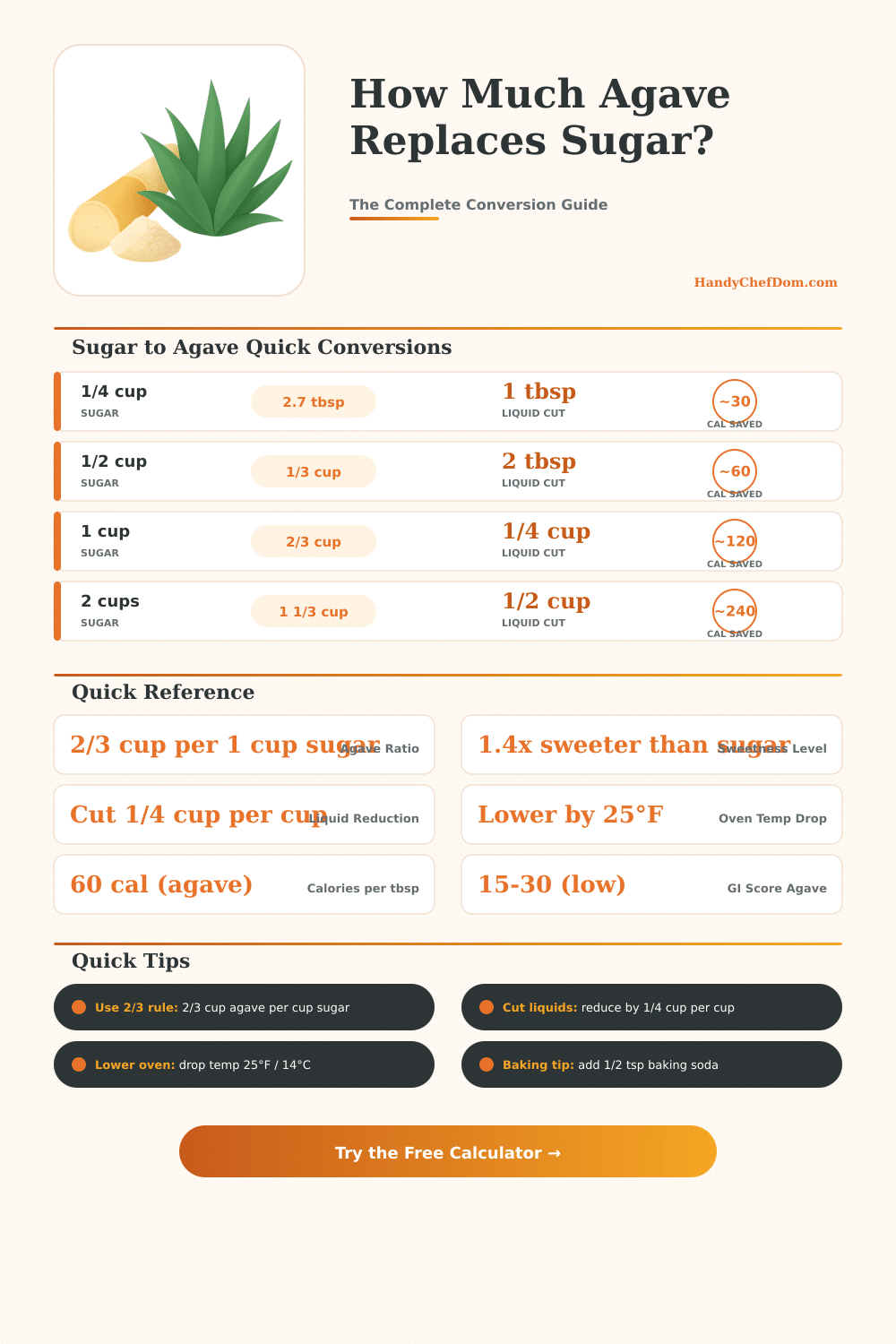
The mainstream proportion, that I commonly mention, are two thirds of cup of agave nectar for every full cup of regular sugar. That matches to around 67% by volume and it has sense, because agave nectar is almost 1.4 times sweeter than usual table sugar. The weights beat that; one cup of sugar weighs around 200 grams, while the agave match reaches weight of roughly 224 grams.
The extra density of the liquid agave explains that. Regarding calories, a tablespoon of agave has 60, against 48 for sugar, but because one uses less of agave, the final calorie savings for a full cup of swap lands a bit around 130 calories.
Agave Syrup vs Sugar: Health, Sweetness and Baking
The difference in glycemic index is really dramatic, sugar reaches 65, while agave nectar moves between 15 and 30. While baking I noticed, that dropping the tempearture of the oven by around 25°F (14°C) helps to avoid browning and that reducing the other liquids by roughly quarter of cup for every swapped cup of sugar stops the mass becoming too wet. Both sweeteners lack protein and fat, so the nutritional change is only in carbohydrates, agave is based on 75-90% fructose, compared to the 50/50 split of sugar between glucose and fructose.
agave sugar, or also agave syrup and agave nectar, come from a succulent plant native to Mexico. Interestingly, it is the same plant used to produce tequila, but one prepares the juice differently for sweeteners. Although one advertises it commonly as a natural alternative too sugar, agave is actually very processed and fancy product.
The sugar content of agave syrup ranges according to the species of agave plant, that one uses. For instance, syrup from blue agave has around 56% to 60% fructose, 20% glucose and only small amounts of sucrose. In another type, called salmiana, sucrose is the mainstream sugar instead.
The raw juice of agave plant stores healthy fiber called fructans, that relates to positive impacts on metabolism and insulin. But when one prepares the juice into syrup by means of heat or enzymes, those useful fructans break into fructose. That is quite a lot like the process of high fructose corn syrup, which destroys the healthy benefits of the original plant.
One of the mainstream selling spots of agave is its impressive low glycemic index, around 17 compared to 68 for table sugar. The glycemic index ranks carbohydrates according to how quickly they raise the level of blood sugar after a meal. Because the body absorbs agave more slowly, it causes less sudden spike of sugar.
agave syrup tends to be one and half times sweeter than usual table sugar. That means, that one must use less of it to reach the same sweet impact, which could lead to fewer total calories from added sugar. Even so, agave is not necessarily healthier than regular sugar.
It still has very high levels of fructose and even more calories per gram than table sugar. The liver breaks fructose into things like triglycerides, uric acid and free radicals (everything), which can be hard for the body, especially if one eats much of it.
The raw juice of agave plant stores some nutrients with possible antioxidant benefits, but many of them disappear during the high heat or enzyme preparations, that one uses to turn it into syrup. One standard tablespoon of agave syrup holds around 60 calories and 15-16 grams of sugar.
When dealing with baking and cooking, agave works similarly to honey (both are liquid sweeteners). A common swap proportion is two thirds to three quarters of a cup of agave for one full cup of white sugar. One also would want to drop the other liquid ingredients in the recipe by a quarter to a third of a cup, because agave adds extra moisture.
At the end of the day, natural sweeteners like agave are really unhealthy only when one consumesthem too much without other balanced dietary elements. Sugar stays sugar, and limiting additions as much as possible always is a wise step.