🌡 Sous Vide Cooking Time Calculator
Calculate precise time and temperature for perfectly cooked sous vide results every time
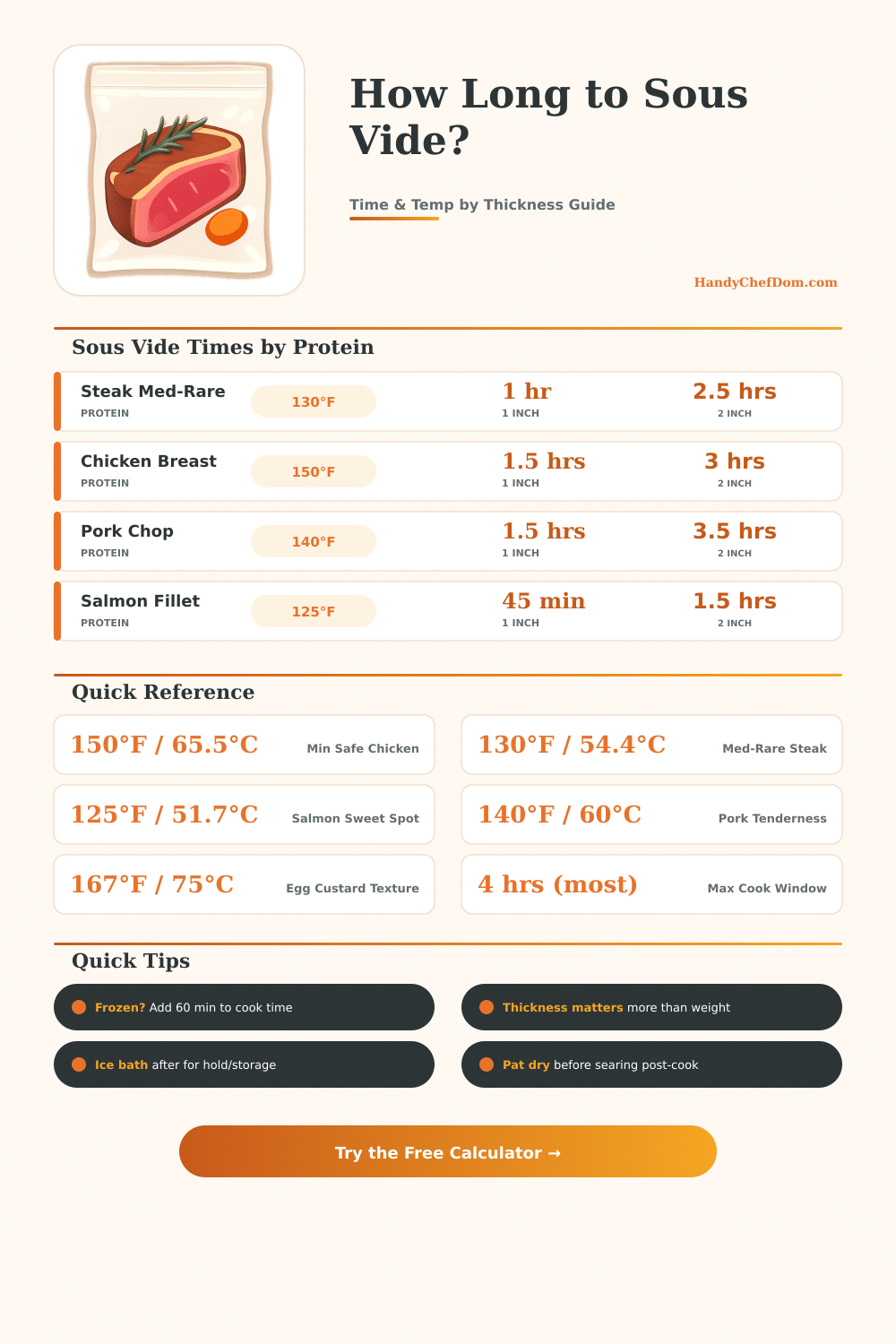
| Protein | Doneness | °F | °C |
|---|---|---|---|
| Beef Steak | Rare | 125 | 51.7 |
| Beef Steak | Medium-Rare | 130 | 54.4 |
| Beef Steak | Medium | 140 | 60.0 |
| Beef Steak | Medium-Well | 150 | 65.6 |
| Beef Steak | Well Done | 160 | 71.1 |
| Chicken Breast | Tender & Juicy | 150 | 65.5 |
| Chicken Breast | Traditional Texture | 160 | 71.1 |
| Pork Chop | Slightly Pink | 140 | 60.0 |
| Pork Chop | Traditional | 150 | 65.6 |
| Pork Belly | Tender (12hr) | 165 | 73.9 |
| Pork Belly | Fall-Apart (24hr) | 170 | 76.7 |
| Salmon | Silky / Sashimi-like | 110 | 43.3 |
| Salmon | Translucent & Soft | 120 | 48.9 |
| Salmon | Flaky & Moist | 130 | 54.4 |
| Lamb | Medium-Rare | 131 | 55.0 |
| Lamb | Medium | 140 | 60.0 |
| Duck Breast | Medium-Rare | 131 | 55.0 |
| Duck Breast | Medium | 140 | 60.0 |
| Eggs | Soft & Runny | 145 | 62.8 |
| Eggs | Jammy | 150 | 65.6 |
| Eggs | Firm Custard | 167 | 75.0 |
| Shrimp | Just Done | 135 | 57.2 |
| Shrimp | Firm | 140 | 60.0 |
| Thickness | Beef / Lamb | Chicken | Pork Chop | Salmon |
|---|---|---|---|---|
| 0.5 in (1.3 cm) | 40 min | 45 min | 40 min | 30 min |
| 1 in (2.5 cm) | 1 hr | 1.5 hrs | 1.5 hrs | 45 min |
| 1.5 in (3.8 cm) | 1 hr 45 min | 2 hrs 15 min | 2 hrs 15 min | 1 hr 10 min |
| 2 in (5.1 cm) | 2 hrs 30 min | 3 hrs | 3 hrs 30 min | 1 hr 30 min |
| 2.5 in (6.4 cm) | 3 hrs 30 min | 4 hrs | 4 hrs 30 min | 2 hrs |
| 3 in (7.6 cm) | 4 hrs 30 min | 5 hrs | 5 hrs 30 min | 2 hrs 30 min |
| Protein | Serving (oz) | Serving (g) | Yield After Cook |
|---|---|---|---|
| Beef Steak | 6 – 8 oz | 170 – 227 g | ~90 – 95% |
| Chicken Breast | 6 oz | 170 g | ~85 – 90% |
| Pork Chop | 6 – 8 oz | 170 – 227 g | ~88 – 92% |
| Salmon Fillet | 5 – 6 oz | 142 – 170 g | ~90 – 95% |
| Lamb Rack (2 chops) | 6 – 8 oz | 170 – 227 g | ~85 – 90% |
| Duck Breast | 6 oz | 170 g | ~80 – 85% |
| Shrimp | 4 – 6 oz | 113 – 170 g | ~85 – 90% |
Sous vide cooking times scale exponentially with thickness, not linearly. A 1-inch steak needs about 60 minutes, but jump to 2 inches and youre looking at roughly 150 minutes. Ive found yield sits around 90 to 95% for most proteins, compared to maybe 75% from grilling.
At 130 degrees Fahrenheit for medium-rare beef, the window stretches to about 4 hours max before texture degrades noticeably.
Sous Vide Cooking: How Long to Cook and Why
The info below does not come from some computer or automatic tools. It is based on actual users’ memories, talks in forums and experiences of cooking communities on the net.
Sous vide is a French phrase, that means “under vacuum“. This cooking method is made up of that, that one puts food in sealed plastic bags or glass jars and later cooks it in water, whose temperature one exactly controls. The French chef Georges Pralus found this technique in 1974.
Usually the cook lasts more than the standard way, however the final result commonly deserves the time.
Precise control of temperature is the main feature of sous vide. A sous vide device consists mainly of a heater, water pump and thermostat. Modern models commonly have wireless connections and phone apps for distant control, and some even carry recipes for popular dihses.
For start at home, one must have a submersion circulator as the main tool.
Because of the vacuum sealing in a bag, the food does not lose water or alter its form during cooking. Its weight, flavour, natural colour and smells stay unaffected. This accurate method allows to reach the wanted grade of doneness and texture, which beats the traditional ways.
For instance, four a medium-rare steak one sets the water at 131°F (55°C) and leaves the meat to reach that time.
Sous vide cooks at lower grades than in usual boilers, because the heat stays equal through the whole meat. It pasteurises the meat instead of sterilising it. Rather than reach 160°F only for moments, one can keep it at 130°F for around two hours to reach safety.
Even so pasteurisation does not match sterilisation. The most dangerous germs die, but some stay, so it does not help forconservation in jars.
A terrific bonus is, that food is not possible to overdo. The internal grade stays permanent, and the cook stops there, does not go more away. Chicken breast results surprisingly juicy and moist.
Pork chops and chicken breasts cook safely at 145°F. Eggs receive ideal creamy consistency in the yolk, without rubbery white. Sous vide works well also for quickly melting frozen meats, broths and soups.
Even so this method requires more time to cook foods. Steak requires some hours, and big roast beef maybe six to seven hours. The duration depends on the thickness and size of the bit.
Common are the final sears, because the Maillard reaction does not happen in sous vide. A butane torch can serve for that last step.
Sous vide truly helps for pre-cooking. Steaks of various thicknesses can reach the ideal grade equally, like this one freely uses the boiler for side dishes. In restaurants one sometimes pre-cooks salmon, duck breast and chicken breast sous vide, later warms or sears at service.
It does not always work for vegetables or fish, when one cares about texture and colour, because they can become nearly pulp.