⚖️ Metric Baking Conversion Calculator
Convert cups, ounces, tablespoons & teaspoons to grams and milliliters instantly
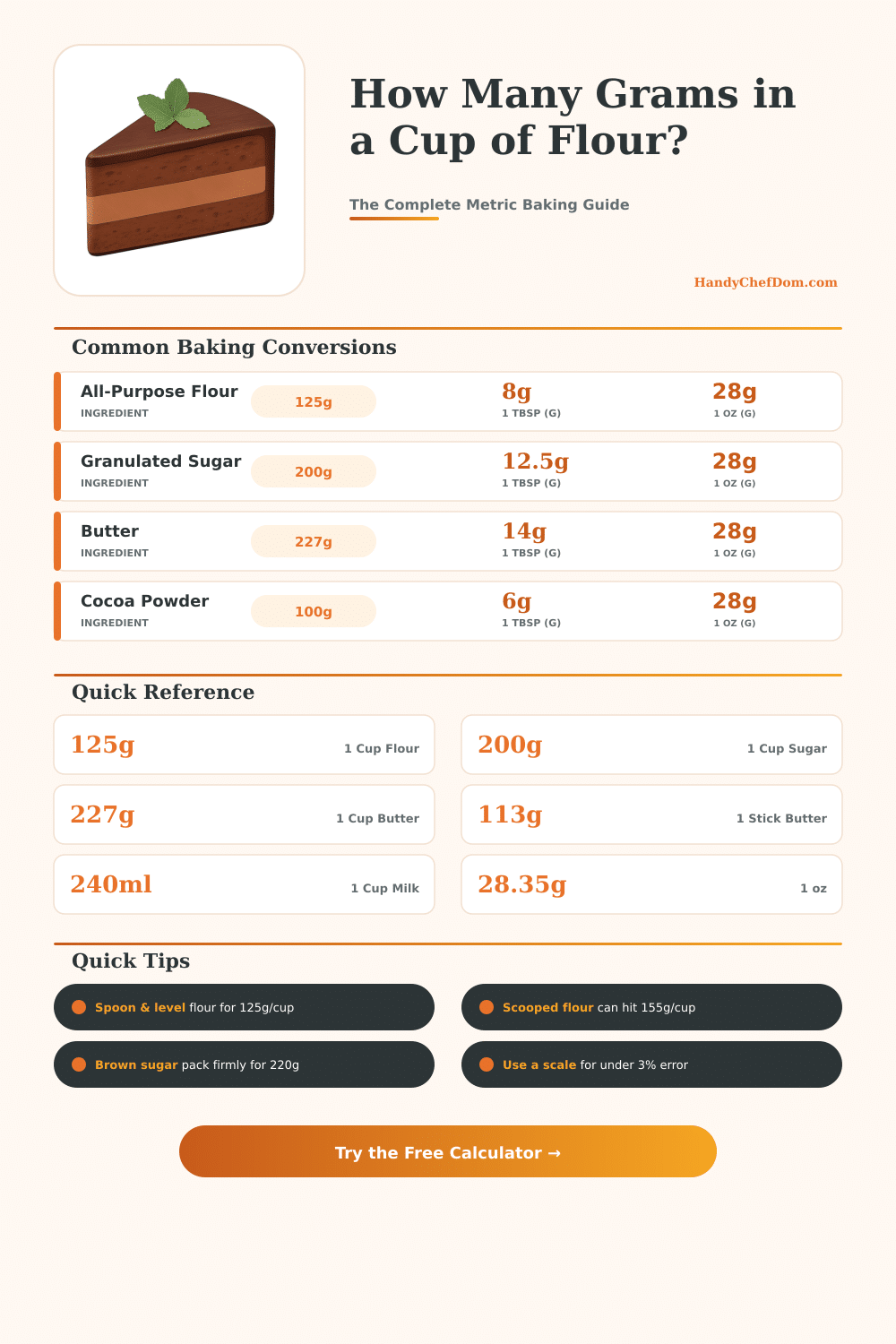
| Ingredient | 1 Cup (g) | 1 Tbsp (g) | 1 Tsp (g) |
|---|---|---|---|
| All-Purpose Flour | 125 | 8 | 2.6 |
| Bread Flour | 130 | 8.1 | 2.7 |
| Cake Flour | 114 | 7.1 | 2.4 |
| Whole Wheat Flour | 128 | 8 | 2.7 |
| Almond Flour | 96 | 6 | 2 |
| Rice Flour | 158 | 9.9 | 3.3 |
| Granulated Sugar | 200 | 12.5 | 4.2 |
| Brown Sugar (packed) | 220 | 13.8 | 4.6 |
| Powdered Sugar | 120 | 7.5 | 2.5 |
| Cocoa Powder | 100 | 6.25 | 2.1 |
| Cornstarch | 128 | 8 | 2.7 |
| Rolled Oats | 90 | 5.6 | 1.9 |
| Chocolate Chips | 170 | 10.6 | 3.5 |
| Ingredient | 1 Cup (g) | 1 Cup (mL) | 1 Tbsp (g) |
|---|---|---|---|
| Water | 237 | 237 | 14.8 |
| Milk (whole) | 244 | 237 | 15.3 |
| Heavy Cream | 238 | 237 | 14.9 |
| Butter (melted) | 227 | 237 | 14.2 |
| Vegetable Oil | 218 | 237 | 13.6 |
| Honey | 340 | 237 | 21.3 |
| Maple Syrup | 312 | 237 | 19.5 |
| Sour Cream | 230 | 237 | 14.4 |
| Yogurt (plain) | 245 | 237 | 15.3 |
| Cream Cheese | 232 | 237 | 14.5 |
| Peanut Butter | 258 | 237 | 16.1 |
| Ingredient | 1 Tsp (g) | 1 Tbsp (g) | ¼ Cup (g) |
|---|---|---|---|
| Baking Powder | 4 | 12 | 48 |
| Baking Soda | 5 | 15 | 60 |
| Table Salt | 6 | 18 | 72 |
| Kosher Salt (Morton) | 5 | 15 | 60 |
| Active Dry Yeast | 3.1 | 9.3 | — |
| Instant Yeast | 3.1 | 9.3 | — |
| Vanilla Extract | 4.2 | 12.6 | — |
| Imperial Measure | Tablespoons | Teaspoons | Milliliters |
|---|---|---|---|
| 1 Cup | 16 | 48 | 237 |
| ¾ Cup | 12 | 36 | 177 |
| ⅔ Cup | 10 ⅓ | 32 | 158 |
| ½ Cup | 8 | 24 | 118 |
| ⅓ Cup | 5 ⅓ | 16 | 79 |
| ¼ Cup | 4 | 12 | 59 |
| 1 Tablespoon | 1 | 3 | 14.8 |
| 1 Teaspoon | ⅓ | 1 | 4.93 |
When one does baking, you often need to convert measures from one type to another. In recipes one switches between cups, grams ounces and many other units, depending on the land or region of origin. That happens because the world does not have one single standard, United States use their usual units, United Kingdom has the imperial, and most of the rest of the world trusts in the metric system.
Here the spot where things become tricky: converting between volume and weight is not always easy. Weight and volume are entirely different concepts, so one can not simply assume that a cup of one ingredient weighs the same as a cup of another. To do this change, you must know the density of the ingredient.
How to Convert Baking Measurements
For instance, bread-flour weighs around 120 grams for one cup. Whole wheat flour is similar, around 120 grams. But flax seeds?
They raech almost 180 grams per cup. Those differences matter a lot in baking, where accuracy genuinely decides everything.
Other point: liquid ounces and heavy ounces do not swap. The liquid ounce measures volume, so it works for liquids. The heavy ounce relates to mass.
If you take a dry measuring cup and try to use it for liquid, your baking will suffer. It is one of those simple mistakes that destroys a hole recipe.
A lot of tools exist to help. Some convert cups to grams and vice versa. Others deal with temperature changes, rising times or whole weight conversions.
You find also helpful lists for common baking ingredients, that cover everything from cups to grams and spoons to grams.
The main point? Conversion numbers range according to the source where one looks. Plain flour can appear as 125 grams at one website, 145 at another and 150 at a third.
In some recipes that 20-gram difference genuinely matters. Even after careful conversion, sometimes you will have to fix things when you try the recipe in practice.
Use a heavy scale in the kitchen for ingredients to reduce problems and surprises. It removes all the guessing about whether flour needs sifting, airing before measurement or full level in the cup. Naturally, expert bakers that work by feeling and intuition can skip that for basic recipes.
But getting reliable results time after time without weighing? That is hardly possible.
Temperature conversions are another key part of baking math. Conversions between Fahrenheit and Celsius appear always, and most ovens have a built-in switch for that. You find also lists about oven temperatures together with matching gas marks.
For convection ovens, dropping the temperature by 25 degrees works well, especially for recipes with longer baking times.
Recipe scaling is also useful when you must prepare for more or fewer folks. Multiply or divide the recipe according to the desired number of servings. The scale factor is found by dividing the wanted amount by the original.
With baking however, not everything scales evenly. Eggs get tricky when one scales down, although beating an egg and weighing it helps. Also conversions for pan sizes exist, that helpto adapt a recipe for different forms.