🧈 Butter Conversion Calculator
Convert between sticks, cups, tablespoons, ounces, grams & pounds instantly
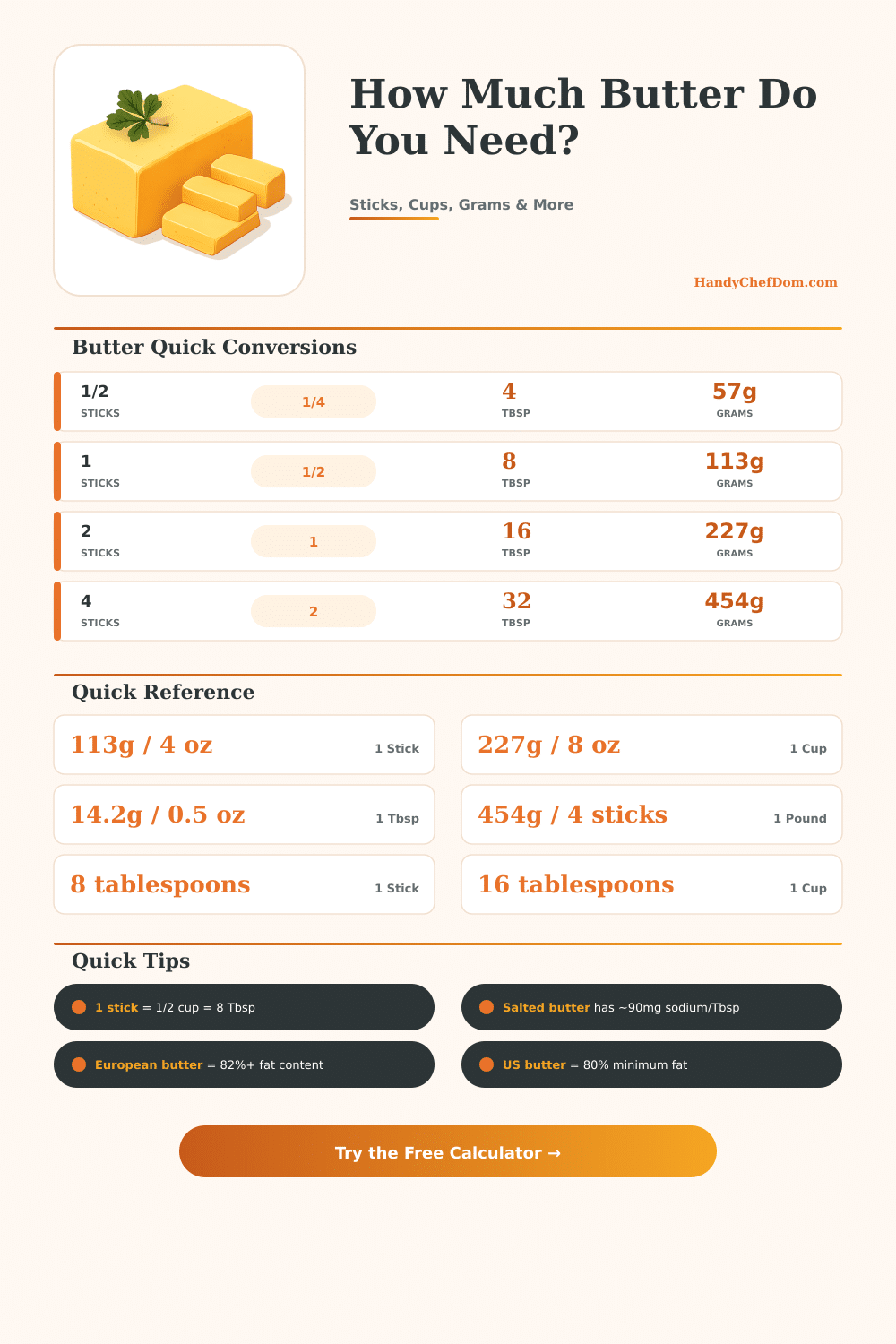
| Sticks | Cups | Tbsp | Oz | Grams | Lb |
|---|---|---|---|---|---|
| ¼ | ⅛ | 2 | 1 | 28.4 | 0.06 |
| ½ | ¼ | 4 | 2 | 56.7 | 0.13 |
| 1 | ½ | 8 | 4 | 113.4 | 0.25 |
| 1½ | ¾ | 12 | 6 | 170.1 | 0.38 |
| 2 | 1 | 16 | 8 | 226.8 | 0.50 |
| 3 | 1½ | 24 | 12 | 340.2 | 0.75 |
| 4 | 2 | 32 | 16 | 453.6 | 1.00 |
| Region | Common Size | Weight | Equivalent |
|---|---|---|---|
| US (stick) | 1 stick | 113.4g / 4 oz | ½ cup / 8 Tbsp |
| US (block) | 1 lb box | 453.6g / 16 oz | 4 sticks / 2 cups |
| European | Standard block | 250g / 8.8 oz | ~1.1 cups / 17.6 Tbsp |
| UK | Standard block | 250g / 8.8 oz | ~1.1 cups / 17.6 Tbsp |
| Australia/NZ | Standard block | 250g / 8.8 oz | ~1.1 cups / 17.6 Tbsp |
| European (small) | Individual pat | 10g / 0.35 oz | ~2 tsp |
| US (pat) | Restaurant pat | 5g / 0.18 oz | ~1 tsp |
| Tablespoons | Teaspoons | Grams | Ounces |
|---|---|---|---|
| 1 | 3 | 14.2 | 0.50 |
| 2 | 6 | 28.4 | 1.00 |
| 3 | 9 | 42.5 | 1.50 |
| 4 | 12 | 56.7 | 2.00 |
| 6 | 18 | 85.1 | 3.00 |
| 8 | 24 | 113.4 | 4.00 |
| 12 | 36 | 170.1 | 6.00 |
| 16 | 48 | 226.8 | 8.00 |
| Butter Type | Fat % | Water % | Milk Solids % |
|---|---|---|---|
| US Regular (USDA Grade AA) | 80% | 16–18% | 2–4% |
| European Style | 82–86% | 12–16% | 2–3% |
| Clarified / Ghee | 99–100% | <0.5% | <0.5% |
| Whipped Butter | 80% | 16–18% | 2–4% |
| Light / Reduced Fat | 40–50% | 40–50% | 2–5% |
Note: Here some bits from real descriptions and conversations about butter, gathered from different books and pages.
When you beat cream until it simply stays with its main parts, fat, proteins and cream… You get butter. It stays at room heat a bit between soft and easily spread with around 81% of butter fat.
Butter: What It Is and How to Use It
The word itself has long history. It comes from the old English “butere”, borrowed from the Latin “butyrum”, that also gave to Italian “burro” and to French “beurre”. One can spread it on cold bread, melt it in food for richer taste or add it as last touch.
The secret of butter in the kitchen lies in one main trait: its high fat. More fat means less water, what helps to bring out the natural butter taste and change the flavor and texture in the mouth. Even so, butter consists only of around 80% of fat.
The rest? Milk parts and water. That 20-percent differnece between butter and pure fat truly matters, when one cooks.
Start with the tastes, because here butter truly shines. Spread it on freshly baked bread, and everything becomes better right away. Cold dishes, pour it over roasted potato, mix it in mashed potato, suddenly everything seems more rich.
Even fried eggs improve, if one uses butter in the pan instead of olive oil. Five grams of butter, what matches to about 36 calories, can turn average egg dish into something special.
butter has many calories, because it almost entirely is made up of fat. One spoon (around 14 grams); stores almost 100 calories. To understand that, consider a medium banana, that has a like amount.
Take 100 grams, and you find around 717 calories, from that 81 grams of fat, with almost no proteins or carbohydrates.
Many kinds of butter exist, and good to no them. In drawn butter one melts it with the milk parts still floating in it. Cleared butter, rather, one melts and then filters, to remove those parts, all useful for high smoke point during cooking.
One commonly uses drawn butter to make sauce in fine kitchens. Whatever type one chooses, avoid heating it until the smoke point, because then the fat splits and it starts to have bad taste.
Look also at mixed butters. The French see them almost as sauces. Mix soft butter with solids or liquids as you wish, form it in a roll, cool and then slice, when needed.
Think about steak butter full of crushed pepper, chopped shallots, parsley and blue cheese mixed in unsalted butter. Similarly, whipped butter comes with tastes as red wine, depending on the match with other foods.
Grass-fed butter, if eaten in small amounts, could give more benefits and fewer issues than the usual kind. Moreover, butter carries fat-soluble vitamins A, D and E, together with important fatty acids. There is also butyrate, a natural anti-inflammatory, that your gut bacteria themselves produce.
For baking, here good advice: do not mix the flour and butter too well. Leave little bits of butter visible in the mix. If you want to try something new, homemade butter is not hard.
Pour heavy cream in a food processor, mix for around 10 minutes, and you have fresh butter.
The fight between salted and unsalted butter never ends. Some insist, that one must use unsalted, to control the salt in the food. But from my experience, many home cooks, even bakers, do well with salted butter, without problems.
When one moves to top butters of small American dairies, that highlight cultured or grass-fed types, here the differences show. French butters have like fame because of their quality. The gap between an average store stick and real good butter is like that between simple cheddar and cheese aged for years.
There was a whole era, when people painted butter as the villain. But the science did not back that idea. Meanwhile, the margarines, pushed as healthier replacements, were full of trans fats, that science proved to be truly dangerous.
Processed plant fats… Liquids, that one chemically changed to make them solid as inbutter. Turned out to be the real fault.