🧀 Mayo Calorie Calculator
Calculate calories & nutrition in mayonnaise by serving size, type, and amount
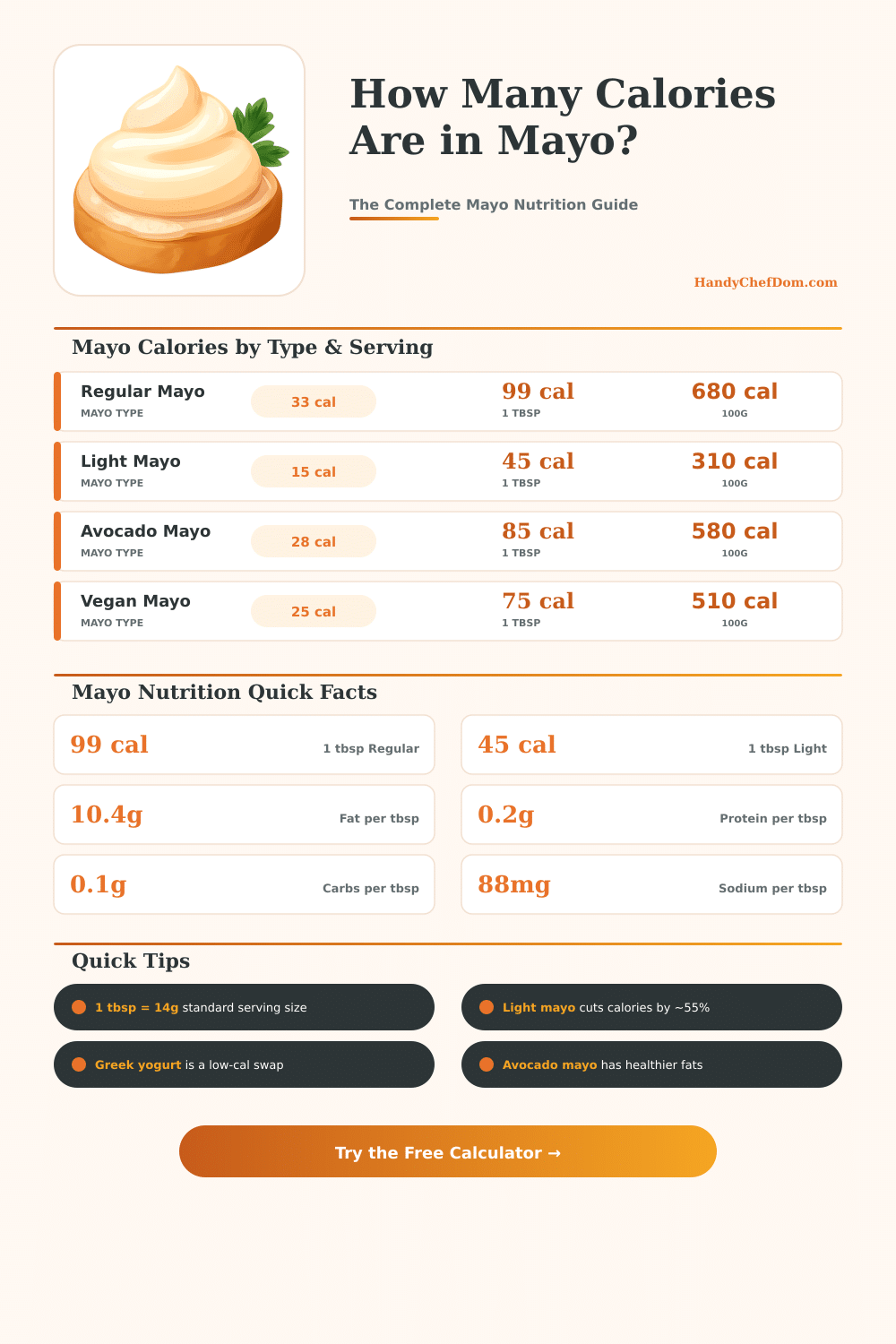
| Mayo Type | 1 tsp (5g) | 1 tbsp (14g) | 1 oz (28g) | 100g |
|---|---|---|---|---|
| Regular Mayo | 33 cal | 99 cal | 196 cal | 680 cal |
| Light Mayo | 15 cal | 45 cal | 89 cal | 310 cal |
| Avocado Mayo | 28 cal | 85 cal | 168 cal | 580 cal |
| Vegan Mayo | 25 cal | 75 cal | 148 cal | 510 cal |
| Olive Oil Mayo | 30 cal | 90 cal | 178 cal | 620 cal |
| Low-Fat Mayo | 12 cal | 35 cal | 69 cal | 240 cal |
| Nutrient | Regular | Light | Avocado | Vegan | Olive Oil | Low-Fat |
|---|---|---|---|---|---|---|
| Calories | 99 | 45 | 85 | 75 | 90 | 35 |
| Total Fat (g) | 10.4 | 4.5 | 9.0 | 8.0 | 9.5 | 3.5 |
| Saturated Fat (g) | 1.6 | 0.5 | 1.2 | 0.8 | 1.4 | 0.5 |
| Cholesterol (mg) | 6 | 5 | 5 | 0 | 5 | 5 |
| Sodium (mg) | 88 | 105 | 95 | 80 | 90 | 115 |
| Carbs (g) | 0.1 | 1.5 | 0.5 | 1.0 | 0.2 | 2.0 |
| Protein (g) | 0.2 | 0.1 | 0.1 | 0.1 | 0.2 | 0.1 |
| Use Case | Typical Amount | Regular Cal | Light Cal |
|---|---|---|---|
| 🍞 Sandwich (1 side) | 1 tbsp (14g) | 99 | 45 |
| 🍔 Burger Bun | 2 tbsp (28g) | 198 | 90 |
| 🥗 Green Salad | 3 tbsp (42g) | 297 | 135 |
| 🐟 Tuna Salad Sandwich | 2 tbsp (28g) | 198 | 90 |
| 🥔 Potato Salad (1 cup) | 5 tbsp (70g) | 495 | 225 |
| 🥗 Coleslaw (1 cup) | 4 tbsp (56g) | 396 | 180 |
| 🍟 Dipping Sauce | 2 tbsp (28g) | 198 | 90 |
| 🥚 Deviled Egg (each) | 1 tsp (5g) | 33 | 15 |
| 🫓 Wrap | 1.5 tbsp (21g) | 149 | 68 |
| 🍗 Chicken Salad | 3 tbsp (42g) | 297 | 135 |
mayo belongs to those foods that wakes strong emotional reactions. Some spread it on every meal on the other hand others simply do not stand its smell or makeup. It is made up of a mix of oil and egg yolks.
The egg yolks work as a binder, and mustard also can help that process. In mayo there is almost no water. It forms a thick mix from oil with a bit of salt.
How to Make and Use Mayo
Home-made mayo is hard to achieve like this. A stick blender works well for it, and the whole work lasts only a moment. Even a whole egg can serve instead of only the yolk, and it still succeeds.
The secret lies in making sure that all ingredients reached room temperature. If ingredients are not at room temperature, mayo can clearly fail. Usually one alone yolk is enough for the blending.
It is beter to add lemon juice at the finish than at the start of the preparation, what helps to get good results.
Sometimes home-made mayo turns out too thin instead of creamy. Pouring the oil slowly should give it thickness, but that does not always happen. The blender maybe moves too slowly, or ingredients are too warm, or the mix was not worked long enough.
Store-bought mayo commonly carries thickeners, stabilizers and preservatives, so store versions stay like this firmly together.
Home-made mayo can appear a bit greasy. Those little white spots that happen after cooling probably come from too much oil that never fully mixed, but only held together in the cold of the fridge. They likely do not come from moisture ore mold.
Store-bought mayo really only exists because of ease. Making fresh mayo for a fast school meal does not work for most times. Home-made mayo has more sense when one uses it as a side sauce to asparagus or beside special food.
Hellmann’s is a popular brand that uses cage-free eggs. Its ingredients include soybean oil, water, whole eggs, distilled vinegar, egg yolks, salt, sugar and focused lemon juice. Kewpie mayo also gets much attention these days.
Different areas tend to prefer different brands. Mixing hot sauce with mayo gives a wonderful spread for roast beef sandwiches and works as a great sauce for breaded and deep-fried vegetables. Chipotle mayo is another nice option.
Garlic mayo is simply regular mayo with garlic added at the finish. The garlic stays in little bits but does not blend in, so its smell does not spread inevery serving.
A standard serving of mayo matches one spoon. Regular mayo has many calorie and fat. Around ten grams of fat per serving, with almost two grams of packed fat.
That is quite a lot for such an amount. Fat-free versions exist, but they widely do not worth the effort.