🍵 Oolong Tea Caffeine Calculator
Calculate how much caffeine is in your oolong tea based on type, cups & steep time
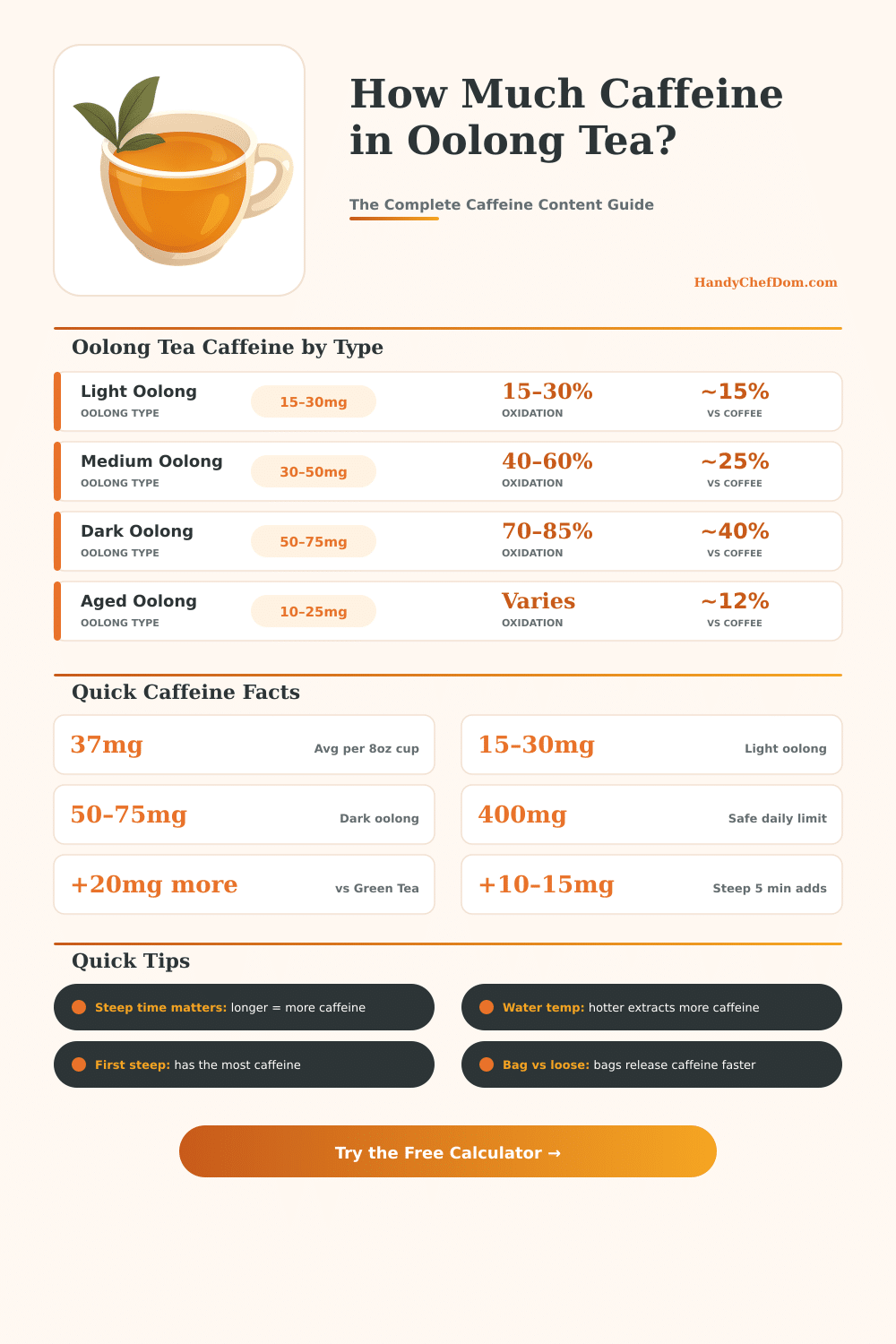
| Oolong Type | Per 8 fl oz Cup | Per 100ml | Oxidation Level | vs Green Tea |
|---|---|---|---|---|
| Light / Green Oolong | 15–30mg | 6–11mg | 15–30% | Similar / Less |
| Medium Oolong | 30–50mg | 11–18mg | 40–60% | Slightly More |
| Tie Guan Yin | 25–45mg | 9–16mg | 20–40% | Comparable |
| Dark / Roasted Oolong | 50–75mg | 18–27mg | 70–85% | More |
| Dan Cong / Phoenix | 40–65mg | 14–23mg | 50–70% | More |
| Wuyi Rock Oolong | 45–70mg | 16–25mg | 60–80% | More |
| Milky Oolong | 20–40mg | 7–14mg | 20–35% | Comparable |
| Aged / Vintage Oolong | 10–25mg | 4–9mg | Varies | Less |
| Steep Time | Caffeine Extracted | % of Total Available | Flavor Profile |
|---|---|---|---|
| 30 seconds | ~20% of base | 20% | Very light |
| 1 minute | ~40% of base | 40% | Delicate |
| 2 minutes | ~60% of base | 60% | Balanced light |
| 3 minutes | ~75% of base | 75% | Standard |
| 5 minutes | ~90% of base | 90% | Full-bodied |
| 7–10 minutes | ~100% of base | 100% | Strong / Astringent |
| Steep Number | Caffeine Retention | Example (base 40mg) | Notes |
|---|---|---|---|
| 1st Steep | 100% of base | ~40mg | Full caffeine |
| 2nd Steep | ~50–60% | ~20–24mg | Still significant |
| 3rd Steep | ~25–35% | ~10–14mg | Moderate drop |
| 4th Steep | ~10–20% | ~4–8mg | Low caffeine |
| Beverage | Per 8oz (mg) | Per 12oz (mg) | Per 100ml (mg) |
|---|---|---|---|
| Oolong Tea (avg) | 37mg | 55mg | 13mg |
| Green Tea | 25–35mg | 38–52mg | 9–12mg |
| Black Tea | 40–70mg | 60–105mg | 14–25mg |
| White Tea | 15–30mg | 22–45mg | 5–11mg |
| Matcha (1 tsp) | 60–80mg | — | — |
| Drip Coffee | 95–165mg | 143–248mg | 33–58mg |
| Espresso (1oz) | 63mg/shot | — | 212mg |
| Decaf Coffee | 2–15mg | 3–22mg | 1–5mg |
| Population Group | Recommended Max / Day | Approx. Cups Oolong | Notes |
|---|---|---|---|
| Healthy Adults | 400mg | ~8–11 cups | FDA guideline |
| Pregnant / Nursing | 200mg max | ~4–5 cups | WHO recommendation |
| Teens (13–17) | 100mg max | ~2–3 cups | Pediatric guideline |
| Children (<12) | Not recommended | 0 cups | Avoid caffeine |
| Caffeine Sensitive | 50–100mg | ~1–2 cups | Individual variation |
Oolong Tea is a classic Chinese kind of tea, produced from the plant Camellia sinensis, just like green and black teas. The main difference lies in the way one prepares it. It belongs to partly oxidized teas so it sits between unoxidized green tea and fully oxidized black tea.
Even if the oxidation reaches only 20 percent or up to 80 percent, one considers it oolong. That broad range explains why oolong belongs to the most varied tea types.
Oolong Tea: What It Is and How to Make It
The word “oolong” comes from Chinese “wulong“, which translates as “black dragon”. Legend describes that it received that name thanks to the long, dark-colored and curved forms of the leaves. One sometimes calls it also Wu Long tea or almost brown tea.
It first appeared in the district Wuyi of Fujian in China, famous for its rock teas. Also in Taiwan it enjoys big popularity as a drink.
Preparing oolong requires more care than any other tea type. One leaves the leaves to wilt under strong sunshine, later happens a bit of oxidation, before one curls and twists them. The quality of oolong depends much on the skill of the maker.
Every stage in teh making of oolong requires attention and care.
The taste changes a lot according to the grade of oxidation and roasting. Oolong with light oxidation tastes like green tea, with fresh flowery notes and light yellow color. During the roasting stage, the taste moves toward rich fruits, nuts, and finally candy or smoky tones.
The color of the liquid goes from yellow-green to golden-red or brown-pink. The bitterness drops when the roasting strengthens, and the hole flavor becomes deeper and rich. Oolong commonly has quite a sweet finish.
Tieguanyin is among the most known oolongs, coming from Anxi. The most sold is the modern kind with light oxidation and some roasting. Although it is oolong, it looks green because of the low oxidation and one sometimes calls it “green oolong“.
Dancong forms another rare and lovely kind, that is worth to try.
Unlike many teas, oolong can be brewed many times, and every brew gives a slightly different taste. That makes it very good value for cost per cup. Boiling oolong is not advised, because that can remove the tender flowery notes.
For most oolongs, the water should reach almost 100°C, but for light and young oolong similar to green, cooling it to 85-90°C works more well. Using a scale is better than a spoon, because oolong leaves have various forms and weights. One cup holdsaround 38 milligrams of Caffeine.