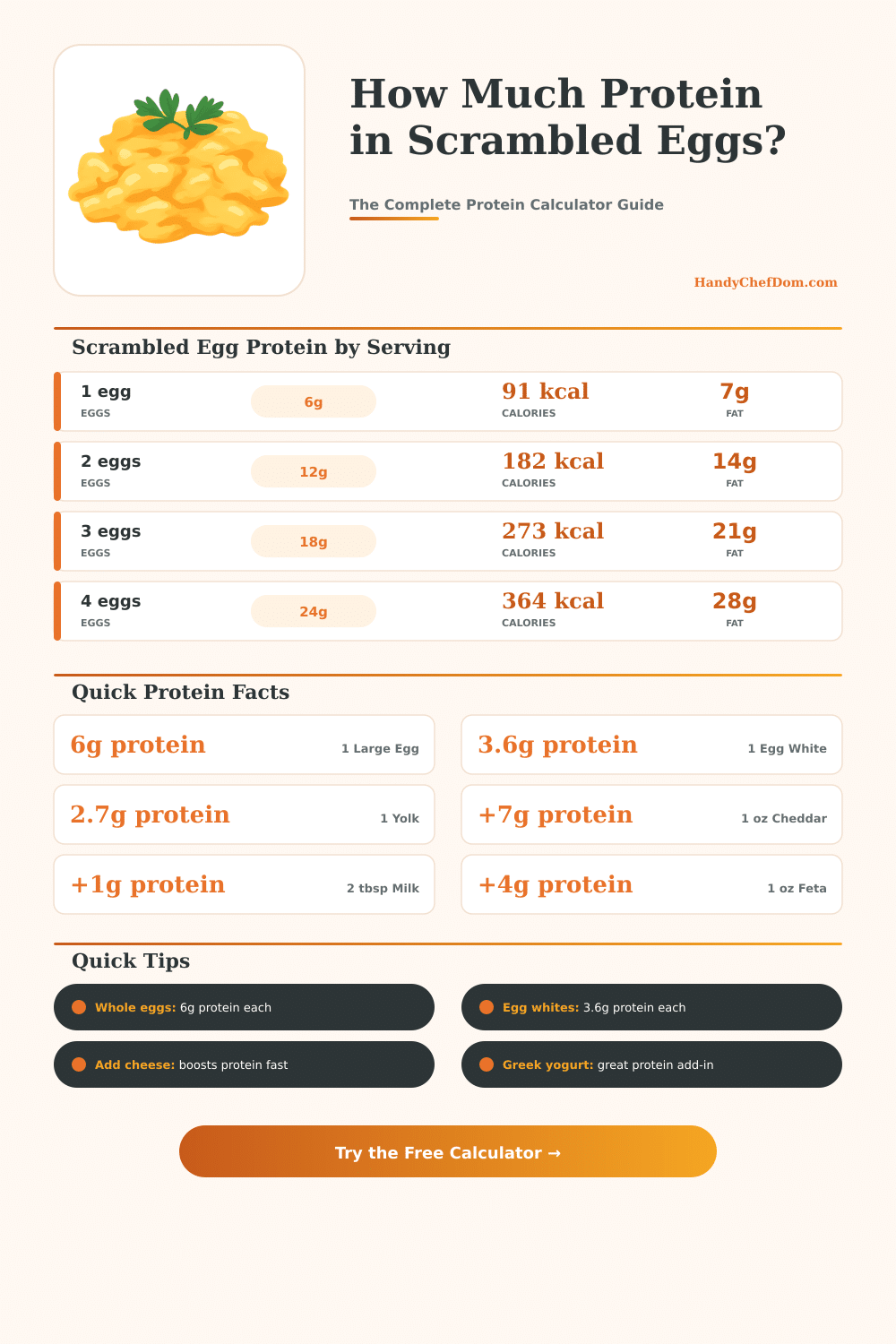
🥚 Scrambled Eggs Protein Calculator
Instantly calculate protein & nutrition in your scrambled eggs — including add-ins
| Cheese Type | Protein (g) | Calories | Fat (g) | Carbs (g) |
|---|---|---|---|---|
| Cheddar | 7.0g | 114 kcal | 9.4g | 0.4g |
| Mozzarella | 6.3g | 85 kcal | 6.3g | 0.6g |
| Feta | 4.0g | 75 kcal | 6.0g | 1.1g |
| Parmesan | 10.0g | 111 kcal | 7.3g | 0.9g |
| Cottage Cheese | 3.5g | 29 kcal | 0.6g | 1.1g |
| Milk Type | Protein (g) | Calories | Fat (g) | Carbs (g) |
|---|---|---|---|---|
| Whole Milk | 0.5g | 9 kcal | 0.5g | 0.7g |
| Skim Milk | 0.5g | 5 kcal | 0.0g | 0.7g |
| Oat Milk | 0.2g | 8 kcal | 0.2g | 1.3g |
| Heavy Cream | 0.2g | 51 kcal | 5.4g | 0.4g |
| Serving | Protein | Calories | Fat | Carbs |
|---|---|---|---|---|
| 1 Large Egg (scrambled) | 6.3g | 91 kcal | 6.7g | 0.6g |
| 2 Large Eggs (scrambled) | 12.6g | 182 kcal | 13.4g | 1.2g |
| 3 Large Eggs (scrambled) | 18.9g | 273 kcal | 20.1g | 1.8g |
| 4 Large Eggs (scrambled) | 25.2g | 364 kcal | 26.8g | 2.4g |
| 1 Egg White only | 3.6g | 17 kcal | 0.1g | 0.2g |
| 1 Egg Yolk only | 2.7g | 55 kcal | 4.5g | 0.6g |
Scrambled eggs can be the fastest way for a morning meal. The cooking time we talk about is less than a minute so a splash of fresh eggs is not a problem. Also the list of ingredients stays simple.
For a basic recipe one uses usually four big eggs, what gives two bits each person… That is a good ratio. Butter stays the usual fat for cooking, whether it is salted or not, that does not matter much.
How to Make Soft, Creamy Scrambled Eggs
Here where everything becomes interesting: use low heat, because it is the main secret for soft and creamy scrambled eggs. Also medium-low temperature works, but keeping everything below does make a big difference. Add a bit of whole milk to help reach this right mix between moisture and richness, without that everything gets too heavy.
Heavy cream is another option, it binds the protein and stops them from releasing too much liquid, what results in more fluffy eggs. Something between half and half in the middle also works well for that rich, fluffy structure.
Salt the eggs before they touch the pan? Here is a clever idea. The salt softens the protein, so they do not tighten too much during cooking, what helps everything stay soft and juicy.
If you leave the salted eggs stand around fifteen minutes, the protein divides even moer. The mix becomes a bit more liquid before it even starts cooking.
The way of stirring matters more than one thinks. During the few seconds, fold and scrape the bottom and sides of the pan, to create nice curds and stop the eggs from drying. A rubber spatula, that moves slowly, forms bigger curds, while a fork or faster movement gives more small ones.
It depends on your own taste. A nice trick, that always helps, is removing the pan from the heat, when the eggs are eighty percent cooked, the leftover warmth will finish the job.
There is also the method with a double boiler and wooden spoon, that gives surprisingly fluffy results, if one does it well. A double boiler requires more time, but it creates creamy eggs without need of cream or butter. Adding cold butter in the last moments stops the cooking sharply.
Want to improve the taste? Diced ham and cheddar cheese mixes quickly and gives strong flavor. Grated cheese, Worcestershire sauce or hot sauce all work well.
Even one spoonful of yogurt, mixed inside, makes a difference. Finishing with a bit of sour cream instead of cream cheese results in eggs, that are almost unbelievably creamy. A bit of heavy cream in the finish stops the cooking process really well.
Here what scrambled eggs really are knot: fried. Frying means high heat and browning, but neither one nor the second happens here. Fully cooked scrambled eggs should not become fully dry and rubbery.
The main goal is to stop, when they are almost set, but the surface is onlyslightly wetter than the final state, that you want.