🥑 Avocado Protein Calculator
Find out exactly how much protein is in your avocado — by size, serving, or custom weight
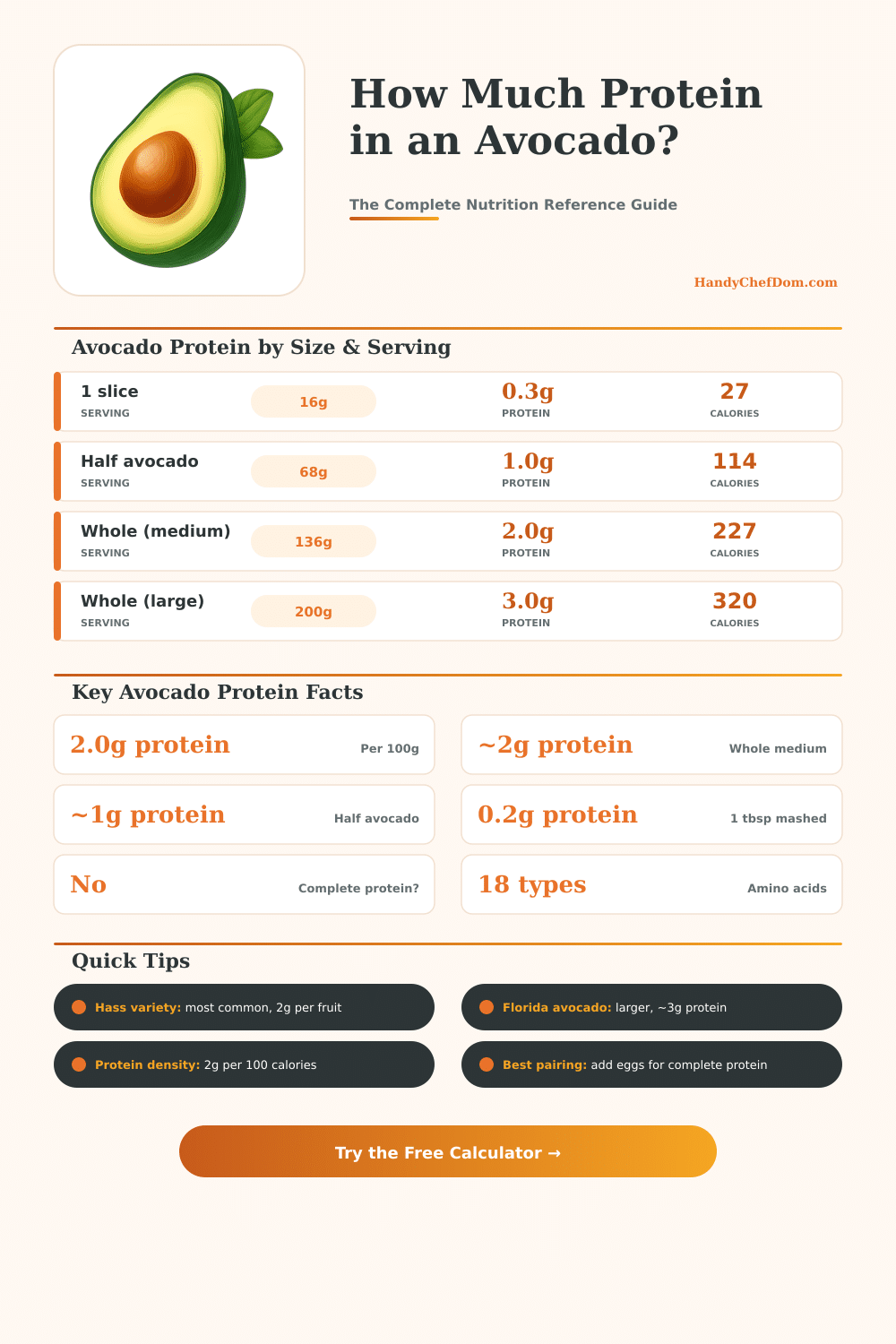
| Serving Size | Weight (g) | Weight (oz) | Protein (g) | Calories | Fat (g) |
|---|---|---|---|---|---|
| 1 Slice | 16g | 0.6oz | 0.3g | 26 | 2.4g |
| 1 Tbsp Mashed | 15g | 0.5oz | 0.2g | 23 | 2.1g |
| 2 Tbsp (guac serving) | 30g | 1.1oz | 0.4g | 46 | 4.3g |
| Half (medium, edible) | 68g | 2.4oz | 1.0g | 114 | 10.5g |
| 1 Cup Sliced | 150g | 5.3oz | 3.0g | 240 | 22.0g |
| Whole Small | 136g | 4.8oz | 2.7g | 218 | 20.0g |
| Whole Medium (Hass) | 136g | 4.8oz (edible ~68g) | 2.0g | 227 | 21.0g |
| Whole Large (Hass) | 200g | 7.1oz | 3.0g | 320 | 29.5g |
| Florida Avocado (whole) | 304g | 10.7oz | 4.6g | 365 | 27.0g |
| Variety | Protein (g) | Calories | Fat (g) | Typical Size |
|---|---|---|---|---|
| Hass (California) | 2.0g | 160 | 14.7g | 136–200g whole |
| Florida (Slimcado) | 1.5g | 120 | 10.1g | 304–400g whole |
| Fuerte | 1.8g | 148 | 13.2g | 170–250g whole |
| Reed | 2.1g | 165 | 15.2g | 250–400g whole |
| Bacon | 1.7g | 140 | 12.5g | 170–300g whole |
| Pinkerton | 1.9g | 155 | 13.8g | 180–270g whole |
| Avocado Size | Total Weight | Edible Flesh | Yield % | Protein (total) |
|---|---|---|---|---|
| Extra Small | 100g / 3.5oz | 55g / 1.9oz | 55% | 1.1g |
| Small | 150g / 5.3oz | 82g / 2.9oz | 55% | 1.6g |
| Medium | 201g / 7.1oz | 136g / 4.8oz | 68% | 2.7g |
| Large | 250g / 8.8oz | 170g / 6.0oz | 68% | 3.4g |
| Extra Large | 304g / 10.7oz | 207g / 7.3oz | 68% | 4.1g |
| Florida (Whole) | 304g / 10.7oz | 307g / 10.8oz (avg) | 70% | 4.6g |
The avocado is an evergreen tree from the laurel family. Its scientific name is Persea americana. It comes from the Americas, and findings show that folks used avocados already thousands of years ago in Central and South America.
They were first grown in Central America and later in Florida and California during the 19th century.
All About Avocados
Some call them alligator pears because of its pear shape and rough skin similar to that of an alligator. They are also sometimes called butter fruit. The fruit has bright green colour, big seed and dark tough bark.
Its flesh is creamy and smooth. Ripe avocados taste as if a bit melted butter with fresh nutty touch.
Although some count avocados as vegetables, they actually are fruits. Exactly said, they belong to the berries. It surprises many folks.
Avocados enjoy big popularity in various cultures. They form the main ingredient for guacamole. Simple guacamole is made with red onion, serrano pepper, coriander, lime juice and salt.
Grinding them in a mortar with a pestle gives a rihcer set of tastes. Besides guacamole, avocado goes well with salads, sandwiches, soups or even sweets. In Brazil they make sweet avocado cream from it.
You can deep fry or shallow fry avocados, cut them in ramen, bake or add to sauces. Unripe ones work more for cooking, because the heat dries them out.
There are hundreds of avocado species. In California they grow eight varieties for sale. The Hass avocados are the most common in the whole world.
They hold a range of nutrients and important plant parts.
The fats form the bulk of the avocado nutrition, with around 15 grams per 100 gram serving. Carbohydrates reach about 8.5 grams, while protein stays low at only 2 grams. Most of the carbohydrates come from soluble and insoluble fiber.
Half of a Hass avocado has around 117 calories, with 10.5 grams of fat and 6 grams of carbohydrates. The usual serving is 50 grams, sew third of an average avocado, that holds about 75 calories. That serving gives 11 percent of the daily fiber value.
A whole avocado can pass 300 calories, so the amount matters.
Research that looked at 30 years of data about around 111 000 folks showed that weekly eating of one avocado links with 16 percent lower risk for heart diseases and 21 percent lower risk for heart problems. Avocados are rich in healthy fats, especially monounsaturated. They also have potassium, vitamin K and folic acid.
To choose a good avocado, check that it gives to light pressure but stays quite solid. It should not have marks and be quite heavy for its size. Too ripe avocados can still be edible if the taste pleases, but the more they collapse, theless one escapes mold problems.