🍚 Rice Protein Calculator
Find out exactly how much protein is in any type and amount of rice
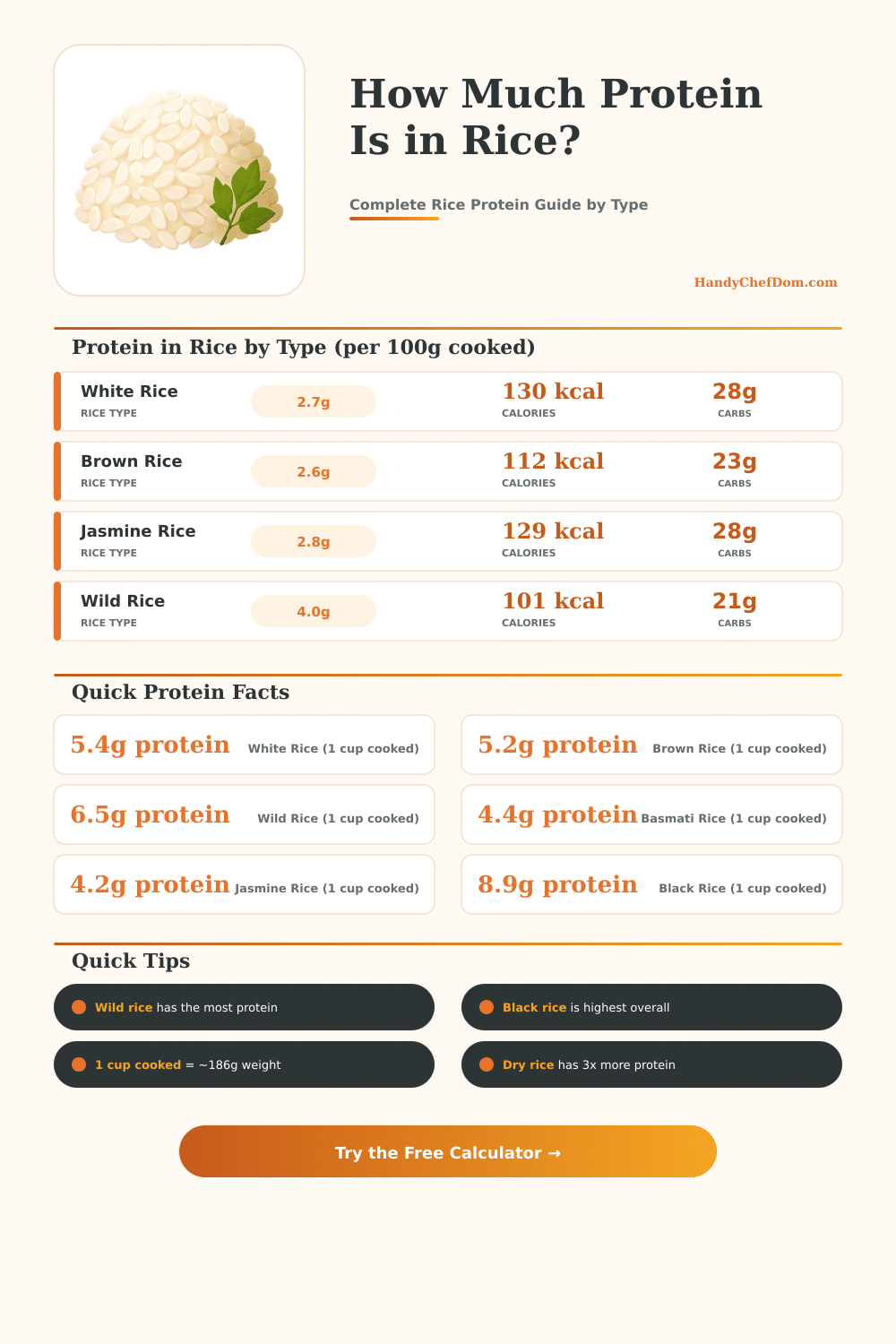
| Rice Type | Protein (g) | Calories | Carbs (g) | Fat (g) |
|---|---|---|---|---|
| White Rice | 2.7g | 130 kcal | 28.2g | 0.3g |
| Brown Rice | 2.6g | 112 kcal | 23.5g | 0.9g |
| Jasmine Rice | 2.8g | 129 kcal | 28.1g | 0.3g |
| Basmati Rice | 3.5g | 121 kcal | 25.2g | 0.4g |
| Wild Rice | 4.0g | 101 kcal | 21.3g | 0.3g |
| Black Rice | 4.9g | 160 kcal | 34.2g | 1.5g |
| Red Rice | 4.5g | 149 kcal | 31.1g | 1.1g |
| Arborio Rice | 2.8g | 130 kcal | 28.6g | 0.3g |
| Sushi Rice | 2.5g | 160 kcal | 36.0g | 0.3g |
| Sticky/Glutinous Rice | 2.0g | 169 kcal | 37.1g | 0.3g |
| Serving Size | Weight (g) | White Rice Protein | Brown Rice Protein | Wild Rice Protein |
|---|---|---|---|---|
| 1 cup cooked | 186g | 5.0g | 4.8g | 6.5g |
| ½ cup cooked | 93g | 2.5g | 2.4g | 3.3g |
| ¼ cup cooked | 47g | 1.3g | 1.2g | 1.9g |
| 100g cooked | 100g | 2.7g | 2.6g | 4.0g |
| 1 cup dry / uncooked | 185g | 14.0g | 13.8g | 19.5g |
| ½ cup dry / uncooked | 93g | 7.0g | 6.9g | 9.8g |
| 1 oz dry | 28g | 2.1g | 2.0g | 3.0g |
| Dry Amount | Cooked Yield | White Rice Protein (dry) | White Rice Protein (cooked yield) |
|---|---|---|---|
| ¼ cup dry (46g) | ~¾ cup cooked | 3.5g | 3.5g |
| ½ cup dry (93g) | ~1½ cups cooked | 7.0g | 7.0g |
| 1 cup dry (185g) | ~3 cups cooked | 14.0g | 14.0g |
| 2 cups dry (370g) | ~6 cups cooked | 28.0g | 28.0g |
Rice belongs to the mainstream food sources of the world and forms a basic grain. More than half of mankind, especially in Asia and Africa, depends on it as an everyday base. It comes from the species Oryza sativa typical for Asia, but there is also another, less spread type called Oryza glaberrima from Africa.
Folks in East and Southeast Asia, together with billions of others around the globe, base their food on rice as mainstream food.
Rice: Types, Nutrition and How to Cook
In more than 100 lands around the world, rice serves as mainstream food. Many families use it not only one time, but in several meals daily. Its wide appeal comes from the starchy nature, high calorie content and truly low price.
Especially that last part keeps its spread everywhere.
The available range is truly thrilling, more than 120 000 different rice types exist. Their differences shape things as the grade of milling, size of the grains, starch amount and taste features. For instance, the Indian basmati has long grains, that are tender and scented, so it works well for curries, dal, bhaji or for pulao.
Even so, the difference cooks otherwise, and some types suit particular dishes, so if one swaps one type by means of another in a recipe, the result does not always work.
Compared to other grains like barley, oats or wheat, rice has more starch, but fewer proteins. It is like potatoes or pulp, all three base on starchy carbs. Brown rice however brings more interesting features.
It is rich in phenols and flavonoids, that are antioxidants protecting cells against damages and lowering risk of early aging. From brown rice one receives also a lot of vitamins and minerals. When one compares whole grain with white rice, the whole grain type beats it by means of more fibers, proteins and general nutrients.
The serving sizes range according to the used rice type. For white or brown rice, adults usually take half a cup cooked. Basmati, jasmine and quinoa differ a bit, a quarter of cup cooked forms the standard portion for an adult.
If one measures one cup of dry rice and cooks it according to directions on the packet, one will receive around for portions. Half a cup of cooked white rice stores around 102 calories.
A rice cooker truly helps to get same results every time. Good rice creates a big difference. Just like olive oil, where the good quality is great, while the average is only good.
Before cooking, one should wash the rice and leave it rest some minutes after the finish of cooking, to improve the texture. Good method is made up of covering thejar by means of strong heat, lower the heat and leave it alone for around 15 minutes.