🥫 3-Month Food Storage Calculator
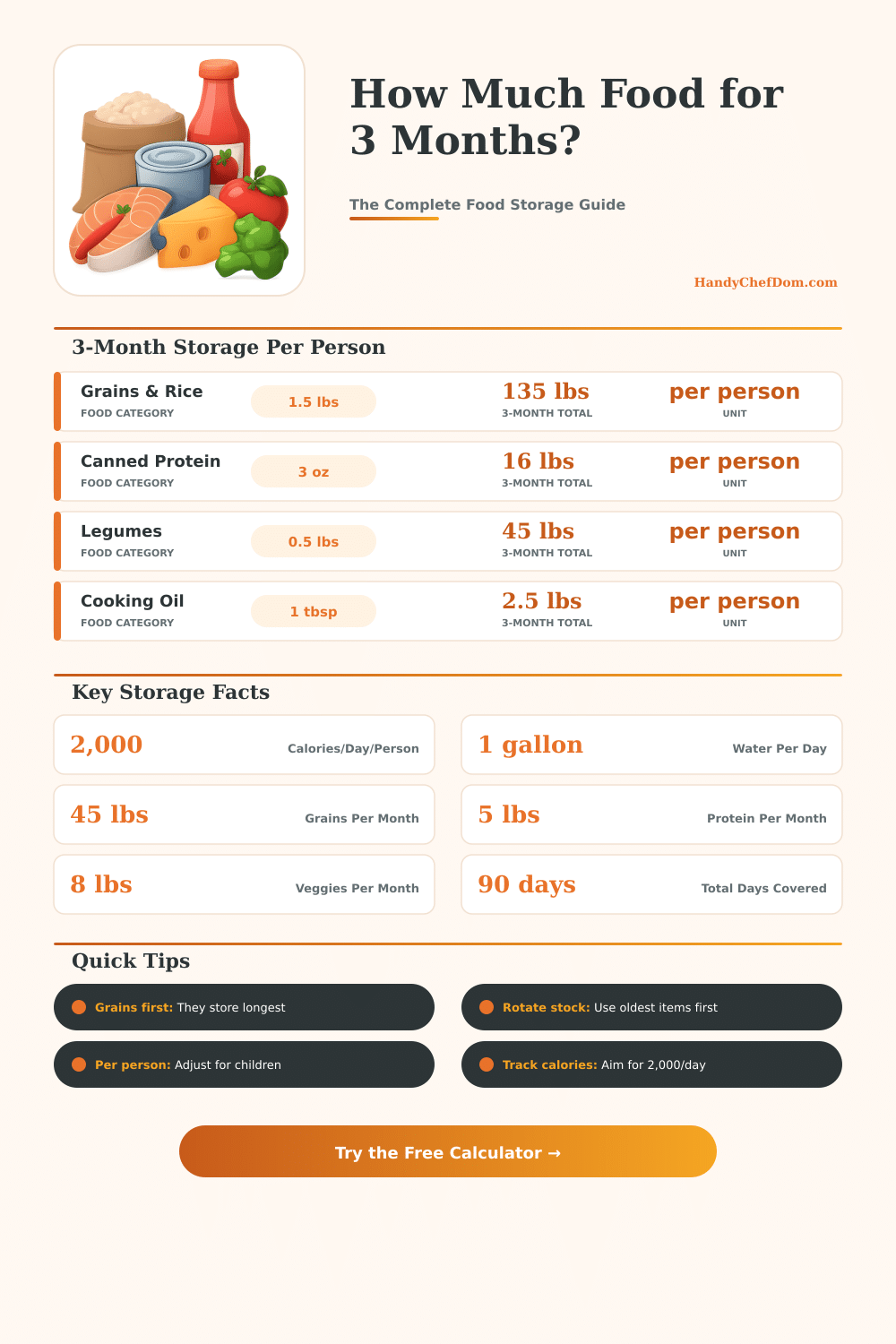
Calculate exact food quantities needed for your household over 90 days
| Food Category | Daily Amt (oz) | 90-Day Total (lbs) | 90-Day Total (kg) | Notes |
|---|---|---|---|---|
| Grains (rice, wheat, oats) | 3.5 oz | ~20 lbs | ~9 kg | Largest category |
| Legumes (beans, lentils) | 1.5 oz dry | ~8 lbs | ~3.6 kg | Key protein source |
| Canned/Dried Meat | 2 oz | ~11 lbs | ~5 kg | Tuna, chicken, beef |
| Canned Vegetables | 4 oz | ~22 lbs | ~10 kg | Varied types |
| Canned Fruits | 3 oz | ~17 lbs | ~7.7 kg | Including dried |
| Fats & Oils | 0.5 oz | ~2.8 lbs | ~1.3 kg | Cooking oil, shortening |
| Dairy (powdered milk) | 1.5 oz dry | ~8 lbs | ~3.6 kg | Calcium source |
| Sugar & Sweeteners | 0.75 oz | ~4 lbs | ~1.8 kg | Honey included |
| Salt & Seasonings | 0.1 oz | ~0.6 lbs | ~0.27 kg | Flavor & preservation |
| Baking Supplies | 0.3 oz | ~1.7 lbs | ~0.77 kg | Flour, baking powder |
| Food Item | Dry/Stored Qty | Yield Cooked | Servings |
|---|---|---|---|
| White Rice (1 lb dry) | 1 lb / 0.45 kg | ~6 cups cooked | ~6 servings |
| Dried Pinto Beans (1 lb) | 1 lb / 0.45 kg | ~6 cups cooked | ~8 servings |
| Rolled Oats (1 lb) | 1 lb / 0.45 kg | ~5 cups cooked | ~10 servings |
| Pasta (1 lb dry) | 1 lb / 0.45 kg | ~8 cups cooked | ~8 servings |
| Canned Tuna (5 oz can) | 5 oz / 142g | Ready to eat | ~2 servings |
| Powdered Milk (1 lb) | 1 lb / 0.45 kg | ~1 gallon liquid | ~16 servings |
| Canned Beans (15 oz) | 15 oz / 425g | ~1.75 cups | ~3.5 servings |
| Lentils (1 lb dry) | 1 lb / 0.45 kg | ~5 cups cooked | ~8 servings |
| Person Type | Drinking (gal/day) | Total w/ Cooking (gal/day) | 90-Day Total (gallons) |
|---|---|---|---|
| Adult (moderate activity) | 0.5 gal | 1 gal | 90 gal |
| Adult (active / hot climate) | 0.75 gal | 1.5 gal | 135 gal |
| Child (5–12 years) | 0.35 gal | 0.75 gal | 67.5 gal |
| Toddler (under 5) | 0.2 gal | 0.5 gal | 45 gal |
| Senior (65+) | 0.5 gal | 1 gal | 90 gal |
Food Storage turns around the task of keeping them fresh, so that one can eat them after days, weeks or even months since the purchase or harvest. That helps to cut the waste in the kitchen because one can keep unused bits for later use. Choose good tins and know where to store them, and it really changes everything.
Glass and plastic containers for Food work both well, even so each has its benefits. In glass tins one can right away see what is inside. Tight closures on every kind help to keep the freshness.
Easy Ways to Store Food
Some Food indeed lasts more well in glass than in plastic, because plastic sometimes affects the content. Plastic ruled the world of Storage during the last several years, although metal tins also get used.
The main piece of Tupperware is the airtight closure, that locks the taste and stops mold. They are made from materials of high quality. Pyrex offers a colorful series of round glass tins and separate glass containers with seals.
Tins of Anchor Glass, especially the round ones, last years. Some containers are meant for small portions of healthy snacks and vegetables, what makes them ideal helpers for preparing meals.
Steel lunch boxes, bento boxes and travel tins work surprisingly well for filling snacks, carrying lunch or keeping leftovers. They can receive both warm and cold Food. Stackable containers with seals and drawers ease the use of every space in the kitchen.
Organisation is the base for a handy and joyful kitchen.
When tins fill, one should lay them on shelves or in cabinets that are easily reached, that is a wise step. Like this one can check the content of a tin without removing it every thyme. One should avoid overfilling tins, to stop mold.
After going through the dishwasher, leftover water can stay inside. If one closes such tins while they are still wet, the water can cause bacteria growth. Fully drying them before closing is more important than many folks think.
Also, keeping Food without a seal in the fridge can do that the taste of one Food mixes with another.
Closures that disappear are almost unavoidable. Even so a tin without a seal is still useful for other causes. Some series of tins have several sizes with the same seal, what is very handy.
For long-term Storage, vacuum sealing with devices like FoodSaver really helps. Dry goods like flour, rice, pasta, beans, oats and sugar one can lay in large five-gallon buckets. Keeping dry products free from insects is key.
Freezing is one of the simple ways to keep Food. Vacuum sealed meat and vegetables last much longer than simply in a normal bag. Ready fat lasts around three months in the fridge and almost forever if frozen.
The method FIFO, that means “first in, first out”, helps to sparemoney and cut waste in the fridge.