🌿 Daily Fiber Intake Calculator
Find your personalized daily fiber goal based on age, sex, weight & activity level
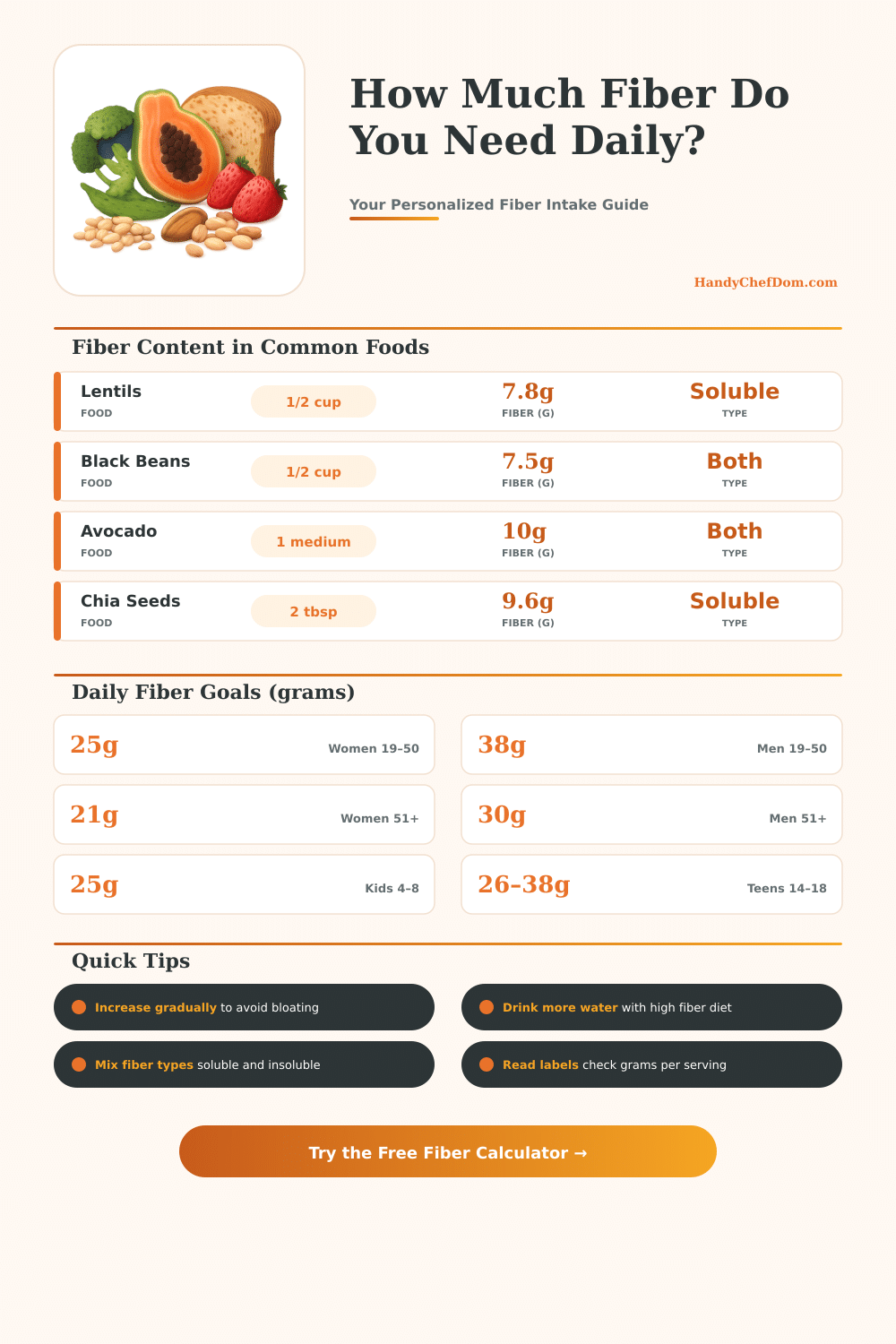
| Age Group | Female (g/day) | Male (g/day) | Notes |
|---|---|---|---|
| 1–3 years | 19 | 19 | Toddler |
| 4–8 years | 25 | 25 | Child |
| 9–13 years | 26 | 31 | Pre-teen |
| 14–18 years | 26 | 38 | Teen |
| 19–30 years | 25 | 38 | Young Adult |
| 31–50 years | 25 | 38 | Adult |
| 51–70 years | 21 | 30 | Older Adult |
| 71+ years | 21 | 30 | Senior |
| Pregnancy | 28 | — | All ages |
| Breastfeeding | 29 | — | All ages |
| Food | Serving Size | Fiber (g) | Type |
|---|---|---|---|
| Avocado | 1 medium (150g) | 10.0 | Both |
| Chia Seeds | 2 tbsp (28g) | 9.6 | Soluble |
| Lentils (cooked) | 1/2 cup (99g) | 7.8 | Soluble |
| Black Beans (cooked) | 1/2 cup (86g) | 7.5 | Both |
| Split Peas (cooked) | 1/2 cup (98g) | 8.1 | Soluble |
| Chickpeas (cooked) | 1/2 cup (82g) | 6.3 | Both |
| Oats (dry) | 1/2 cup (40g) | 4.0 | Soluble |
| Quinoa (cooked) | 1 cup (185g) | 5.2 | Insoluble |
| Broccoli (cooked) | 1 cup (156g) | 5.1 | Insoluble |
| Brussels Sprouts | 1 cup (156g) | 4.1 | Both |
| Sweet Potato (baked) | 1 medium (130g) | 3.8 | Both |
| Apple (with skin) | 1 medium (182g) | 4.4 | Soluble |
| Pear (with skin) | 1 medium (178g) | 5.5 | Soluble |
| Raspberries | 1 cup (123g) | 8.0 | Insoluble |
| Almonds | 1 oz (28g) | 3.5 | Insoluble |
| Flaxseeds (ground) | 2 tbsp (14g) | 3.8 | Soluble |
| Whole Wheat Bread | 1 slice (28g) | 1.9 | Insoluble |
| Artichoke (cooked) | 1 medium (120g) | 10.3 | Soluble |
| Property | Soluble Fiber | Insoluble Fiber |
|---|---|---|
| Dissolves in water | Yes | No |
| Forms a gel | Yes | No |
| Slows digestion | Yes | No |
| Primary benefit | Lowers LDL cholesterol, blood sugar control | Promotes bowel regularity |
| Top sources | Oats, beans, apples, psyllium | Wheat bran, whole grains, vegetables |
| Fermented by gut bacteria | Yes (prebiotic) | Partially |
| Ideal intake | 6–10g/day | 15–28g/day |
⏳ Gradual Increase: Increase fiber by no more than 5g per week to allow your gut microbiome to adapt and minimize bloating or gas. Sudden high-fiber diets can cause significant GI discomfort.
Fiber is a kind of carbohydrate that your body does not manage to fully break and absorb. Although most carbohydrates turn into sugar molecules that the body uses, Fiber follows a different path, it simply crosses the whole digestive system without being processed. One finds it in natural foods, and on nutrition labels it usually shows as soluble or insoluble Fiber.
Good main sources of nutritious Fiber include fruits, vegetables whole grain cereals and beans. Beans, peas and lentils also form reliable options for reaching your daily Fiber goals. Especially lentils show greatly.
Why Fiber Matters and How to Eat More
They are lean, packed in protein and rich in Fiber. Those tiny edible seeds appear in different colours, each with its own slight taste, and truly all of them are rich in nutrients. Black peas, almonds, chia seeds, raspberries, lima beans and pumpernickel bread complete some otehr wonderful high Fiber choices that deserve a mention.
Here something worth noting: the bulk of Americans does not receive nearly the needed amount of Fiber. The typical person picks around 15 grams daily, what stays a bit under the advice of specialists. Your target should lay between 25 and 30 grams a day from real foods, not from supplements.
More commonly women aim for 25 to 28 grams, while men should aim for 30 to 33 grams. When you reach 50 years, those daily amounts drop a bit.
Food full in Fiber brings several great benefits four your body. It relates to lowering of health risks for many diseases, care about your digestion and aid in lowering of cholesterol. Also your heart gets benefits.
Most interesting, Fiber slows the absorption of sugar, what helps to better control of blood sugar. In short, Fiber ensures that everything moves smoothly through your gut.
To start growing your Fiber in food, you do not need any trick, simply more fruits and vegetables already really help. Whether fresh, frozen or preserved, everything counts. Berries, apples, bananas, kiwi fruits, figs and passion fruits all make practical choices.
Passion fruit, especially if you eat the pulp with seeds, sits among the Fiber richest. Guava itself beats that also. Whole grains offer another easy way.
Those grains keep all three parts of the grain. The bran, the endosperm and the core, where the bran forms the outer layer, that truly stores the main part of Fiber.
Swapping refined grain products for whole grain versions truly ranks among the easiest changes in your food, without bothering the habit. Here the point: cooking does not truly destroy the Fiber and other indigestible plant matter, although it softens them. Because of that some people find cooked vegetables gentler for their digestion than raw.
Even if vegetables end in soups or other cooked foods, most of their Fiber stays unaffected.
Getting enough Fiber in your food does notrequire feeling overloaded or difficult. Beans, fruits, vegetables and whole grains all give the benefits perfectly.