🥬 Net Carbs Calculator
Subtract fiber & sugar alcohols to find your true net carbs — perfect for keto & low-carb tracking
| Food | Serving | Total Carbs | Fiber | Sugar Alc. | Net Carbs |
|---|---|---|---|---|---|
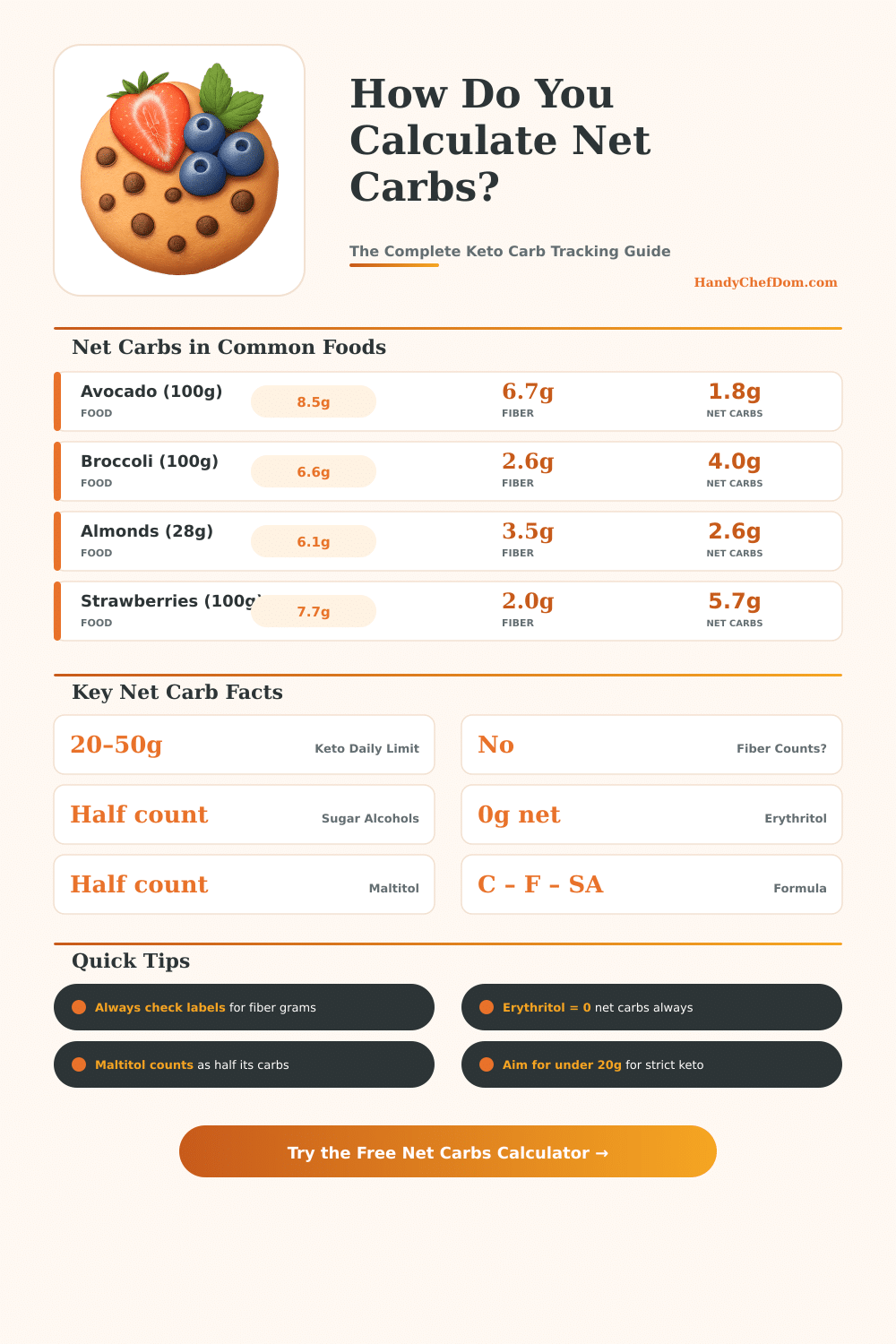
| Avocado | 100g | 8.5g | 6.7g | 0g | 1.8g |
| Broccoli (raw) | 100g | 6.6g | 2.6g | 0g | 4.0g |
| Cauliflower | 100g | 4.9g | 2.0g | 0g | 2.9g |
| Spinach | 100g | 3.6g | 2.2g | 0g | 1.4g |
| Strawberries | 100g | 7.7g | 2.0g | 0g | 5.7g |
| Raspberries | 100g | 11.9g | 6.5g | 0g | 5.4g |
| Blueberries | 100g | 14.5g | 2.4g | 0g | 12.1g |
| Almonds | 28g (1 oz) | 6.1g | 3.5g | 0g | 2.6g |
| Walnuts | 28g (1 oz) | 3.9g | 1.9g | 0g | 2.0g |
| Greek Yogurt (plain) | 100g | 3.6g | 0g | 0g | 3.6g |
| Cheddar Cheese | 28g (1 oz) | 0.4g | 0g | 0g | 0.4g |
| Egg (large) | 50g | 0.4g | 0g | 0g | 0.4g |
| White Bread | 30g (1 slice) | 15.0g | 0.6g | 0g | 14.4g |
| Dark Chocolate (85%) | 30g | 10.2g | 2.8g | 0g | 7.4g |
| Sugar Alcohol | Net Carb Impact | Glycemic Index | Common In |
|---|---|---|---|
| Erythritol | 0% (fully subtract) | 0 | Keto sweeteners, Truvia |
| Xylitol | ~50% counted | 13 | Gum, mints, baked goods |
| Sorbitol | ~50% counted | 9 | Sugar-free candy |
| Maltitol | ~50% counted | 52 | Chocolate, candy |
| Lactitol | ~50% counted | 6 | Sugar-free chocolate |
| Isomalt | 100% counted | 9 | Hard candy, pastries |
| Mannitol | ~50% counted | 0 | Dietetic foods |
| Inulin / FOS | 0% (it’s fiber) | 0 | Fiber bars, supplements |
| Diet Type | Daily Net Carbs | Ketosis? | Best For |
|---|---|---|---|
| Strict Keto | < 20g | Yes ✔ | Weight loss, epilepsy |
| Standard Keto | 20 – 50g | Usually | Most keto dieters |
| Moderate Low-Carb | 50 – 100g | No | Weight maintenance |
| Liberal Low-Carb | 100 – 150g | No | General health |
| Standard Diet | 225 – 325g | No | General population |
Net carbs are those carbohydrates in foods that the body truly can digest and use for energy. Makers of foods coined this category to profitably exploit the trend of low-carb diets. The idea allows people on a diet taste sweet and creamy products without the full effects of carbohydrates.
Even so, it is not simply market deceit but has deeper meaning.
Net Carbs: What They Are and How to Count Them
The basic method is very simple. One takes the total carbohydrates of something eaten and removes the fiber together with sugar alcohols. What stays, that one calls Net carbs.
For instance, if a label shows 40 grams of total carbohydrates and 5 grams of fiber, the result is 35 grams of Net carbs. Also, 85 grams of raw carrots store 7 grams of carbohydrates and 2.6 grams of dietary fiber, so that the Net carbs come to 4.4 grmas.
Fiber one removes because the body cannot truly digest the biggest part of it. It simply passes through the body without being broken down. So fiber does not raise the sugar in blood like other carbohydrates.
In short, Net carbs are those that turn into glucose and cause a rise of insulin.
Sugar alcohols complicate the cause a bit more. They do not all match one to the other. Maltitol more strongly raises the blood sugar than the rest, so only the half of its grams one should consider as pure carbohydrates.
If one does not mind those details, imprecise calculation follows. Also, some producers remove whole content of sugar alcohols from there calculations about carbohydrates, what sometimes gives mistakes. Even if a product lacks sugar but has sugar alcohols, it still can work on the blood sugar.
By the way, those alcohols commonly cause wind and swelling in the belly, because they are hardly digested.
Allulose and erythritol can be fully removed from the total carbohydrates. For other sugar alcohols, like xylitol, one should remove only the half.
Be well aware of rounding in the numbers on labels. A label maybe points 4 grams of total carbohydrates and 2 grams of fiber, what gives 2 grams of Net carbs. But the actual values could be 4.4 grams total and 1.5 grams of fiber, resulting in 2.9 grams of Net carbs.
For one serving that does not matter a lot, but for five servings it adds up to 4.5 extra grams.
Starchy vegetables store seven or more grams of Net carbs per serving. Foods from whole grains usually have fewer pure carbohydrates than their white, starchy match because the whole grains keep their fiber, which is rich in fiber.
For foods without labels, for instance fruits or vegetables, programs like the Atkins Carb Calculator help figure the count of Net carbs. The FDA always advises to use the total carbohydrates from nutrition labels. In the United Kingdom some labels already exclude fiber from the calculation of carbohydrates, so that here removing fiber again could be wrong.
Checking the list of ingredients together with thenutrition info helps to escape hidden carbohydrates and mistakes.