🍬 Erythritol to Sugar Conversion Calculator
Convert any sugar amount to erythritol — get exact weights, volumes & calorie savings instantly
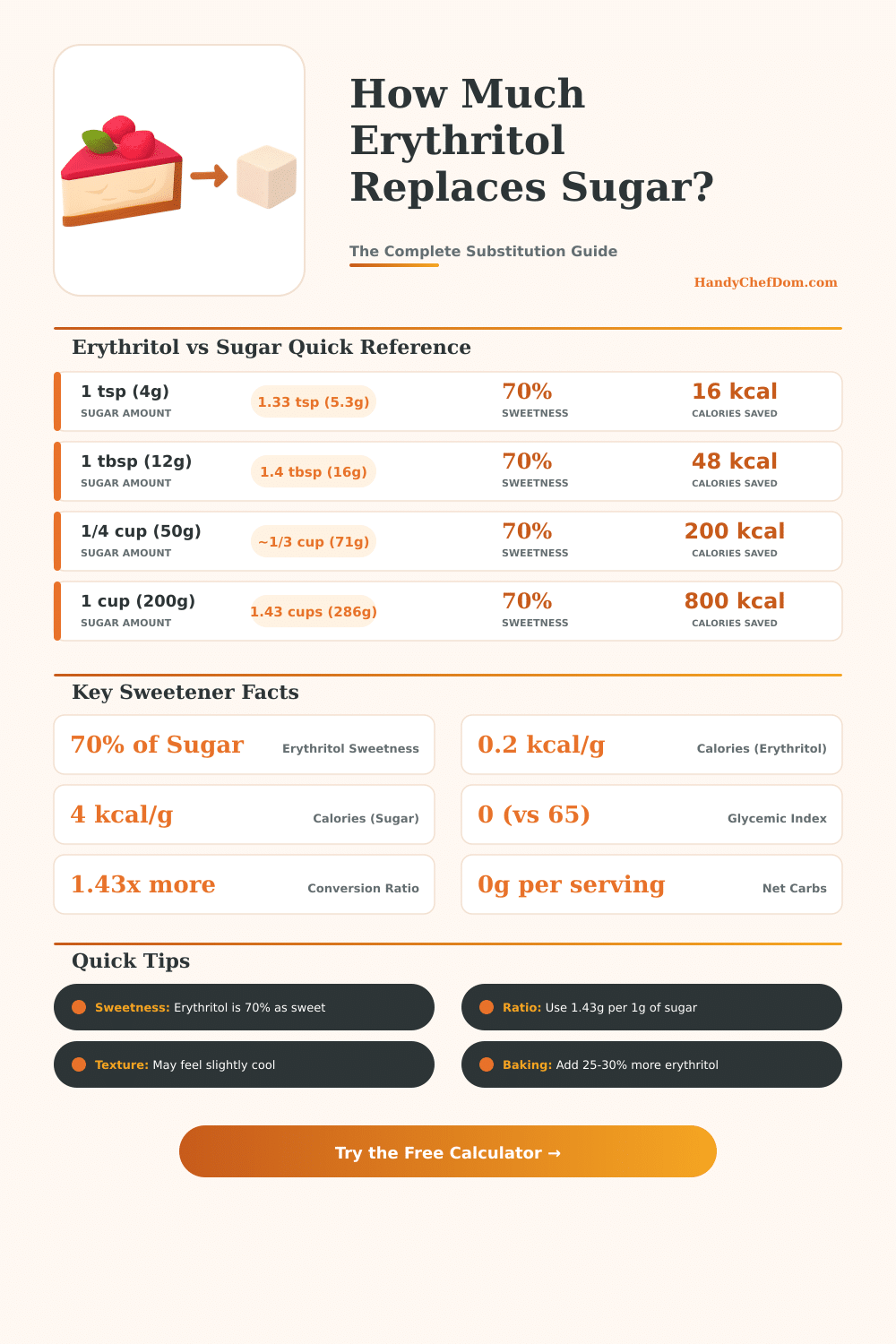
| Sugar Amount | Sugar (g) | Erythritol (g) | Erythritol (Volume) | Calories Saved |
|---|---|---|---|---|
| 1 teaspoon | 4.2g | 6.0g | ~1.4 tsp | ~15 kcal |
| 1 tablespoon | 12.5g | 17.9g | ~1.4 tbsp | ~46 kcal |
| 1/8 cup | 25g | 35.7g | ~2.9 tbsp | ~93 kcal |
| 1/4 cup | 50g | 71.4g | ~5.7 tbsp | ~186 kcal |
| 1/3 cup | 67g | 95.7g | ~7.7 tbsp | ~249 kcal |
| 1/2 cup | 100g | 142.9g | ~11 tbsp | ~372 kcal |
| 2/3 cup | 134g | 191.4g | ~15 tbsp | ~499 kcal |
| 3/4 cup | 150g | 214.3g | ~17 tbsp | ~557 kcal |
| 1 cup | 200g | 285.7g | ~23 tbsp | ~743 kcal |
| 2 cups | 400g | 571.4g | ~46 tbsp | ~1486 kcal |
| Sweetener | Sweetness vs Sugar | Calories (kcal/g) | Glycemic Index | 1 cup Sugar Equivalent |
|---|---|---|---|---|
| White Sugar | 100% | 4.0 | 65 | 1 cup (200g) |
| Erythritol | 70% | 0.2 | 0 | 1.43 cups (286g) |
| Xylitol | 100% | 2.4 | 13 | 1 cup (192g) |
| Stevia (pure) | 200–400% | 0 | 0 | 1/2–1/4 tsp |
| Monk Fruit | 150–250% | 0 | 0 | 1/2–1/3 tsp |
| Allulose | 70% | 0.4 | 0 | 1.43 cups (249g) |
| Coconut Sugar | 75% | 3.8 | 35 | 1.33 cups (240g) |
| Honey | 125% | 3.0 | 58 | 3/4 cup (250g) |
| Measurement | White Sugar (g) | Erythritol (g) | Difference |
|---|---|---|---|
| 1/4 teaspoon | 1.1g | 1.75g | +0.65g |
| 1 teaspoon | 4.2g | 7.0g | +2.8g |
| 1 tablespoon | 12.5g | 21.0g | +8.5g |
| 1/4 cup | 50g | 71.4g | +21.4g |
| 1/2 cup | 100g | 142.9g | +42.9g |
| 1 cup | 200g | 285.7g | +85.7g |
Erythritol is a kind of carbohydrate that one calls a sugar alcohol. It ranks among the most used sweeteners on the market currently. Naturally it appears in tiny amounts in various fruits, vegetables and other plant products.
One finds it also in things like rich fruit, cheese, pistachios and wine. Although it appears in nature, one produces Erythritol for stores by means of fermentation. The body itself creates it by means of a process called the pentose phosphate pathway but only in small amounts.
Erythritol: A Zero-Calorie Sweetener, Uses and Risks
Erythritol has around 70 percent of the sweetness of sugar. It has almost no calories. According to the law, one can label a sweetener as zero-calorie if it delivers under five calories each serving.
For Erythritol a serving matches one spoon, what weighs around four grams. That amount gives about 1.6 calories, so it is sold as a zero-calorie addition. It does not change the sugar in blood or the insulin, so it works well for diets meant for weight loss, diabetes and ketogenic meals.
Its glycemic raet matches zero.
Erythritol sweeteners come in different crystal forms, for instance granular, crystallized or powder. One uses it commonly in thin foods, sugar drinks, bakery products, protein bars, energy drinks and without sugar fizzy drinks. To cook with granular Erythritol, usually you need to dissolve the crystals.
It does not like water, so foods with it commonly stay dry. It does not caramelize or help the browning, that gives to cake and biscuit there taste and crunchy surface. Beating of eggs with Erythritol does not do the same bit as sugar.
It also does not work with yeast.
Erythritol can replace sugar, because it does not upset the belly like other sugar alcohols, for instance mannitol, sorbitol or maltitol. Even so, too much eating however can create problems in digestion, like disgust and loose stool.
Last year some issues appeared from scientific studies. Research works show a link between Erythritol and bigger risk of heart attack or brain stroke, that does not kill. In lab tests it boosted release of a blood vessel clogging substance and risk of blood clot breaking.
But the body itself produces Erythritol in stress moments, as during a hart incident, and not all studies fully explain that.
Unlike xylitol, that is truly poisonous for dogs, Erythritol is widely thought to be safe for them in normal doses. It does not cause sharp drops in blood sugar or liver damage in pets. Erythritol seems to beeven better for teeth than xylitol.