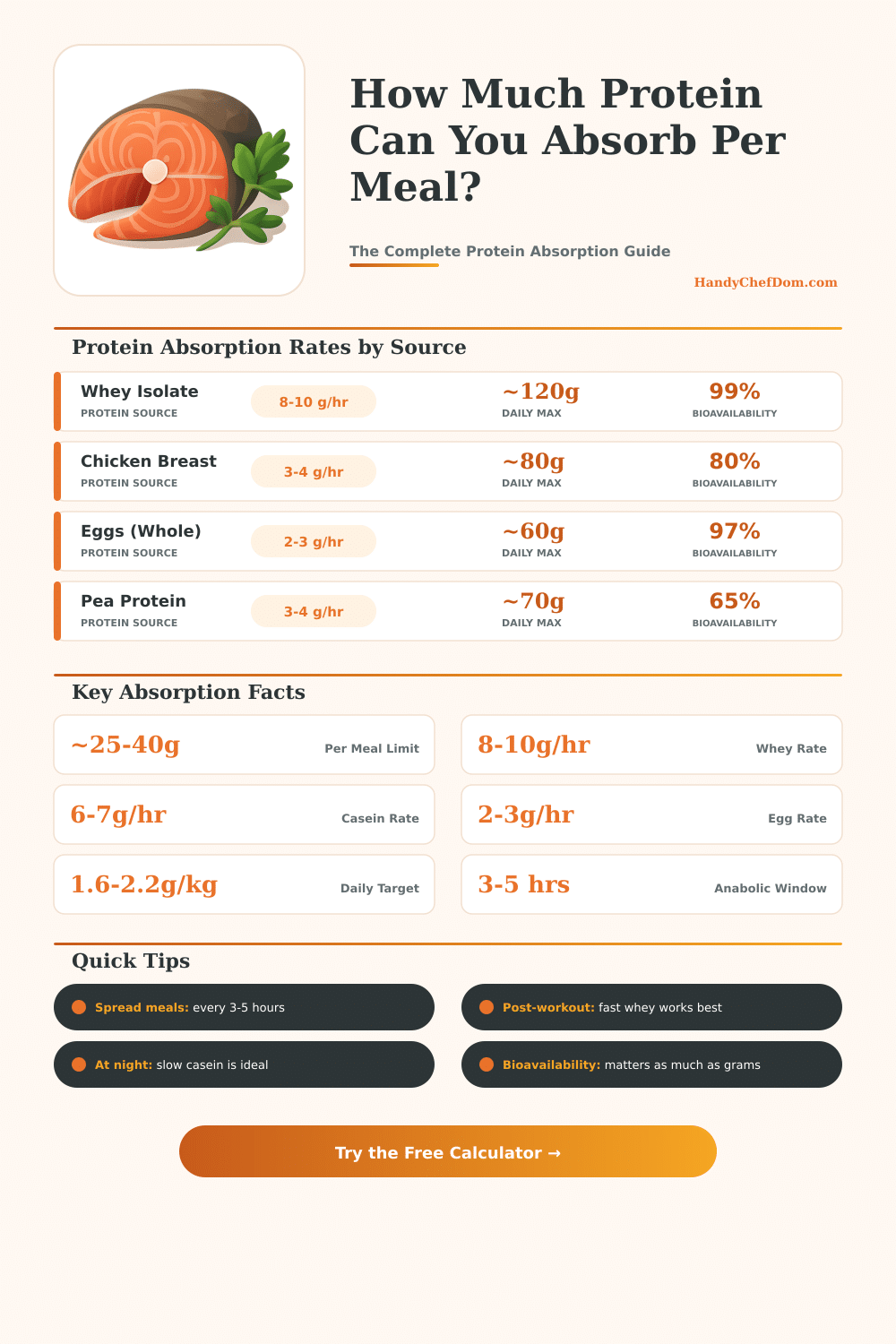
💪 Protein Absorption Calculator
Find out how much protein your body can absorb per meal & optimize your daily intake
| Protein Source | Digestion Rate (g/hr) | Bioavailability | PDCAAS Score | Best Timing |
|---|---|---|---|---|
| Whey Isolate | 8–10 g/hr | 99% | 1.00 | Post-workout |
| Whey Concentrate | 6–8 g/hr | 90% | 1.00 | Post-workout |
| Casein (Micellar) | 6–7 g/hr | 80% | 1.00 | Before sleep |
| Egg White | 2–3 g/hr | 91% | 1.00 | Any time |
| Chicken Breast | 3–4 g/hr | 80% | 0.92 | Lunch / Dinner |
| Fish / Seafood | 4–6 g/hr | 83% | 0.96 | Any time |
| Beef / Red Meat | 3–4 g/hr | 74% | 0.92 | Dinner |
| Soy Protein Isolate | 3–4 g/hr | 74% | 1.00 | Any time |
| Pea Protein | 3–4 g/hr | 65% | 0.89 | Any time |
| Hemp Protein | 2–3 g/hr | 50% | 0.63 | Smoothies |
| Brown Rice Protein | 2–3 g/hr | 60% | 0.47 | Any time |
| Greek Yogurt | 3–5 g/hr | 85% | 1.00 | Snack / Breakfast |
| Goal | Min (g/kg) | Optimal (g/kg) | Max Useful (g/kg) | Example (75kg) |
|---|---|---|---|---|
| General Health | 0.8 | 1.2 | 1.6 | 60–120g/day |
| Maintain Muscle | 1.2 | 1.6 | 2.0 | 90–150g/day |
| Build Muscle | 1.6 | 2.0 | 2.4 | 120–180g/day |
| Fat Loss (preserve muscle) | 1.8 | 2.2 | 2.6 | 135–195g/day |
| Endurance Performance | 1.4 | 1.8 | 2.0 | 105–150g/day |
| Healthy Aging (55+) | 1.2 | 1.6 | 2.0 | 90–150g/day |
| Intense Athlete | 1.8 | 2.2 | 3.0 | 135–225g/day |
| Body Weight | Per Meal (min) | Per Meal (optimal) | Daily Total |
|---|---|---|---|
| 50 kg (110 lbs) | 15g | 20–25g | 80–110g |
| 60 kg (132 lbs) | 17g | 22–28g | 96–132g |
| 70 kg (154 lbs) | 20g | 25–32g | 112–154g |
| 80 kg (176 lbs) | 22g | 28–36g | 128–176g |
| 90 kg (198 lbs) | 25g | 32–40g | 144–198g |
| 100 kg (220 lbs) | 28g | 35–45g | 160–220g |
Protein is everywhere in your body, in the muscles, bones, skin, hair and almost every other tissue that you can imagine. It forms the enzymes, those little workers, that lead many chemical processes. It is also a key part of hemoglobin that carries oxygen through the blood.
Because almost every cell stores Protein, some call it “the building block of life” and truly, that is not too much to say.
Why Protein Matters and Where to Get It
At its base, Protein simply is made up of chains of amino acids, bound together. Around 20 different types of those acids float around and can combine in almost endless ways. The order in which they arrange themselves decides the form of every Protein and the task that it will do.
Some proteins pass signals between cells. Others help digestion, help muscles squeeze or fight against diseases.
Your body needs Protein for energy, growth, repair and so that everything works well. Especially the bones and muscles. It also helps you feel full for longer after a meal.
Even so, too much of something good can be harmful. Too large amounts can carry real dangers. If you have problems with kidneys, keep to around 0.8 grams per kilo of body weight daily to stay safe and do not load them too much.
For sitting adults, this is the advised daily dose anyway. Folk weighing 75 kilos need around 60 grams per day.
If you lift weights and train hard, then the numbers change. Athletes and serious gym lovers usually raise their Protein intake, because muscle growth needs that. Add that extra Protein to regular training and good sleep, and you have a good chance for real muscle building.
Most Americans depend on animal products for their Protein supply. Even so, that is not the only option. Whole grains like quinoa and buckwheat give a lot, just like tofu, lentils and peas for plant-based eating.
Eggs deserve attention, a large one has around 7.5 grams, while a very big egg brings you closer too 8.7 grams. Fruits also slightly help. Passion fruit stands in the lead with about 5 grams per cup, although most fruits do not give a lot of Protein.
Weird but real, fermented bread has good Protein content.
Complete Protein matters, because some nutrients found mostly in animal products. Vitamin B12, heme iron and zinc belong to that group, which makes them harder to get on a plant diet. But plant-based meals do not leave you without them.
Mixing beans with rice or quinoa gives full Protein that works without meat.
Protein powders come in many types, whey, casein, soy and pea forms, each with its fans. One serving usually gives around 24 grams. Whey Protein commonly is the best choice for muscle growth.
Mixing whey with casein or switching to plant powder can help baked foods stay more moist than with whey alone. You can easily mixProtein powder into smoothies, soups, patties, cakes or brownies without big effort.