🍺 Homebrew ABV Calculator
Calculate alcohol by volume from original & final gravity readings
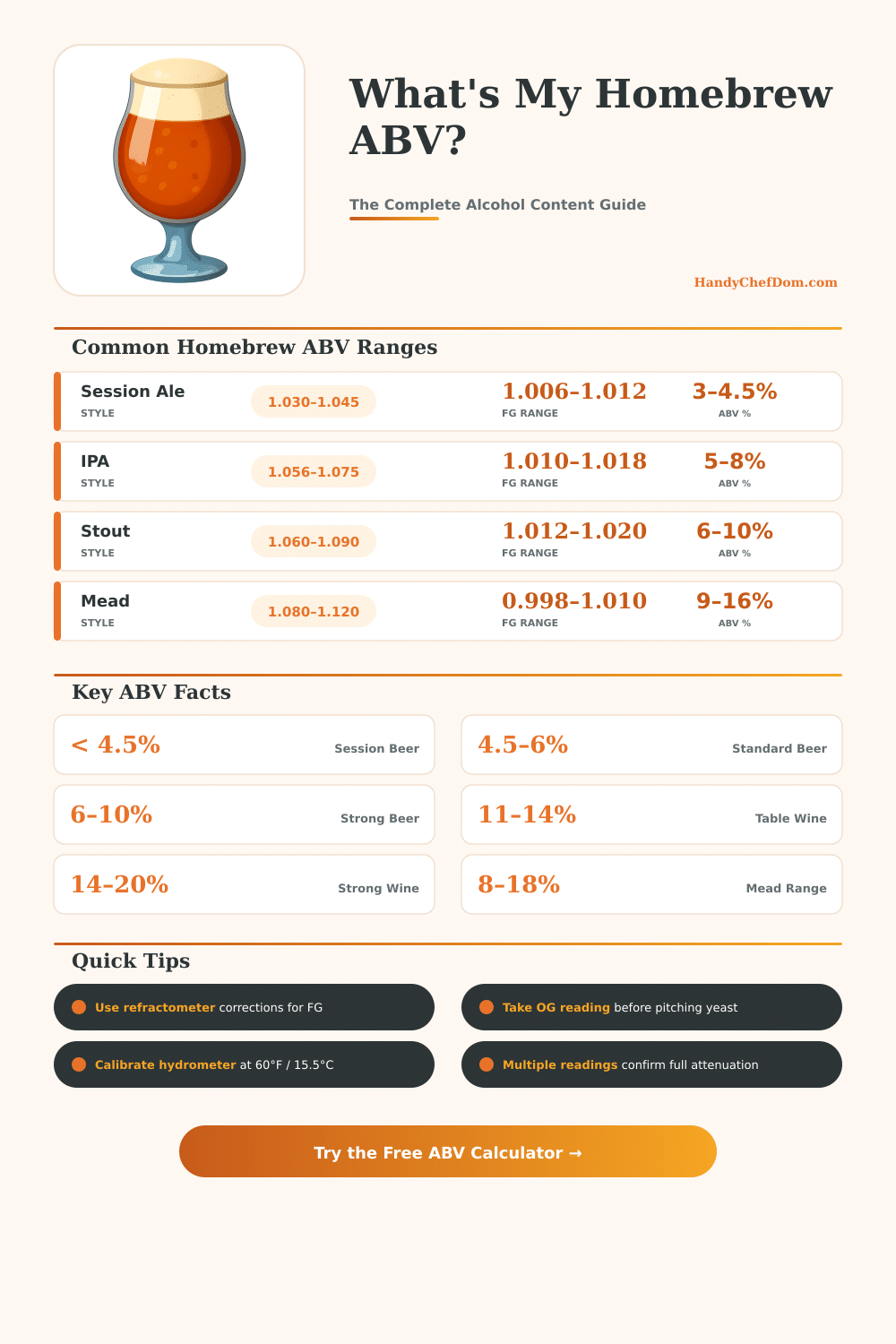
| Style | OG Range (SG) | FG Range (SG) | Typical ABV | Attenuation |
|---|---|---|---|---|
| Session Ale/Beer | 1.030 – 1.045 | 1.006 – 1.012 | 3.0 – 4.5% | 68–75% |
| Pale Ale / APA | 1.045 – 1.060 | 1.010 – 1.015 | 4.5 – 6.2% | 72–80% |
| IPA / DIPA | 1.056 – 1.090 | 1.010 – 1.018 | 5.5 – 10% | 70–80% |
| Stout / Porter | 1.060 – 1.090 | 1.012 – 1.022 | 5.5 – 10% | 65–75% |
| Wheat Beer | 1.044 – 1.056 | 1.008 – 1.016 | 4.0 – 5.5% | 72–80% |
| Belgian Tripel | 1.075 – 1.085 | 1.008 – 1.016 | 8.0 – 10% | 78–86% |
| Barleywine | 1.080 – 1.120 | 1.016 – 1.030 | 8.0 – 12% | 64–72% |
| Lager | 1.040 – 1.055 | 1.006 – 1.012 | 4.0 – 5.5% | 75–82% |
| Cider (Dry) | 1.045 – 1.065 | 0.998 – 1.005 | 5.5 – 8.5% | 85–95% |
| Table Wine | 1.070 – 1.095 | 0.995 – 1.005 | 9.5 – 13% | 90–97% |
| Mead (Traditional) | 1.080 – 1.130 | 0.998 – 1.015 | 9.0 – 18% | 80–95% |
| High-Gravity Mead | 1.130 – 1.160 | 1.010 – 1.025 | 15.0 – 20% | 75–86% |
| Specific Gravity | Brix (°Bx) | Plato (°P) | Approx. Sugar (g/L) |
|---|---|---|---|
| 1.000 | 0.0 | 0.0 | 0 |
| 1.010 | 2.6 | 2.6 | 26 |
| 1.020 | 5.1 | 5.0 | 51 |
| 1.030 | 7.6 | 7.5 | 77 |
| 1.040 | 10.0 | 9.9 | 103 |
| 1.050 | 12.4 | 12.4 | 129 |
| 1.060 | 14.7 | 14.7 | 155 |
| 1.070 | 17.1 | 17.0 | 181 |
| 1.080 | 19.3 | 19.3 | 207 |
| 1.090 | 21.5 | 21.5 | 233 |
| 1.100 | 23.7 | 23.7 | 258 |
| 1.110 | 25.9 | 25.8 | 284 |
| 1.120 | 28.0 | 27.9 | 309 |
| Sample Temp | °F | Add to SG Reading | Example Corrected SG |
|---|---|---|---|
| 50°F / 10°C | 50 | –0.001 | 1.050 → 1.049 |
| 60°F / 15.5°C | 60 | +0.000 (baseline) | 1.050 → 1.050 |
| 68°F / 20°C | 68 | +0.001 | 1.050 → 1.051 |
| 77°F / 25°C | 77 | +0.002 | 1.050 → 1.052 |
| 86°F / 30°C | 86 | +0.003 | 1.050 → 1.053 |
| 95°F / 35°C | 95 | +0.005 | 1.050 → 1.055 |
| 104°F / 40°C | 104 | +0.007 | 1.050 → 1.057 |
Homebrew is free and open, and allows you to install programs in macOS and Linux without any problems. Where does the name come from? It deals about building programs yourself, as if you prepare something specially for your own taste.
It covers the gaps that Apple or your Linux system leaves from the factory.
Homebrew: Mac programs, making beer, and home-made games
Imagine it as a store of applications, but designed for programmers and expert users, that need command-line tools and utilities. In the world of Unix and Linux, the principle is simple: every program does one task and does that well. If you need something more difficult, you bind those utilities together by means of pipes, redirects, or fast scripting.
Homebrew operates based on Git and Ruby. During the first installation, it creates a directory in /usr/local with a Git deposit. It works on macOS and Linux without problems.
After cloning of the repo homebrew/core, the system involves around 82 MB. Alone, without installed packages, it almost reaches 100 MB on Mac. Even so, separate packages can become heavy.
For instance, llvm@12 requires around 1.5 GB, so everything depends on what you add.
From a security view, Homebrew fits well with your Mac. It stopped making errors about rights before, so it installs as normal programs. Notable is that the whole project operates as a not-for-profit group, with partners that freely help without salary.
The group depends on gifts to pay license fees, server costs, and the ongoing whole system that keeps everything active.
The command ‘tap’ is where everything becomes interesting. If you launch it without URL, Homebrew assumes that you intend a formula deposit in GitHub and downloads it by means of HTTPS. Because the majority of taps already live hear, it saves you from typing.
If you however point to a URL, it will download a deposit from any place using various protocols.
Here is where it gets cool, “homebrew” almost does not deal about programming. The same word relates to making beer, wine, cider, and mead at home. During most of American history, that was not even legal.
Home brewing became allowed only in 1978. Before the Ban, one could freely do it, and even George Washington himself was a home brewer. Today folks do it partly because of savings, although prices of hops and malt seem to climb.
The starting costs under 100 dollars are quite accessible.
Newcomers commonly start with malt extract, and honestly, it gives good beer. Complete gear is available from shops like Northern Brewer and Austin Homebrew. After buying the basics, one naturally moves to brewing from grain.
The majority of home brewers choose a volume of around 19 liters, or 5 American gallons, because that fits perfectly in Cornelius kegs, that many use.
The word “homebrew” also applies to table gaming. In the fifth edition of Dungeons & Dragons there exists a whole world of home-made elements: own backgrounds, magic objects, original monsters, and spells. Creation of a home-made spell can be easy, take an existing one, check alike, and adjust details.
The changes can be only visual or more thorough. And home-madevideo games cover eagerly created games for retro consoles too.