🧂 Wet Brine Calculator
Calculate exact salt, sugar & water ratios for a perfect brine every time
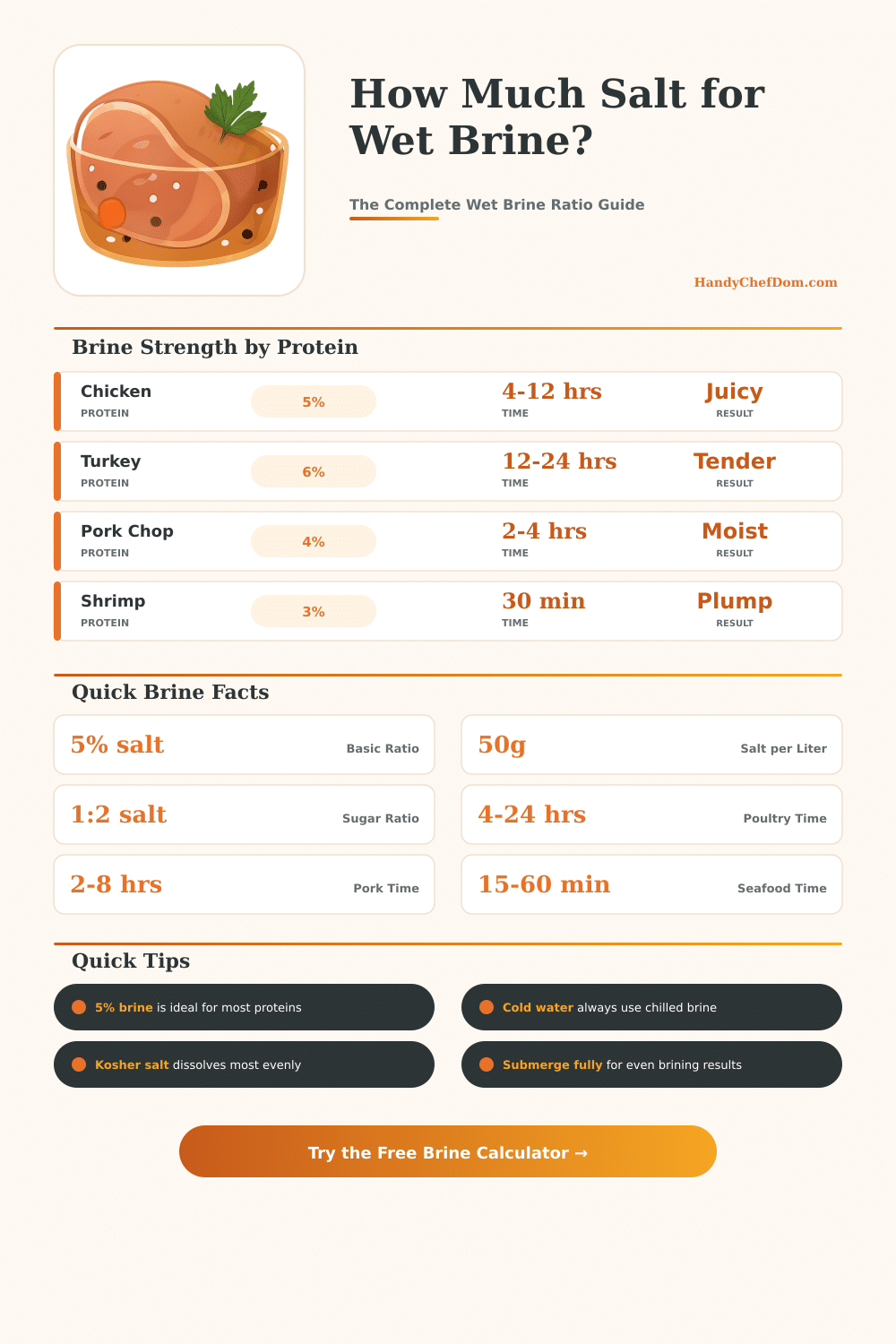
| Protein | Recommended Salt % | Brine Time | Salt per Liter (g) | Salt per Quart (oz) |
|---|---|---|---|---|
| Whole Chicken (3–4 lb) | 5–6% | 4–12 hours | 50–60g | 1.7–2 oz |
| Chicken Breasts | 4–5% | 1–4 hours | 40–50g | 1.4–1.7 oz |
| Whole Turkey (12–14 lb) | 5–6% | 12–24 hours | 50–60g | 1.7–2 oz |
| Pork Chops | 4–5% | 2–6 hours | 40–50g | 1.4–1.7 oz |
| Pork Loin / Tenderloin | 5% | 4–8 hours | 50g | 1.7 oz |
| Duck | 6–7% | 8–24 hours | 60–70g | 2–2.4 oz |
| Shrimp | 3–4% | 15–60 min | 30–40g | 1–1.4 oz |
| Salmon / Fish Fillet | 3–5% | 30–60 min | 30–50g | 1–1.7 oz |
| Vegetables / Pickles | 2–3% | 1–72 hours | 20–30g | 0.7–1 oz |
| Salt Type | Weight per Cup (g) | Volume Factor vs Table Salt | Best For |
|---|---|---|---|
| Table Salt (iodized) | ~290g | 1.0x (baseline) | All-purpose brining |
| Kosher Salt — Diamond Crystal | ~135g | 1.45x more by volume | Preferred by chefs |
| Kosher Salt — Morton | ~240g | 1.2x more by volume | Common grocery brand |
| Fine Sea Salt | ~225g | 1.3x more by volume | Gourmet brines |
| Flaked Sea Salt (Maldon) | ~120g | 1.6x more by volume | Light brines / finishing |
| Water Amount | Salt at 3% (g) | Salt at 5% (g) | Salt at 6% (g) | Sugar (1/2 of 5% salt) |
|---|---|---|---|---|
| 500 ml / 0.5 qt | 15g | 25g | 30g | 12.5g |
| 1 L / 1 qt | 30g | 50g | 60g | 25g |
| 2 L / 2 qt | 60g | 100g | 120g | 50g |
| 3 L / 3 qt | 90g | 150g | 180g | 75g |
| 4 L / 1 gal | 120g | 200g | 240g | 100g |
| 8 L / 2 gal | 240g | 400g | 480g | 200g |
Wet Brine consists basically of salt settled in water, you soak the meat in it before the cook and magic happens. Between the Brine and the meat the levels of salt and moisture match. What is the prize?
Results that show more juicy and tender on the dish.
How Wet Brine Makes Meat Juicy and Tender
Making simple wet Brine happens easily. You warm the water, dissolve in it the salt, and everything is ready. The kind of salt that one chooses really matters, because it determines the wanted saltiness.
Many recipes point one cup of kosher salt per gallon of water. When one uses table salt instead, that matches around ten ounces per gallon; same result, but different starting point. Scaling for smaller amounts is simple math.
Such methods work well for thin bits of poultry and pork. The extra moisture changes possibly dry bird or chop into really juicy food. Here the problem: almost everything in what the meat soaks is water.
That can give the meat a bit bland or soft taste. Smell elements commonly are too big to easily go across the cells of the meat. The Brine itself could have wonderful smell and taste, but deep reach into the roast?
Not that much works, as one would imagine. Salt well enters. Herbs and spices?
They mostly stay on the surface and skin.
One can add sugar too the mix in about same amount as the salt. Even so molecules of sugar are quite a lot big, so they need several days to really enter the meat. Also, flavors, herbs and spices all work as good extras.
Apple cider, rosemary, garlic, brown sugar, peppers, bay leaves and citrus bark all add different feel to the cause.
Time is key here. I noticed that around one hour of Brine time per pound works as good center. Turkey weighing of twelve until fourteen pounds?
Sharply the effect becomes nice. Bits of chicken are another cause, they should not sit here more than some hours, otherwise everything gets too salty. Delay it any more, and one struggles against themselves.
Balanced Brine takes another method. The meat slowly reaches a fixed salt level, then stays stable. After one reaches that spot, it does not get saltier, even if one leaves it sitting here however long.
It needs less salt at first, but needs more attention. For typical wet Brine, aim for salt focus between five and seven percent, what settles the most cases well.
What is the biggest downside? Finding space in the fridge for a real tub is an actual challenge. Fit whole turkey in a bath of cold liquid?
Big load for the fridge. Fill it with ice around to keep it fresh, like this one can Brine sharply or extend until forty-eight hours if needed. One final tip: never reuse Brine from bird for the next.
The ingredients quickly disappear, so making freshlot always makes sense.