🍞 Bulk Fermentation Calculator
Estimate sourdough bulk fermentation time by temperature, starter %, and rise target
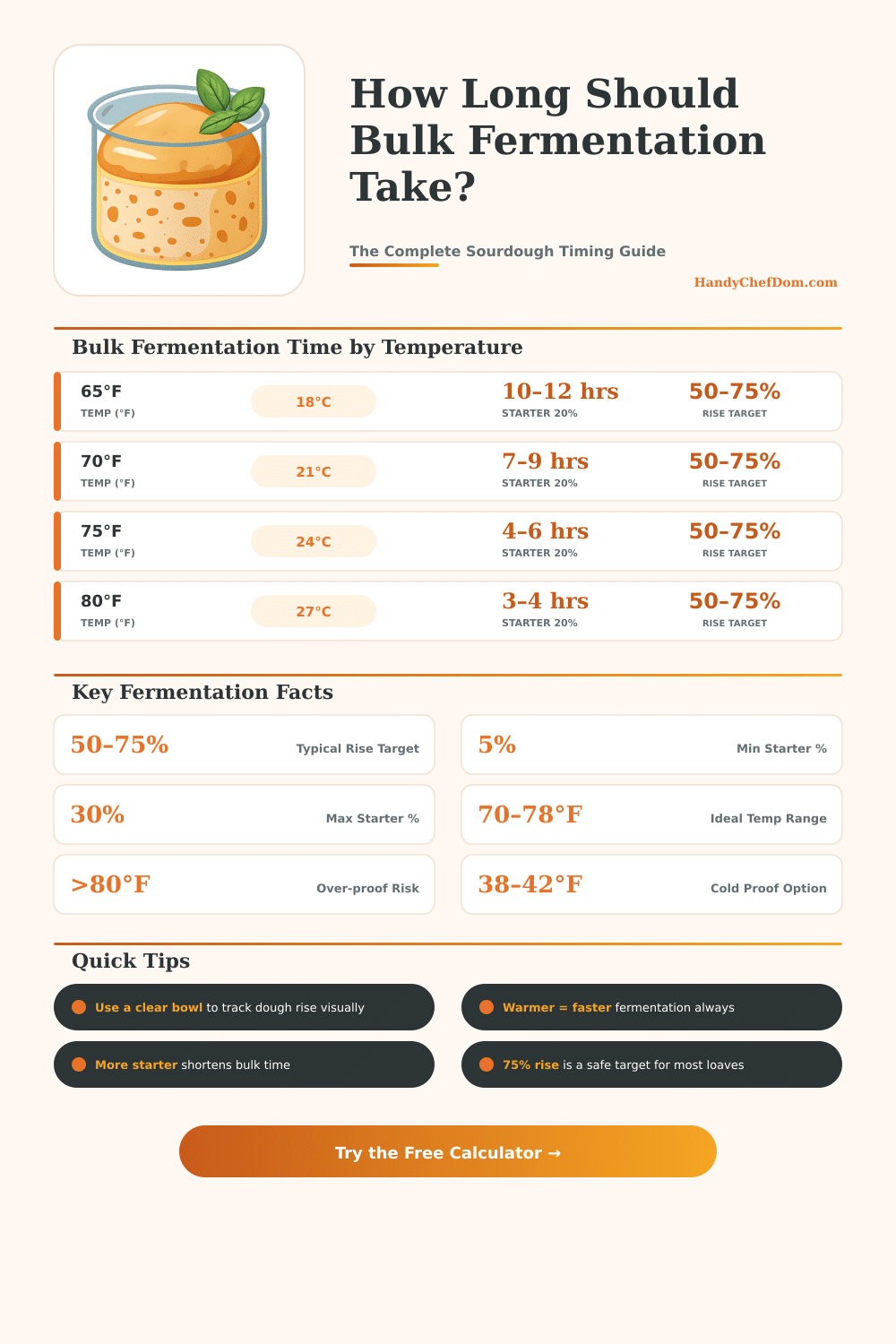
| Temp (°F) | Temp (°C) | Starter 10% | Starter 20% | Starter 30% |
|---|---|---|---|---|
| 64°F | 18°C | 12–16 hrs | 10–12 hrs | 8–10 hrs |
| 68°F | 20°C | 9–11 hrs | 7–9 hrs | 5–7 hrs |
| 72°F | 22°C | 7–9 hrs | 5–7 hrs | 4–5 hrs |
| 75°F | 24°C | 5–7 hrs | 4–5 hrs | 3–4 hrs |
| 78°F | 26°C | 4–5 hrs | 3–4 hrs | 2.5–3 hrs |
| 82°F | 28°C | 3–4 hrs | 2–3 hrs | 1.5–2 hrs |
| Starter % | Activity Level | Speed Factor | Best For |
|---|---|---|---|
| 5–8% | Very Slow | 0.55x | Overnight / cold bulk |
| 10–15% | Slow | 0.75x | Long daytime bulk |
| 18–22% | Medium | 1.0x (baseline) | Standard same-day bulk |
| 25–30% | Fast | 1.35x | Shorter bulk windows |
| 35–50% | Very Fast | 1.7x | Quick breads / rescue |
| Rise Target | Visual Cue | Dough Feel | Result |
|---|---|---|---|
| 25–30% | Barely domed | Tight, stiff | Dense crumb |
| 40–50% | Noticeably puffy | Pillowy, jiggly | Open crumb |
| 60–75% | Well-risen, airy | Very soft | Very open crumb |
| 90–100% | Doubled | Fragile bubbles | Risk of over-proof |
| Factor | Change | Effect on Time | Notes |
|---|---|---|---|
| Temperature | +5°F / +3°C | −20–25% | Biggest single factor |
| Salt | +0.5% BF | +5–8% | Inhibits yeast slightly |
| Hydration | +10% | −5–10% | Wetter = faster |
| Whole Wheat | +10% | −8–12% | More enzymes present |
| Starter % | +10% | −15–20% | More yeast = faster |
The bulk Fermentation is one of the most important steps for making fermented bread. It is also called the first rise or the main Fermentation. That phase starts just after the end of mixing and ends when one shapes and preforms the dough.
In that time the dough stays as one big lump. It makes carbon dioxide and other parts during the Fermentation. Here the dough gets the biggest part of its flavor.
How to Do the First Rise for Bread
Finding the right length for bulk Fermentation is one of the most common things to learn. The goal is to allow the bacteria to eat quite a lot to create enough amounts of gas in the dough. Even so, if one lets them eat too much flour, the dough becomes weak and can not hold that gas.
Reaching that balnace takes care.
Heat has huge impact. The speed of Fermentation almost doubles for every increase of 15°F. So, controlling the heat becomes even more important in warmer situations. Keeping stable heat during the bulk Fermentation helps to reach reliable and repeatable results.
The best range for room temperature is from 24°C to 28°C, which matches to around 75°F to 82°F. During summer, when the kitchens are warm, the first rise lasts between four and six hours. In winter, it can take twelve to eighteen hours.
The surrounding heat also affects how the dough should expand. When the temperature goes above 27°C, one limits the bulk rise to around 25 percent volume increase. At cool conditions around 20°C, it deserves to reach even 75 percent.
The maximum time that the Fermentation lasts depends on the starter and the kind of flour. Strong flour together with especially lively starter can handle 100 percent bulk Fermentation and still give good results.
In the first half of the bulk Fermentation, one does two too four sets of coil folds or top and bottom folds. Usually one does all of them 20 to 40 minutes from the start, later with longer breaks. Like this one builds structure and traps the gases, which makes it easier to watch the volume increase.
The gentle handling of the dough through those folds is what makes it easier to shape.
Finding the moment when the bulk Fermentation ends is commonly a challenge. It is hard to tell only by touch and feel. Better to follow the volume increase.
Commonly one aims for 50 to 75 percent of volume increase. The bulk Fermentation usually ends when the dough doubles its size and shows small bubbles. Tins with visible lines and marks for quarters make the tracking of the rise easier.
Although longer lasts the bulk Fermentation, that much less is needed for the final proofing. Also, long bulk Fermentation with little starter commonly gives more sour bread. Doughs from whole wheat rise more quickly because of the bran content andcan go slack if one over ferments them.
Doughs for white bread are more forgiving and more simply judged by sight.