🍞 Sourdough Bulk Fermentation Calculator
Get precise bulk fermentation timing based on temperature, starter %, hydration & flour type
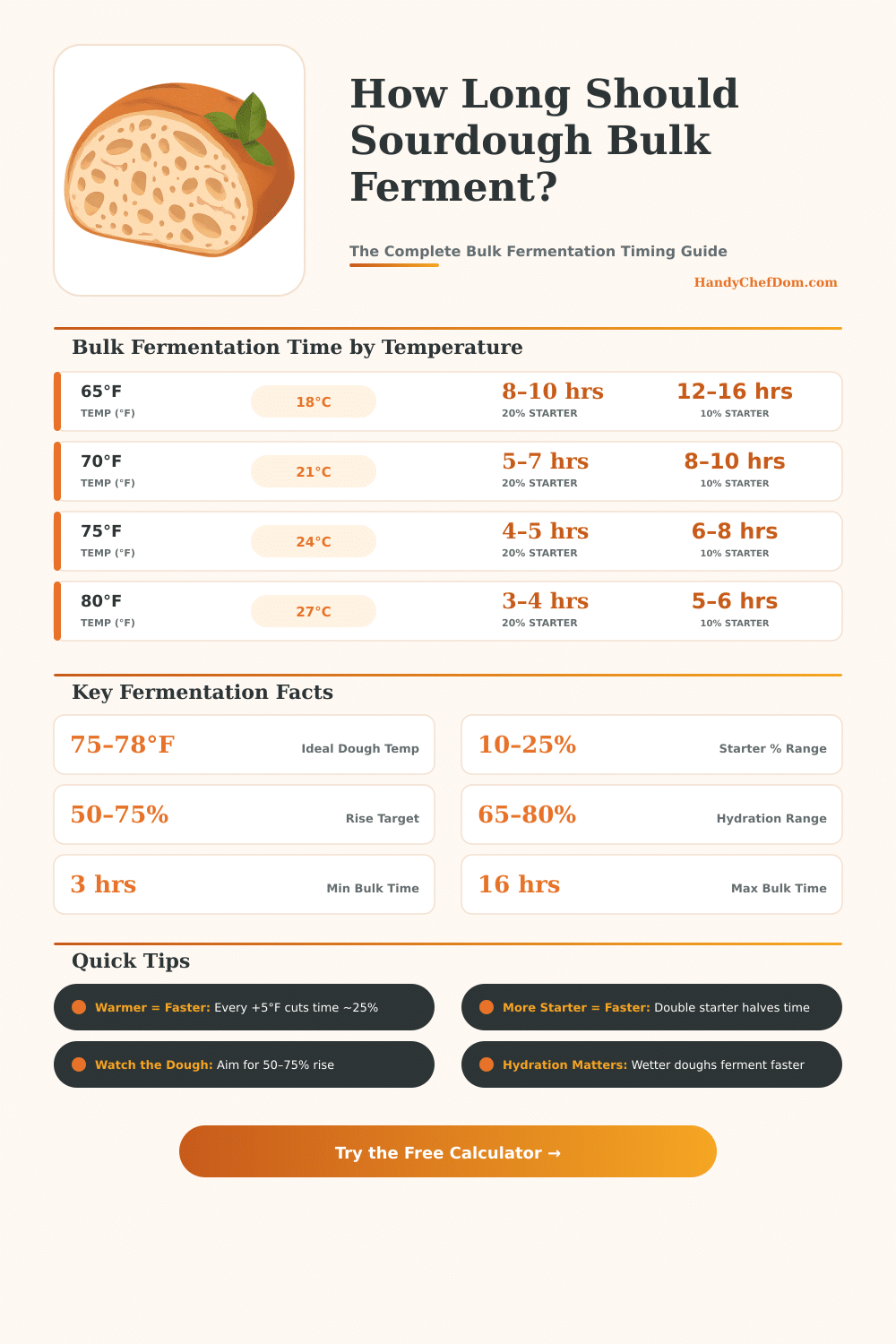
| Temp °F | Temp °C | 10% Starter | 20% Starter | 30% Starter |
|---|---|---|---|---|
| 64°F | 18°C | 12–16 hrs | 8–10 hrs | 6–8 hrs |
| 68°F | 20°C | 9–12 hrs | 6–8 hrs | 4–6 hrs |
| 72°F | 22°C | 7–9 hrs | 5–6 hrs | 3.5–5 hrs |
| 75°F | 24°C | 5–7 hrs | 4–5 hrs | 3–4 hrs |
| 78°F | 26°C | 4–6 hrs | 3–4 hrs | 2–3 hrs |
| 82°F | 28°C | 3–4 hrs | 2–3 hrs | 1.5–2 hrs |
| Flour Type | Speed Factor |
|---|---|
| White / Bread | Baseline (1.0x) |
| All-Purpose | Slightly slower (1.05x) |
| 20% Whole Wheat | Faster (0.90x) |
| 50% Whole Wheat | Faster (0.80x) |
| 100% Whole Wheat | Much faster (0.65x) |
| Rye (any %) | Very fast (0.60x) |
| Hydration | Effect |
|---|---|
| 60–65% | Slower (stiff dough) |
| 68–72% | Near baseline |
| 73–78% | Slightly faster |
| 79–85% | Noticeably faster |
| 86–90%+ | Fastest (slack dough) |
| Starter Activity | Peak Rise Time | Speed Multiplier | Bulk Impact |
|---|---|---|---|
| Vigorous | Doubles <4 hrs | 0.80x | −20% time |
| Moderate | Doubles 4–6 hrs | 1.00x | Baseline |
| Slow | Doubles 7–10 hrs | 1.30x | +30% time |
Sourdough is a kind of bread made through fermentation without help of business. Rather than the use of store-bought yeast or chemical helpers like baking-powder or baking-soda, it depends on sourdough starter to rise the dough. Sourdough starter is made up of living culture from flour and water.
That culture naturally rises the bread dough, without need of bought yeast. Various kinds of starters exist: home-made bought or received from other bakers.
What Is a Sourdough Starter and How to Make It
At its core, starter is a mix of flour, water, wild yeast, bacteria and natural acids. It rises bread and other grain products. One can easily get such starter from soil, or simply buy it or receive from a friend, to start the adventure with sourdough.
Sourdough uses natural yeast and bacteria of the lactobacillus family to rise the dough. The fermentation produces lactic acid, that tells about the flavor of the bread. This sour flavor, typical for sourdough, comes diretcly from the fermentation process.
Moreover, the same method helps the body more easily digest the protein in the bread.
To create sourdough starter, one needs both yeast and lactobacilli. Yeast is not a bacterium; it is a fungus. If one starts with yeast, the bacteria will then appear on their own.
A simple way to prepare starter is too mix whole grain flour with unsweetened pineapple juice or orange juice on the first day, then cover and leave at room temperature for 24 hours. Later, regular feedings and care keeps it active. The method with only flour and water also works sometimes, although no recipe is absolutely foolproof.
One commonly uses the 1:2:3 method for basic sourdough. It means one part of starter, two parts of water and three parts of flour, everything by weight. Salt is added at two percent of the flour weight.
For instance: 100 grams starter, 200 grams water, 300 grams flour and 6 grams salt.
Sourdough surprisingly handles mistakes. Some bakers even skip feeding the starter, kneading the dough or shaping the loaf. The dough simply mixes, rests, gets poured in a bread pan, ferments a bit and then bakes.
Like this one gets good sourdough sandwich rolls. One can also try with whole wheat, rye or other grains. Add-ins like blueberries or olives can go in.
Good sourdough has a light and airy inside, with crisp brown skin outside. Until the 19th century, sourdough was almost the only way to rise bread. People believe that it started already before 10,000 years BC.
Sourdough starter does not limit to bread (it works for muffins), crepes andcakes also.