🧂 Equilibrium Brine Calculator
Calculate the exact salt & water needed for perfectly brined meat, fish, or vegetables
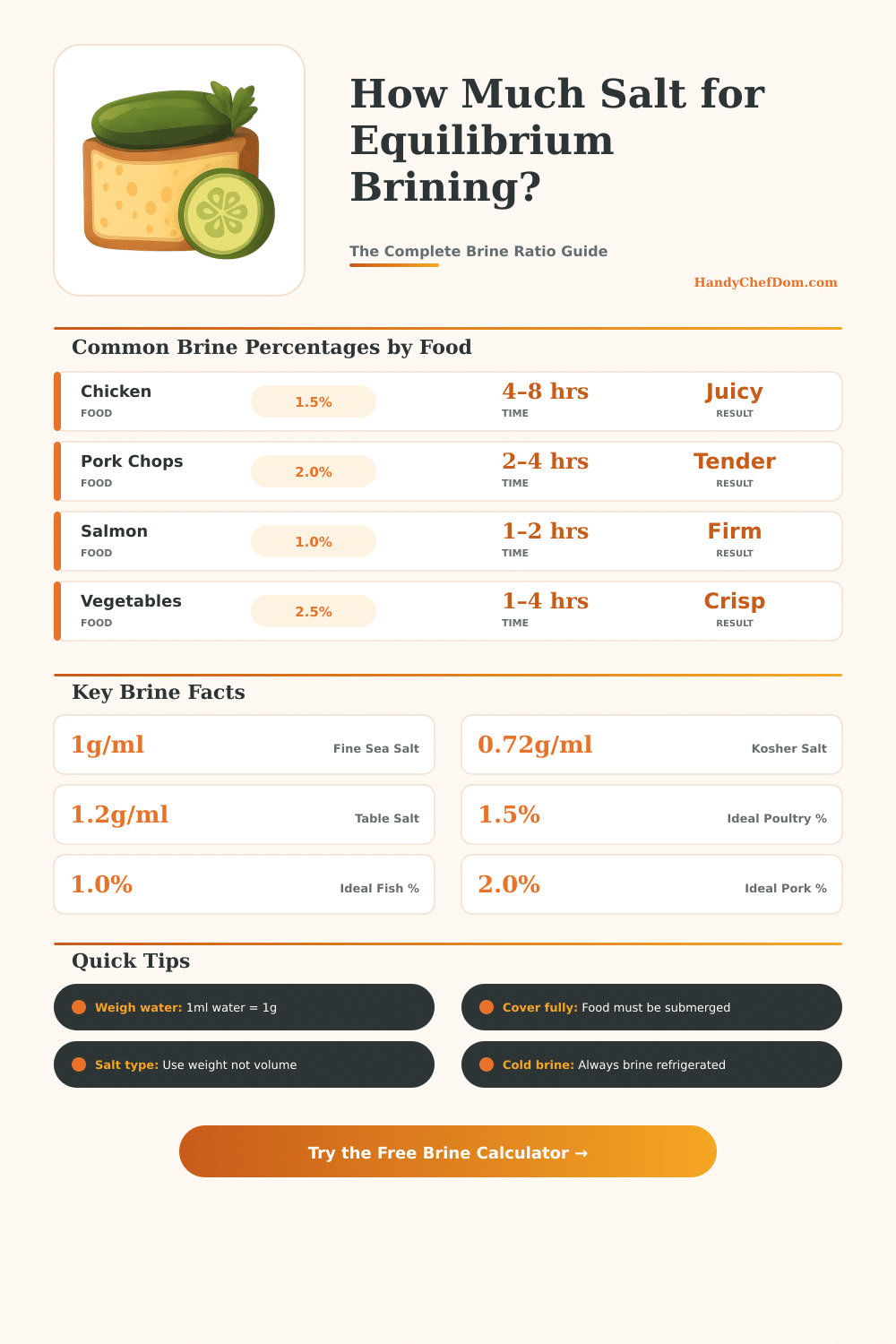
| Food Type | Salt % | Brine Time | Notes |
|---|---|---|---|
| Whole Chicken (1.5 kg) | 1.5% | 12–24 hrs | Yields juicy, evenly seasoned meat |
| Chicken Breasts | 1.2–1.5% | 4–8 hrs | Prevents drying out when grilled |
| Pork Chops (bone-in) | 2.0% | 4–8 hrs | Enhances moisture retention |
| Pork Loin / Tenderloin | 1.5–2.0% | 6–12 hrs | Great for smoking or roasting |
| Turkey Breast | 1.5% | 12–36 hrs | Use cold water for large cuts |
| Whole Turkey | 1.5% | 24–72 hrs | Scales well with correct ratio |
| Salmon / Trout | 1.0% | 1–4 hrs | Firms texture, reduces albumin |
| Shrimp / Prawns | 1.5% | 30–60 min | Improves snap and flavor |
| Beef Steak | 0.8–1.5% | 2–8 hrs | Enhances crust formation |
| Vegetables (firm) | 2.0–3.0% | 30 min–4 hrs | Great for pickles & lacto-ferments |
| Soft-Boiled Eggs | 6.0–8.0% | 4–8 hrs | For ramen-style seasoned eggs |
| Salt Type | Weight per tsp | Weight per tbsp | Weight per cup (240ml) |
|---|---|---|---|
| Table Salt | 6.0 g / 0.21 oz | 18 g / 0.63 oz | 288 g / 10.2 oz |
| Fine Sea Salt | 5.0 g / 0.18 oz | 15 g / 0.53 oz | 240 g / 8.5 oz |
| Diamond Crystal Kosher | 3.6 g / 0.13 oz | 10.8 g / 0.38 oz | 173 g / 6.1 oz |
| Morton Kosher | 4.4 g / 0.16 oz | 13.2 g / 0.47 oz | 211 g / 7.4 oz |
| Flaky Sea Salt (Maldon) | 3.0 g / 0.11 oz | 9.0 g / 0.32 oz | 144 g / 5.1 oz |
| Volume | Metric Weight | Imperial Weight | Cups |
|---|---|---|---|
| 250 ml | 250 g | 8.8 oz | 1.06 cups |
| 500 ml | 500 g | 17.6 oz / 1.1 lb | 2.11 cups |
| 1 liter | 1000 g / 1 kg | 35.3 oz / 2.2 lb | 4.23 cups |
| 2 liters | 2000 g / 2 kg | 70.5 oz / 4.4 lb | 8.45 cups |
| 1 US cup | 237 g | 8.35 oz | 1 cup |
| 1 US quart | 946 g | 33.4 oz / 2.1 lb | 4 cups |
In its core, brine simply is made up of salt settled in water (no fantasy here). The word itself comes from the old English Saxons, where “brīne” evolved to this exact idea. Simply said you see water fully packed with common salt, usually sodium chloride or calcium chloride.
The focus of salt ranges from around 3.5 % (almost like sea water) to much stronger mixes. When brine reaches full saturation, extra salt no longer dissolves, you reached the limit.
What Brine Is and How It Makes Meat Juicy
Natural brine happens in underground caves, salt lakes and naturally in the ocean itself. These sources historically gave us everyday salt, together with types like magnesium and potassium chlorides and sulphates. Practically, brine is used for meat prep to pickling.
Farmers long depend on it for treating pork legs and belly in ham or bacon.
As a cooking method, brining of meat became very popular. The main idea is easy, you dip the meat in a mix of salt and water. Here is where it becomes interesting: the salt itself breaks down teh proteins in the meat, which helps the cells hold moisture instead of losing it during cooking.
What happens? The meat shows much more soft and juicy. Moreover, you season it from inside to outside, not only dusting the surface.
It works well for birds and for big pork bits.
There are two main ways to choose. Wet brining means dipping the meat in salty bath. Dry brining, on the other hand, is made up of rubbing salt and herbs directly on the skin.
For dry brining, you cover the meat heavily with salt, then leave it bare on a rack in the fridge overnight. The surface moisture dissolves a bit of that salt, and the forming liquid soaks back into the meat.
The goal for brining is around 0.5 to 1 percent of salt in the final product. Traditional brining applies much more focused solution first, then you dip and rinse everything with pure water too remove the excess. Typical wet brine needs 6 % of salt by weight, which matches to one cup of table salt per gallon.
For fast brining (up to 14 hours), half a cup of plain kosher salt per gallon gives better ratio.
Brining does not limit to saving. It helps also for fermentation. Pickle brine, for instance, mixes salt with other liquids to ferment or preserve foods over time.
Even some hours in brine shorten the cooking time, boost the moisture and help the meat cook more evenly. You can add herbs, sugar and flavor bits, although truly it stays brine only if the salt bears the main load. Meat usually absorbs between 10 and 15 percent of its weight from brine.
Olive brine deserves its own attention, it has some real uses beyond simply being leftover liquid. It forms the secret ingredient for a good dirty martini. Goat brine gives that salty touch, that goes surprisingly with garlic, butter and herbs.
Bakers sometimes include it in the dough, onlyadjusting the salty amounts based on what the brine already added to the mix.