🧂 Lacto Fermentation Brine Calculator
Calculate exact salt & water amounts for any jar size and salt percentage
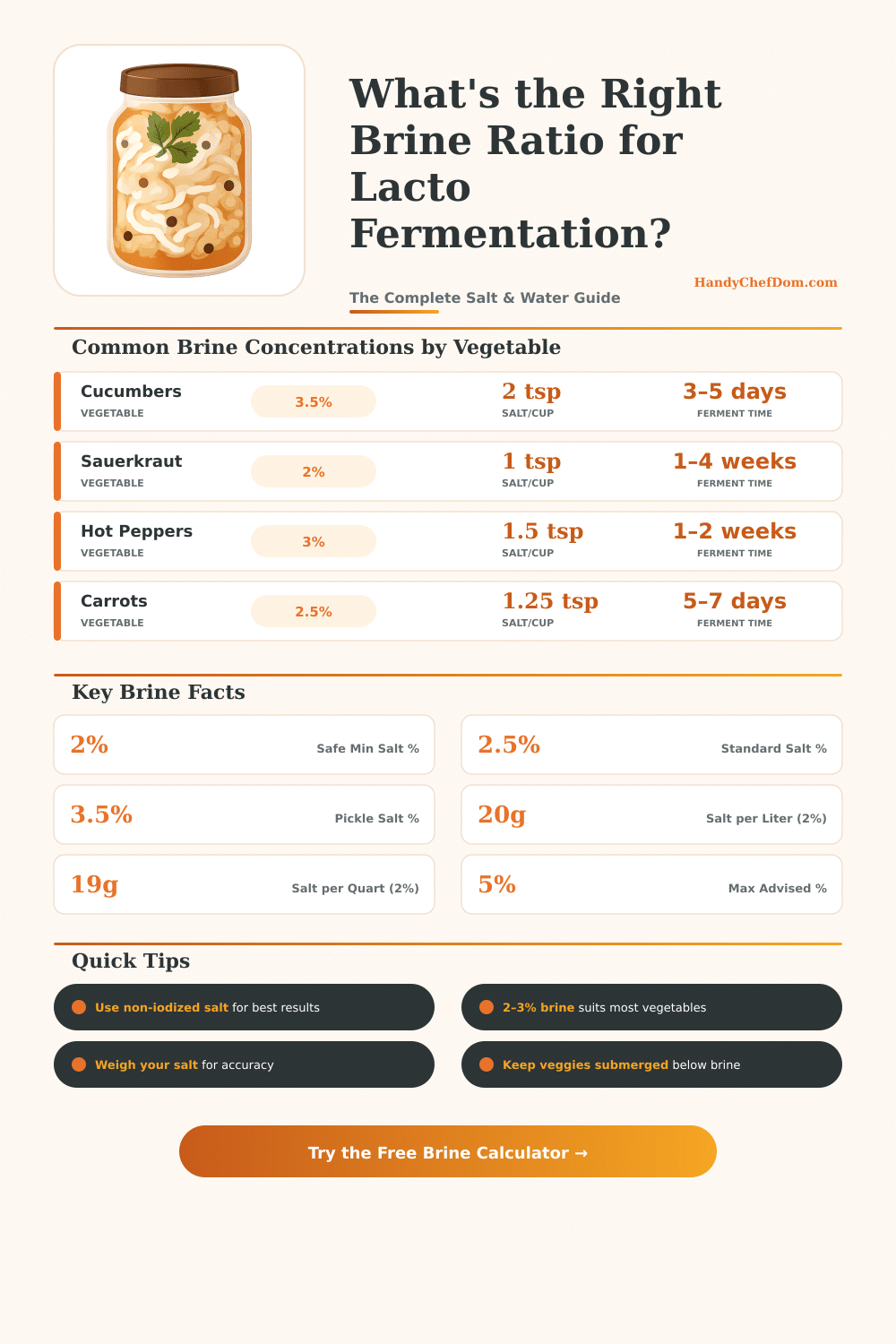
| Vegetable | Recommended Salt % | Salt per Liter (g) | Salt per Quart (tsp)* | Typical Ferment Time |
|---|---|---|---|---|
| Sauerkraut (cabbage) | 2.0% | 20g | 3.5 tsp | 1–4 weeks |
| Dill Pickles (cucumbers) | 3.5% | 35g | 6 tsp | 3–5 days |
| Kimchi | 2.0–2.5% | 20–25g | 3.5–4.5 tsp | 1–5 days |
| Fermented Hot Peppers | 3.0% | 30g | 5.25 tsp | 1–2 weeks |
| Carrots & Root Veg | 2.0–2.5% | 20–25g | 3.5–4.5 tsp | 5–7 days |
| Garlic Cloves | 3.0–3.5% | 30–35g | 5.25–6 tsp | 2–4 weeks |
| Fermented Olives | 5.0% | 50g | 8.75 tsp | 4–12 weeks |
| Radishes & Daikon | 2.0% | 20g | 3.5 tsp | 3–5 days |
| Green Beans | 2.5% | 25g | 4.5 tsp | 5–7 days |
| Beets | 2.0% | 20g | 3.5 tsp | 3–7 days |
| Salt % | Salt per 1L (g) | Salt per 1 Qt (g) | Fine Salt (tsp/L) | Use Case |
|---|---|---|---|---|
| 1.0% | 10g | 9.5g | 1.75 tsp | Very mild, fast ferments |
| 2.0% | 20g | 19g | 3.5 tsp | Sauerkraut, beets, kimchi |
| 2.5% | 25g | 23.7g | 4.4 tsp | General vegetables |
| 3.0% | 30g | 28.4g | 5.25 tsp | Peppers, garlic, firmer veg |
| 3.5% | 35g | 33.1g | 6.1 tsp | Dill pickles, cucumbers |
| 5.0% | 50g | 47.3g | 8.75 tsp | Olives, cured fish |
| Jar Size | Fluid Oz | Milliliters | Liters |
|---|---|---|---|
| Half-Pint Mason Jar | 8 fl oz | 236 ml | 0.24 L |
| Pint Mason Jar | 16 fl oz | 473 ml | 0.47 L |
| Quart Mason Jar | 32 fl oz | 946 ml | 0.95 L |
| Half-Gallon Mason Jar | 64 fl oz | 1,893 ml | 1.89 L |
| 1-Liter Jar | 33.8 fl oz | 1,000 ml | 1.0 L |
| 2-Liter Jar | 67.6 fl oz | 2,000 ml | 2.0 L |
| 1-Gallon Crock | 128 fl oz | 3,785 ml | 3.79 L |
The Fermentation process is probably the most ancient method for preserving foods, that folks used all along. What it requires? Only salt, water and vegetables.
The secret happens in the Brine that forms a zone without oxygen, where only lactobacillus bacteria can grow. It is surprising that those helpful bacteria naturally stick to every fruit and vegetable that you pick.
How to Ferment Vegetables with Salt and Brine
Here is how the whole process works. The lactobacillus culture eats the sugar that your vegetables store. While they feed on those sugars, they make lactic acid, that serves as a natural preservative.
The salt plays a big role here also, because it pulls the water from the vegetables, forming Brine that feeds the good bacteria. Here is the reason that salt for thousands of years stayed the main way to preserve foods.
Getting the salt amount exactly right truly matters. You need at least 1.5 percent salt with airless surroundings, here the lactic bacteria can live and beat the harmful ones. The best taste for fermented vegetables commonly happens in 2; 3 percent salt.
But if you go too far, problems will happen. The lactic acid bacteria handle a bit of salt, but too much slows them and very big amounts will kill them entirely. Then you will end with only salted vegetables, not truly fermented.
The kind of salt that you choose matters a lot. Regular table salt with iodine commonly clouds the Fermentation and even can destroy the bacteria that you grow. It is better to use pickling salt or sea salt.
If you prefer kosher salt, simply raise the amount by around 25 percent, because the crystals are big and less dense.
Weights for Fermentation deserve attention, because they truly are useful. Many vegetables like to float and rise above the Brine. It matters to keep everything under the liquid.
When something stays above the liquid, the whole batch looses value.
Do not poor hot water on your Fermentation batch. That would erase almost all lactobacillus bacteria that you need so that the process succeeds. Leave the Brine fully cool at first.
After blending, everything must happen at room temperature.
In Fermentation more than only lactobacillus happens. Also leuconostoc and pediococcus appear. The trouble is that bad bacteria, like E. Coli and salmonella, can survive at first in that salty and harsh setting.
So fermented foods usually stay several weeks in Brine, time decides everything. For instance sauerkraut: the natural bacteria in the cabbage do the work, turning the sugars into lactic acid. Kimchi from Korea usually ferments at room temperature during three to five days, before going in the refrigerator.
If your batch ends too salty, you can rinse it, although that removes part of the taste and nutrients. Another way is to mix the too saltyfermentation with dishes that have little salt already.