🧪 Brine Density Calculator
Calculate density, specific gravity, and salinity of your salt solution in metric or imperial units
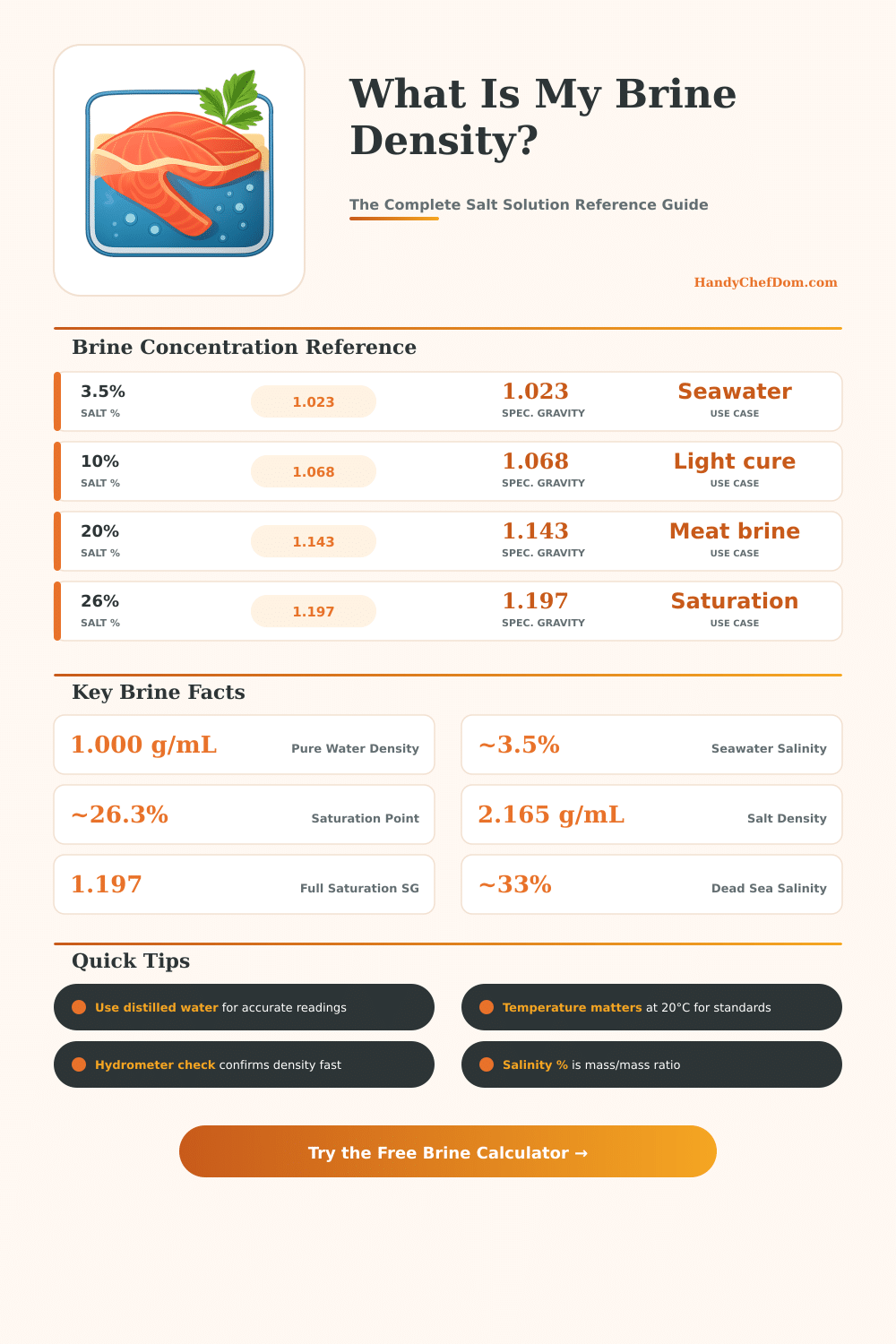
| Salt % (w/w) | Density (g/mL) | Specific Gravity | g/L Dissolved | Common Use |
|---|---|---|---|---|
| 1% | 1.0053 | 1.005 | 10.05 | Lab & medical saline |
| 2% | 1.0125 | 1.013 | 20.25 | Mild saline rinse |
| 3.5% | 1.0233 | 1.023 | 35.8 | Seawater / aquariums |
| 5% | 1.0340 | 1.034 | 51.7 | Light brine, olives |
| 6% | 1.0397 | 1.040 | 62.4 | Pickle brine |
| 8% | 1.0530 | 1.053 | 84.2 | Vegetable ferment |
| 10% | 1.0681 | 1.068 | 106.8 | General meat brine |
| 12% | 1.0816 | 1.082 | 129.8 | Corned beef brine |
| 15% | 1.1042 | 1.104 | 165.6 | Poultry cure |
| 18% | 1.1272 | 1.127 | 202.9 | Fish preservation |
| 20% | 1.1432 | 1.143 | 228.6 | Dry salt / meat cure |
| 23% | 1.1678 | 1.168 | 268.6 | Near-saturation |
| 26.3% | 1.1972 | 1.197 | 314.9 | Saturation point (20°C) |
| Temp (°C) | Temp (°F) | Water Density (g/mL) | Density Correction Factor |
|---|---|---|---|
| 0°C | 32°F | 0.9998 | +0.0002 |
| 4°C | 39°F | 1.0000 | 0.0000 |
| 10°C | 50°F | 0.9997 | –0.0003 |
| 15°C | 59°F | 0.9991 | –0.0009 |
| 20°C | 68°F | 0.9982 | –0.0018 |
| 25°C | 77°F | 0.9970 | –0.0030 |
| 30°C | 86°F | 0.9957 | –0.0043 |
| 40°C | 104°F | 0.9922 | –0.0078 |
| Measurement | Metric | Imperial Equivalent | Notes |
|---|---|---|---|
| Density | 1 g/mL | 8.345 lb/gal | Water at 4°C |
| Density | 1 g/mL | 62.43 lb/ft³ | Standard conversion |
| Density | 1 g/cm³ | 0.03613 lb/in³ | Cubic inch |
| Volume | 1 L | 33.81 fl oz | US fluid ounce |
| Volume | 1 mL | 0.0338 fl oz | Small amounts |
| Mass | 1 g | 0.0353 oz | Avoirdupois |
| Mass | 1 kg | 2.2046 lb | Standard |
| Temperature | 20°C | 68°F | Standard reference |
In the base, brine simply is water fully full of salt, no mysteries here. The word itself comes from old English, written “brīne” during long centuries. It describes water filled with usual salt, usually sodium chloride or calcium chloride, dissolved until the maximum.
For instance sea water has around 3.5 percent focus of salt, what is in the bottom limit for be considered real brine.
Brine: What It Is and How to Use It
Those salty liquids appear naturally everywhere in the world. Underground reserves, salt lakes and even ocean waters everything enters. Through history, one gathered them for average salts and other minerals, as magnesium and potassium mixes.
Its uses are many: it serves as basic preserver for meat, use in pickles and for centuries help to prepare pork belly and thigh for bacon or ham.
brine meat mean dipping it in mix of salt and water, that acts surprisingly from inwardly to outside. The salt alters the proteins, what sounds scientific, but truly it helps the cells in the meat hold more moisture. Like this one receives tender, juicy result, because the muscle fibers a bit dry under teh impact of the salt.
The ideal? Around 0.5 until 1 percentage of salt in the ready meat. After the brine, fast rinse with pure water erases the extra salt.
There is wet brine and dry brine, two different modes, both good. The wet is easy: you dip the meat in salty water bath. The dry way is another: you rub the meat well with salty spice, later leave it stripped on a rack in the refrigerator a bit of time.
Each of them gives good results.
Here the cause with marinades: without salt, they hardly get deep in the meat, especially in thick bits as big steak. Wet brines well add moisture, of course, but they no like this well build taste compared to bitter and fat marinades. Even so, brine truly works great four birds and big pork parts, whether by injection, dipping or mix of both.
For standard wet brine, consider around 6 percent salt of weight… So around one cup of table salt for gallon of water. For faster dipping until 14 hours, half cup of kosher salt for gallon works more well.
Different kinds of salt dissolve in various speeds. During the process, the meat usually absorbs between 10 and 15 percent of its weight from the brine.
Fermentation is other area, where brine plays a main role. Pickle liquids use brine, salt mixed with other liquids. For fermenting or preserving foods, pulling sugar and moisture, that later creates lactic acids protecting against bacteria.
Even olivebrine have its charm, giving salty taste to martinis and many other dishes.