🍺 Homebrew IBU Calculator
Calculate International Bitterness Units for your homebrew beer using Tinseth or Rager formula
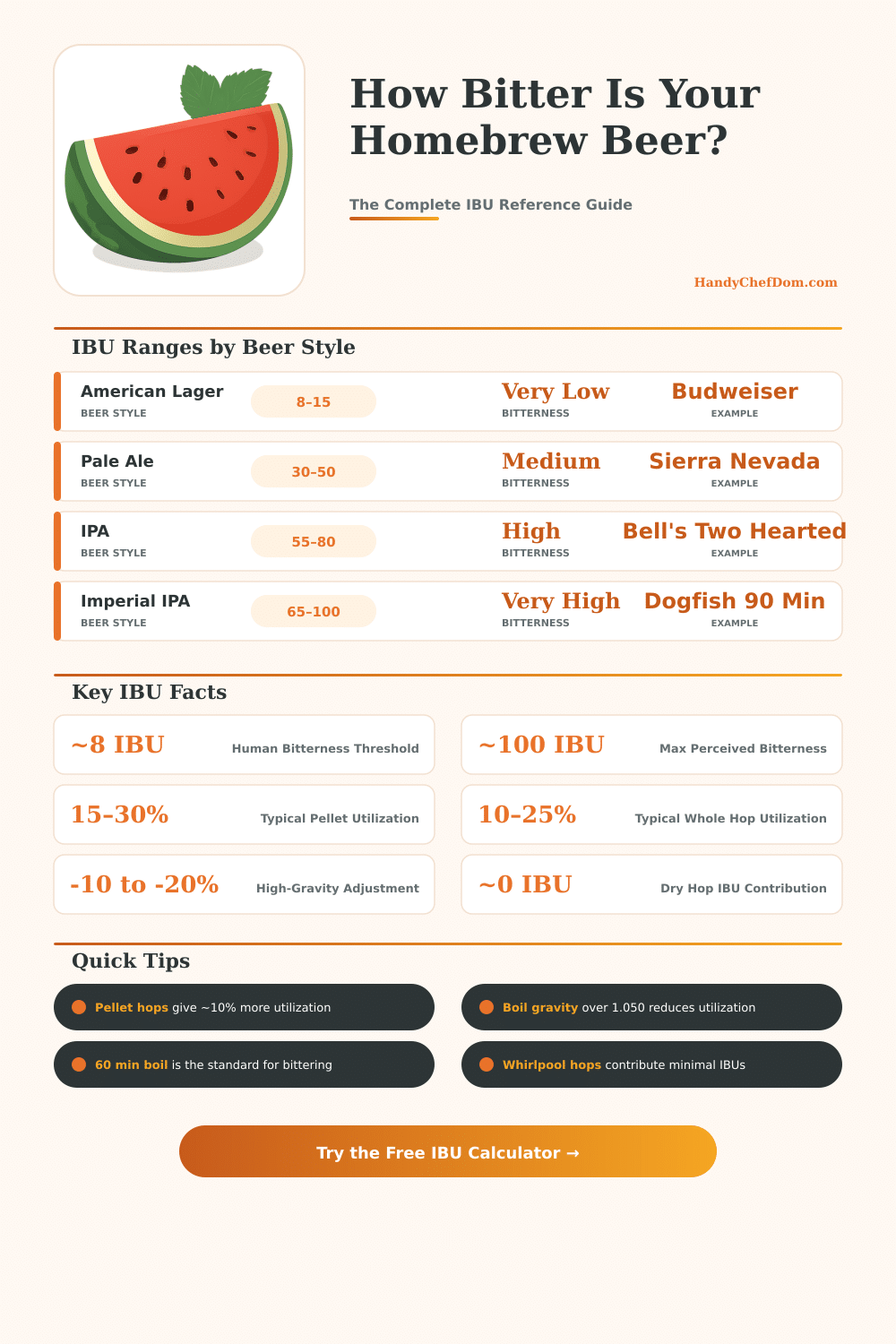
| Beer Style | IBU Range | Bitterness Level | BU:GU Ratio |
|---|---|---|---|
| American Adjunct Lager | 8–15 | Very Low | 0.15–0.30 |
| Hefeweizen / Wheat | 10–20 | Low | 0.20–0.35 |
| German Pilsner | 25–45 | Medium | 0.40–0.75 |
| Belgian Saison | 20–35 | Low–Medium | 0.30–0.55 |
| American Pale Ale | 30–50 | Medium | 0.50–0.80 |
| English Bitter / ESB | 20–40 | Medium | 0.40–0.70 |
| American IPA | 50–80 | High | 0.65–1.00 |
| West Coast IPA | 55–90 | High | 0.70–1.10 |
| New England IPA (NEIPA) | 40–70 | Medium–High | 0.55–0.85 |
| Double / Imperial IPA | 65–100 | Very High | 0.65–0.90 |
| Porter | 20–40 | Medium | 0.30–0.60 |
| American Stout | 35–70 | Medium–High | 0.45–0.80 |
| Russian Imperial Stout | 50–100 | Very High | 0.45–0.90 |
| Hop Variety | Alpha Acid % | Use |
|---|---|---|
| Cascade | 4.5–8.9% | Aroma / Dual |
| Centennial | 9.5–11.5% | Bittering / Dual |
| Chinook | 12–14% | Bittering |
| Citra | 11–13% | Aroma / Dual |
| Columbus (CTZ) | 14–18% | Bittering |
| Hallertau | 3.5–5.5% | Aroma |
| Magnum | 12–14% | Bittering |
| Mosaic | 11.5–13.5% | Aroma / Dual |
| Nugget | 12–14% | Bittering |
| Saaz | 2.5–4.5% | Aroma |
| Simcoe | 12–14% | Bittering / Dual |
| Willamette | 4–6% | Aroma |
| Boil Time | Tinseth Util. (1.050 OG) | Role |
|---|---|---|
| 0 min (Flameout) | 0–5% | Aroma only |
| 5 min | 5–8% | Aroma |
| 10 min | 8–11% | Aroma / Flavor |
| 15 min | 11–14% | Flavor |
| 20 min | 14–17% | Flavor / Bittering |
| 30 min | 18–21% | Bittering |
| 45 min | 22–25% | Bittering |
| 60 min | 24–28% | Bittering |
| 90 min | 27–30% | Bittering |
One makes beer by means of fermentation of enzymes from cereal grains… Mostly malted barley although corn, wheat, rice and oats are used also. The main process starts by mashing the grains to turn enzymes into sugar, later settling that sugar in water to form what one calls wort.
Here, one boils it (usually with hops), later adds yeast. Funny cause: in lands like Germany, one even enacted the definition of beer to ensure what counts.
How Beer Is Made and How to Enjoy It
The range here truly amazes. Pilsners, that ferment at colder temperatures by means of bottom fermenting yeast, are famous because of their clear, pure look and taste… Both in looks and in the mouth.
Also there are imperial stouts, IPAs, porters, ales, lagers, Belgian variations and barrel-aged kinds. The diffrence between truly great barrel-aged beer and simple average? It is huge.
Here the key spot about the taste. It changes. Some can fully ignore IPAs in one year, but shortly find themselves wanting them.
Even in one same style, the quality changes greatly from one beer to the next. For beers good for long session, one wants something in 4 to 5 percent of alcohol, what does not too weigh with hops ore bitterness. If you start now, English mild ales form good starting points, they are mild, malty, smooth and do not overdo with bitterness.
Same goes for Bavarian wheat beer.
None wants flat, old or expired beer. Truly, breweries with good quality control sometimes sell beers after their expiry date, and they stay fine, but fine does not match to tasty. It simply means that it has not truly failed.
Some styles age well, but that does not last forever. Later those fat acids split and start to create bad tastes and quirks in the smells, that you surely willwant to skip.
Average serving of beer is in 12 ounces, and the most many domestic kinds have around 4 to 5 percent of alcohol. In bars you find three main sizes of glass, 4, 8 and 16 ounces. A pour of 4 ounces works well for tastings, because four of them match a pint.
A pour of 8 ounces has more sense for more strong beers.
Beer is also a reliable part in cooking. It well helps in batters for frying; zucchini for example benefits. Beef stew with ale is classic, especially if one uses more dark styles like porters or chocolate browns, that shine in slow cooking.
One even can swap water with beer in bread dough, and depending on the strength of the beer, its taste shows clearly in the ready bread. Pairing with foods needs a bit of care, but the prize comes when it works.