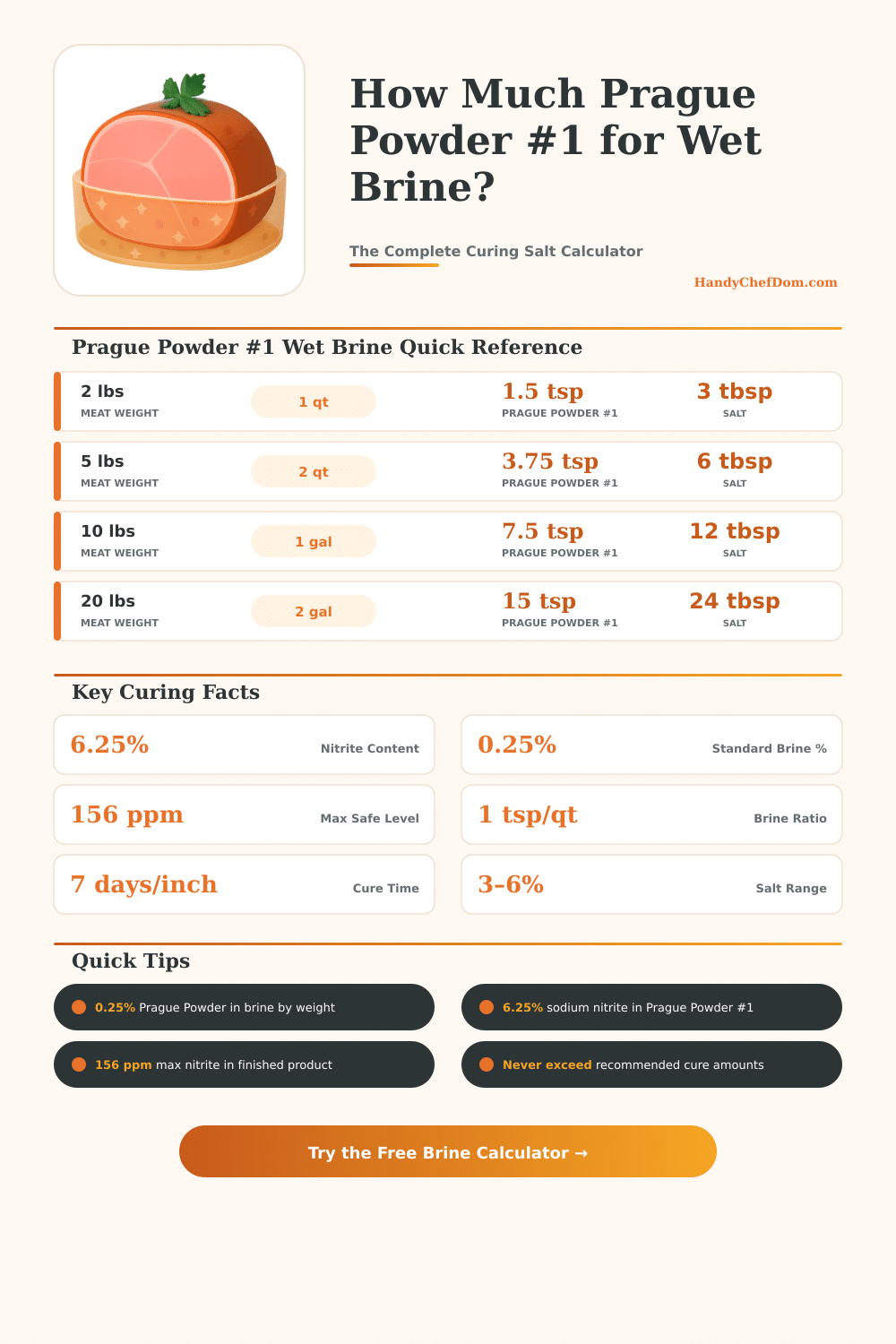
🧂 Prague Powder #1 Wet Brine Calculator
Calculate the exact amount of curing salt, kosher salt & water for a safe, precise wet cure brine
| Brine Volume | Water (oz) | Prague #1 | Kosher Salt | Est. Meat Coverage |
|---|---|---|---|---|
| 1 quart | 32 oz | 1½ tsp (8.5g) | 3 tbsp | Up to 2 lbs |
| 2 quarts | 64 oz | 3 tsp (17g) | 6 tbsp | Up to 4 lbs |
| 1 gallon | 128 oz | 6 tsp (34g) | 12 tbsp | Up to 8 lbs |
| 2 gallons | 256 oz | 12 tsp (68g) | 24 tbsp | Up to 16 lbs |
| 3 gallons | 384 oz | 18 tsp (102g) | 36 tbsp | Up to 24 lbs |
| 5 gallons | 640 oz | 30 tsp (170g) | 60 tbsp | Up to 40 lbs |
| Brine Volume | Water (ml) | Prague #1 | Kosher Salt | Est. Meat Coverage |
|---|---|---|---|---|
| 500 ml | 500 ml | 1.25g | 20g | Up to 0.5 kg |
| 1 liter | 1,000 ml | 2.5g | 40g | Up to 1 kg |
| 2 liters | 2,000 ml | 5g | 80g | Up to 2 kg |
| 4 liters | 4,000 ml | 10g | 160g | Up to 4 kg |
| 8 liters | 8,000 ml | 20g | 320g | Up to 8 kg |
| 20 liters | 20,000 ml | 50g | 800g | Up to 20 kg |
| Meat / Cut | Thickness | Brine Time | Notes |
|---|---|---|---|
| Pork Belly (Bacon) | 2–3 inches | 5–7 days | Flip daily |
| Whole Ham (bone-in) | 6–8 inches | 5–7 days/lb | Inject at bone |
| Corned Beef Brisket | 3–4 inches | 7–10 days | Flip every 2 days |
| Pork Loin | 3–4 inches | 4–6 days | Fully submerged |
| Turkey Breast | 4–5 inches | 2–3 days | Inject if >6 lb |
| Whole Chicken | 4–5 inches | 24–36 hours | Keep refrigerated |
| Duck Breast | 1–2 inches | 12–24 hours | Skin-on preferred |
| Salmon Fillet | 1 inch | 8–12 hours | Rinse well after |
| Pastrami (Navel) | 3–4 inches | 7–10 days | Same as corned beef |
| Grams | Teaspoons (approx) | Tablespoons (approx) | Ounces |
|---|---|---|---|
| 1g | 0.19 tsp | — | 0.035 oz |
| 2.5g | ½ tsp | — | 0.088 oz |
| 5g | 1 tsp | — | 0.18 oz |
| 8.5g | 1½ tsp | ½ tbsp | 0.30 oz |
| 15g | 3 tsp | 1 tbsp | 0.53 oz |
| 30g | 6 tsp | 2 tbsp | 1.06 oz |
| 100g | 20 tsp | 6.7 tbsp | 3.53 oz |
Prague Powder ranks among the most commonly available cures for meat on the market. One hears it called by several different names: Insta Cure #1, Pink Curing Salt #1 or Express Cure. What about that bright pink tone?
It is not natural. Makers mix red coloring in the blend and for that there is good reason: they want to prevent someone from mistaking this for regular cooking salt. That mix could cause serious problems, because Prague Powder absolutely does not replace table salt.
Prague Powder: Uses, Amounts, and Safety
The real makeup is quite simple. It is made up of 6.25 % sodium nitrite mixed with 93.75 % salt (sodium chloride), commonly with a bit of anti-caking agents. The salty part works as a filler…
Without it, one had to measure sodium nitrite by milligrams, what would be difficult work. Although Prague Powder contains salt, the used amount is so small, that it does not work as a replacement for salt in cooking. Both elements require separate measuring and usage according to directions.
The history of this substance goes back to 1925, when Karl Max Seiffert created it and filed a patent for his meat cure. Griffith Laboratories in Chicago took over the rights in 1934 and launched it heavily in business. An interesting fact is, that curing meat with nitrites already has centuries of tradition, that discovery simply updated the old way of preserving foods, that existed through ages.
When talking about the main use of Prague Powder #1, it works well for curing meats, sausages, fishes and dried meats. The main difference is that it works for shorter processes on stuff, that one plans too cook and eat soon after, for instance bacon, hams or corned beef. For long storage, as hard cured salami?
That is not the intended area of that product. Here comes Prague Powder #2. It contains 6.25 % sodium nitrite with 4 % sodium nitrate and 89.75 % table salt.
Over time, that nitrate changes slowly into nitrite, and when your dry cured sausage will be ready to eat, the nitrate should be entirely used up.
Getting the amount right is truly important. The usual ratio is one flat spoon for five pounds of meat, or one ounce for twenty-five pounds. One ounce equals around six spoons or two tablespoons.
One packet is enough for around hundred pounds of meat. Doses are more salty than usual table salt, so even tiny amounts count. One tablespoon itself works for five pounds of meat, that one cut in parts.
The careful strength of Prague Powder comes from its ability to block the making of botulism toxin. It stops the growth of bacteria, keeps diseases from foods and preserves the color and taste for later. Using nitrites without protection in cases like dry cured sausage, where meat sits without oxygen, is real danger.
Pure sodium nitrite in big amounts becomes poisonous, so one mixes it with salt originally. If your packet of Prague Powder looks strange or has wrong color, dump it andtake new. It costs little for safety, and risking the safety of your food simply does not pay.