🥄 Roux Ratio Calculator
Calculate the exact flour-to-fat ratio for any roux type & quantity
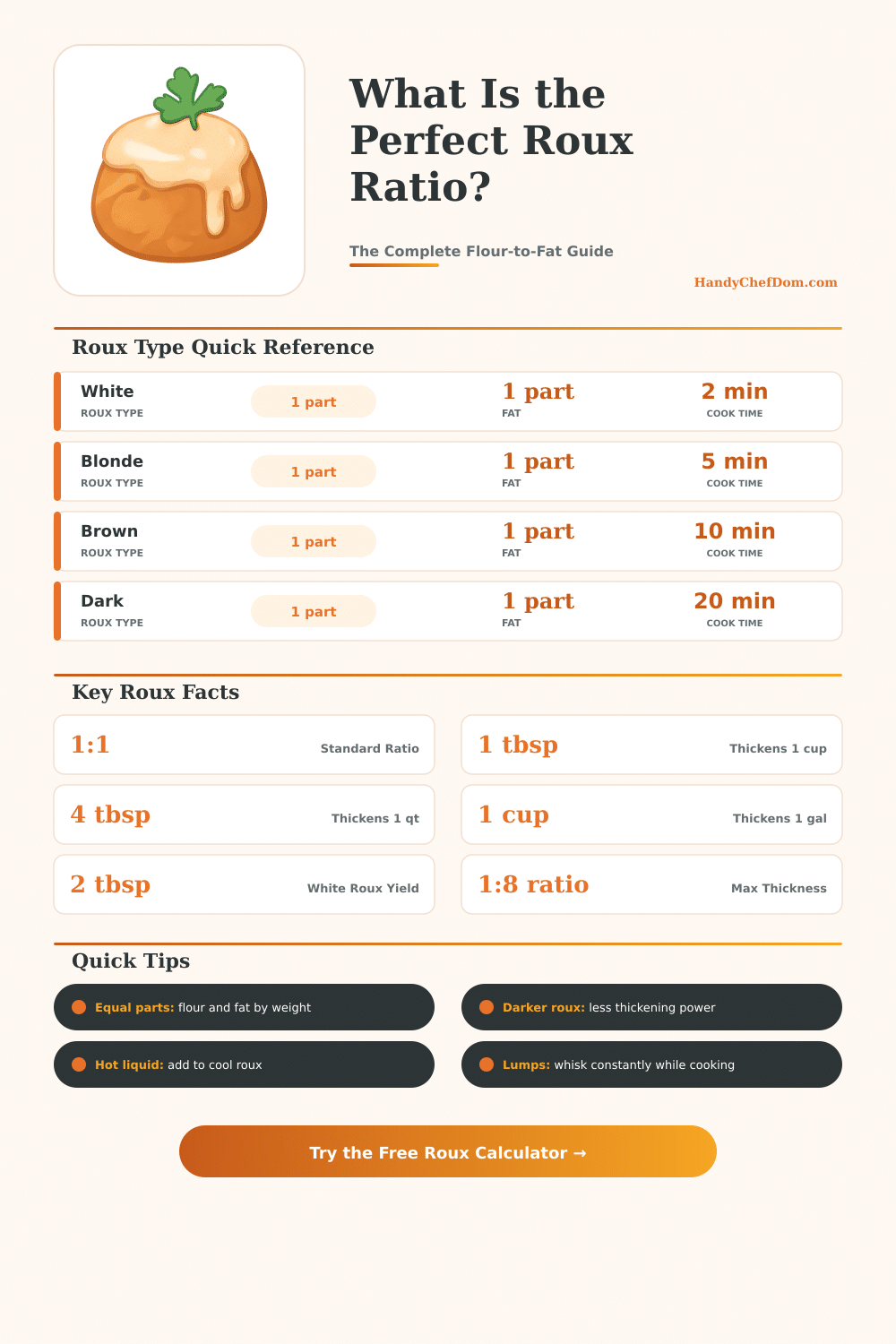
| Roux Type | Cook Time | Color | Thickening Power | Common Use |
|---|---|---|---|---|
| White Roux | 2–3 min | Pale ivory | 100% (highest) | Bechamel, Mac & Cheese |
| Blonde Roux | 5–7 min | Light tan | ~80% | Veloute, Cream soups |
| Brown Roux | 8–12 min | Nut brown | ~60% | Gravies, Espagnole |
| Dark/Black Roux | 20–45 min | Dark brown | ~30% (lowest) | Gumbo, Cajun dishes |
| Sauce Consistency | Flour (imperial) | Fat (imperial) | Flour (metric) | Fat (metric) |
|---|---|---|---|---|
| Light / Thin | 1 tsp | 1 tsp | 4g | 4g |
| Medium / Coating | 1 tbsp | 1 tbsp | 8g | 8g |
| Thick / Heavy | 2 tbsp | 2 tbsp | 16g | 16g |
| Very Thick / Paste | 3 tbsp | 3 tbsp | 24g | 24g |
| Imperial | Grams (All-Purpose) | Tablespoons | Cups |
|---|---|---|---|
| 1 tsp | 2.6g | 0.33 tbsp | 0.021 cups |
| 1 tbsp | 7.8g | 1 tbsp | 0.063 cups |
| ¼ cup | 31g | 4 tbsp | 0.25 cups |
| ½ cup | 63g | 8 tbsp | 0.5 cups |
| 1 cup | 125g | 16 tbsp | 1 cup |
| 1 oz | 28.3g | 3.63 tbsp | 0.227 cups |
| Fat Type | 1 tbsp Weight | 1 cup Weight | Notes |
|---|---|---|---|
| Butter (unsalted) | 14.2g | 227g | Most common |
| Ghee | 13.6g | 218g | Higher smoke point |
| Vegetable Oil | 13.6g | 218g | Neutral flavor |
| Lard / Bacon Fat | 12.8g | 205g | Traditional Cajun |
| Margarine | 14.2g | 227g | Same as butter |
Roux is made up of flour and fat that is cooked together. One uses it to thicken sauces, soups and stuffings. The main idea is easy: we mix equal parts of flour and fat by weight cook them together and use the result to give thicker and smooth texture to foods.
Butter commonly serves as fat, but oil, pork fat or bacon also works well.
Roux: What It Is and How to Make It
To prepare roux, one melts butter or fat in a pan. Then one adds flour and mixes until it is smooth. The mix cooks on low to medium flame, until it gets the wanted color.
This way one avoids lumps when one mixes the flour base into liquids, which is needed for gravy or creamy sauces.
Roux have various levels based on the cooking time. White roux one cooks only briefly, and it works for sauces, soups and stuffings that do not need brown color. Blond roux one uses for velouté.
Brown roux gives deeper colour and taste to dishes. In French kitchen one mostly keeps it light (white), blond or light brown, commonly with butter as fat. In southern cooking, especially in Cajun and Creole styles, one browns it much more, which adds roasted, nutty flavor too the foods.
Dark roux should have taste like brown toast but no burning. It also should smell like this. For deeper browning, oil or another pure fat like pork fat or clarified butter works better than full butter.
The milk bits in normal butter easily burn before the roux quite a lot darkens.
Making roux requires patience. Deep brown roux can take half an hour or even more, with constant stirring. If it starts to smell burned, one dumps it.
Some methods involve browning the flour in an oven instead of on a stove.
Roux forms a basic part in many traditional foods. With milk it creates béchamel, and with broth velouté. All those sauces have hundreds of variations.
Also roux adds gentle nut taste, not only thickens. It is the heart of gumbo and works well in macaroni with cheese.
Roux can be made before. It lasts well, so one can store it and use when needed. Just warm broth, add the saved roux andthe sauce comes together.
The French term roux truly points to a rust color, which hints at the brown tones that flour takes when cooked with butter.