☕ Coffee Grind Calculator
Find the ideal grind size, dose, and grind setting for any brew method and batch size
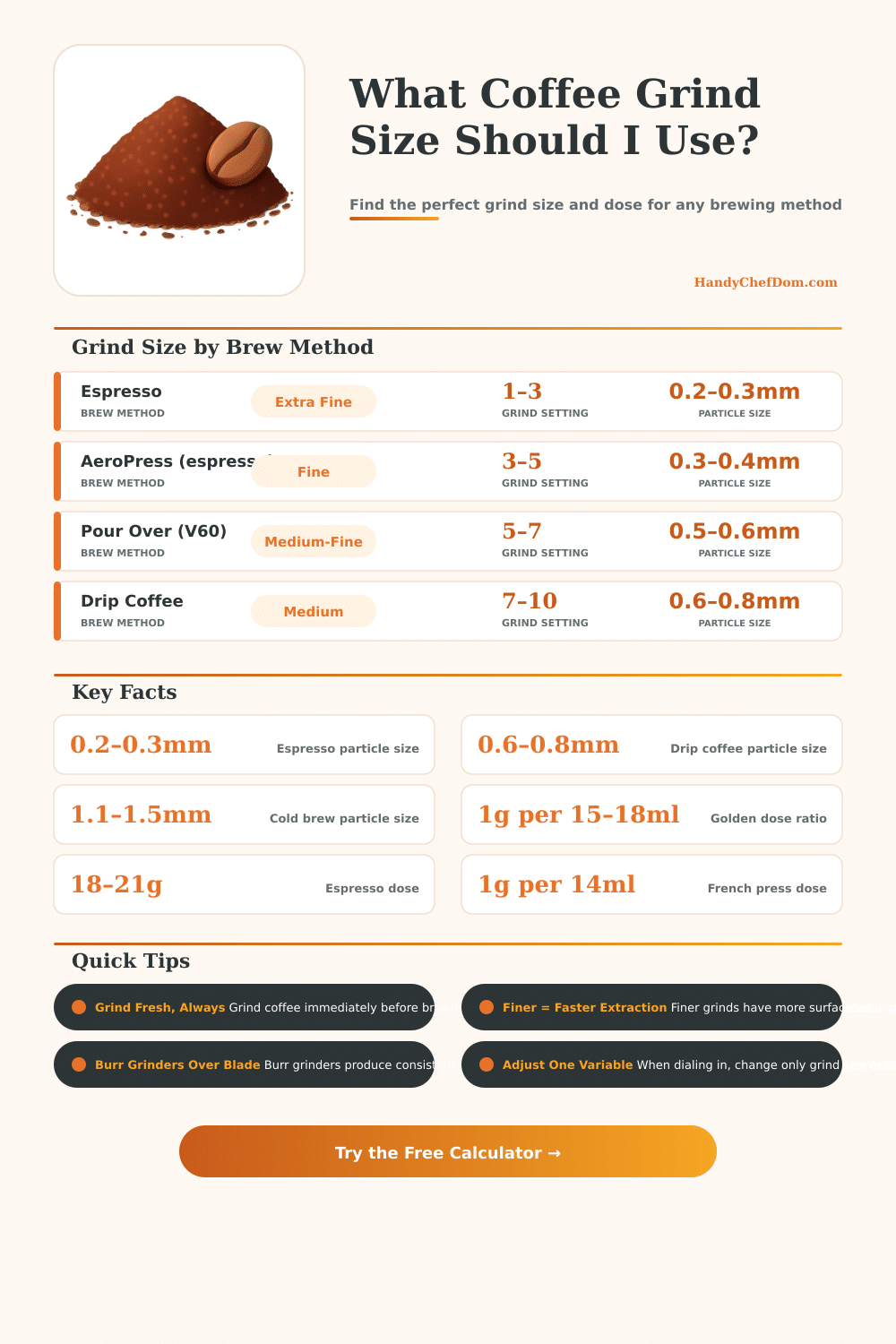
| Method | Grind Size | Setting (1–20) | Particle Size |
|---|---|---|---|
| Espresso | Extra Fine | 1–3 | 0.2–0.3mm |
| AeroPress (espresso) | Fine | 3–5 | 0.3–0.4mm |
| Pour Over (V60) | Medium-Fine | 5–7 | 0.5–0.6mm |
| Drip Coffee | Medium | 7–10 | 0.6–0.8mm |
| Chemex | Medium-Coarse | 10–13 | 0.7–0.9mm |
| French Press | Coarse | 13–16 | 0.9–1.1mm |
| Cold Brew | Extra Coarse | 16–20 | 1.1–1.5mm |
| Percolator | Coarse | 13–16 | 0.9–1.1mm |
| Method | 1 Cup | 2 Cups | 4 Cups |
|---|---|---|---|
| Espresso (double) | 18g | 36g | 72g |
| Pour Over (300ml) | 20g | 40g | 80g |
| Drip (240ml) | 16g | 32g | 64g |
| French Press (350ml) | 23g | 46g | 92g |
| Cold Brew (250ml) | 31g | 62g | 125g |
| Chemex (160ml) | 10g | 20g | 40g |
The size of the grind plays a big role in the taste of coffee. The quality of the beans, whether they are well or badly ground, affects how quickly the water passes through them. That affects the strength of the final drink.
One of the main factors that controls the speed with which water dissolves the small particles, is the size of the grind; those particles give to coffee its taste and color.
How Grind Size Affects Coffee
There are seven main levels of grind for coffee that range from very small to very big. Each of them has a different shape and size of particles. Very big grind is commonly used for French press.
Medium-big, that looks like coarse sand works well for devices like Chemex, Clever dripper or filters with flat base. Medium size most commonly applies for drip methods. Small grind dissolves more quickly and suits well for espresso.
The most small, almost powder, is used for Turkish coffee, that has a feel similar to dust; it sinks to the bottom of the cup and forms a thick deposit.
Using wrong size of grind, one risks problems. Too small grind can cause too much dissolving, what results in bitter or even burned taste. When the grind is too big, the flavor parts do not release fully during the brewing.
For instance typical pre-ground coffee in a French press commonly leads to over-extracted and bitter drink.
Espresso is especially sensitive. The machine pushes water through the coffee at very high pressure. Even a tiny change in the size of the grind can cause too much or too little dissolving, more commonly then in other ways of brewing.
If the grind for espresso is not even, the needed dissolving does not happen well during that brief process, and the shot becomes bad.
The kind of grinder is very important. Blade grinders cut the beans by means of two spinning blades, like propellers. They cost less and take less space in small kitchens.
Even so, they make particles of various sizes, what causes uneven dissolving. The rubbing of the blades creates heat, that can hurt the taste of the beans. Grind in short pauses and shaking quite a lot can help that a bit.
Burr grinders work differently. They crush the beans between two rough discs, called burrs. They pull the beans slowly through and give always even grind.
Such grinders have adjustable settings for big or small size. The best have several speeds, and lower speeds make less heat. They are more expensive, but they last more long.
Freshness is also important. As soon as the beans break, air exposure starts. Reducing the time between grinding and brewing helps to reach the most from coffee.
A mortar and pestle can serve for grind beans by means of downward turning moves, best in small batches instead of everything at once. A blender, on theother hand, does not work and can even hurt fingers.