🧂 Grams to Teaspoons Sugar Converter
Convert grams of sugar to teaspoons — granulated, brown, powdered, honey, and more with real density data
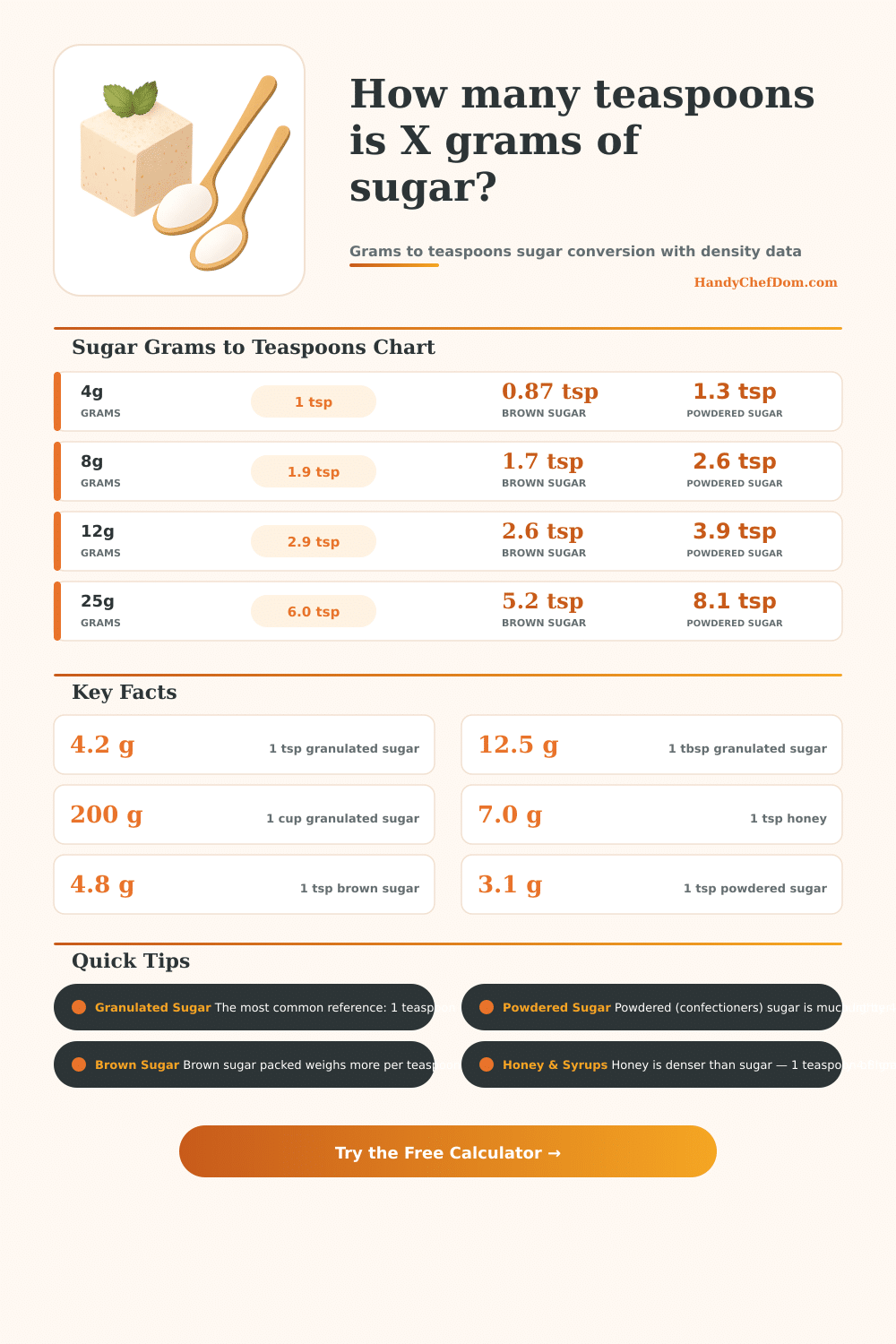
| Grams | Granulated | Brown Sugar | Powdered | Honey | Maple Syrup |
|---|---|---|---|---|---|
| 1g | 0.24 tsp | 0.21 tsp | 0.32 tsp | 0.14 tsp | 0.17 tsp |
| 4g | 0.95 tsp | 0.83 tsp | 1.29 tsp | 0.57 tsp | 0.67 tsp |
| 10g | 2.38 tsp | 2.08 tsp | 3.23 tsp | 1.43 tsp | 1.68 tsp |
| 25g | 5.95 tsp | 5.21 tsp | 8.06 tsp | 3.57 tsp | 4.20 tsp |
| 50g | 11.9 tsp | 10.42 tsp | 16.13 tsp | 7.14 tsp | 8.40 tsp |
| 100g | 23.81 tsp | 20.83 tsp | 32.26 tsp | 14.29 tsp | 16.81 tsp |
| 200g | 47.62 tsp | 41.67 tsp | 64.52 tsp | 28.57 tsp | 33.61 tsp |
| 500g | 119.0 tsp | 104.2 tsp | 161.3 tsp | 71.4 tsp | 84.0 tsp |
| Sugar Type | Density (g/ml) | g per tsp | g per tbsp | g per cup |
|---|---|---|---|---|
| Granulated White | 0.845 | 4.2 | 12.5 | 200 |
| Brown Sugar (packed) | 0.961 | 4.8 | 14.4 | 220 |
| Powdered / Confectioners | 0.620 | 3.1 | 9.3 | 120 |
| Raw / Turbinado | 0.900 | 4.5 | 13.5 | 216 |
| Honey | 1.420 | 7.0 | 21.1 | 338 |
| Maple Syrup | 1.325 | 6.6 | 19.7 | 315 |
| Coconut Sugar | 0.877 | 4.4 | 13.1 | 210 |
| Corn Syrup | 1.380 | 6.9 | 20.6 | 328 |
Sugar is made up of crystals that you get mainly from sugarcane juice and sugar beet. You find it also in sorghum juice and maple juice. It serves everywhere as ingredient, flavoring or even fermenting tool during production.
The word “sugar” covers a wide range of sugar species, that not all have same sweet taste.
All About Sugar: Types, Uses, and Health
Natural sugars are in many usual foods. Fruits store fructose, and milk carries lactose. Take apple: according to type and size it has around 11 grams of sugar.
Natural yoghurt can store up to 8 grams for one serving, but those are not added, because they come directly from the milk itself. Interesting about fructose in fruits is, that it fills the glycogen stores of your liver, which according to some rates helps sleep and repair after intensive workout.
Dried apricots are common in Middle East cooking, and here is the reason. One fresh apricot stores only around 3 grams of sugar. But take four big dried, that you consider one Ration, and suddenly you have around 21 grams.
That is a big difference.
Too much added sugar can cause serious problems: weight gain, obesity, diabetes of the second type, heart disease. The Dietary Guidelines for Americans say clearly: children under 2 years should not receive any addition. For folks of 2 years and more, added sugar should stay under 10 percent of the daily calories.
In 2000-calorie day that limits to around 48 grams. The ideal amount is around 25 grams for women and 36 grams daily for men. Here the problem: average American adult consumes around 17 spoons of added sugar daily.
That surpasses two or even three times the recomendation.
In cooking and baking you have many sugar variants, every apt for the precise sweetness in your food. You can tip it on baked goods, stir in drinks, mix in meat rubs or even on fish. Moreover exist sugar replacements or artificial sweeteners, that sweeten but have fewer calories.
The disadvantage? They can not imitate the real taste, aroma and colour, that real sugar gives during preparation.
Home making brown sugar is easy. For light brown mix spoon of molasses with cup of white sugar. For dark brown use two spoons.
There are two kinds: one, where molasses never left, and another, where you add it to white sugar. Both dissolve hardly because of the dense crystallization. The advice?
Use light or dark brown, it will not alter your recipe noticeably.
Here something, what surprises many: you think, that sugar in bread feeds the yeast. Yeast do not require it; they quite a lot eat flour on their own. Many breads entirely skip sugar.
For sugar cookies mix dry spices with dry ingredients. Zest and herbs go in the wet part. And yes, sugarcounts as wet.