🍬 Caster Sugar Measurement Converter
Convert caster sugar between cups, grams, ounces, tablespoons & teaspoons instantly
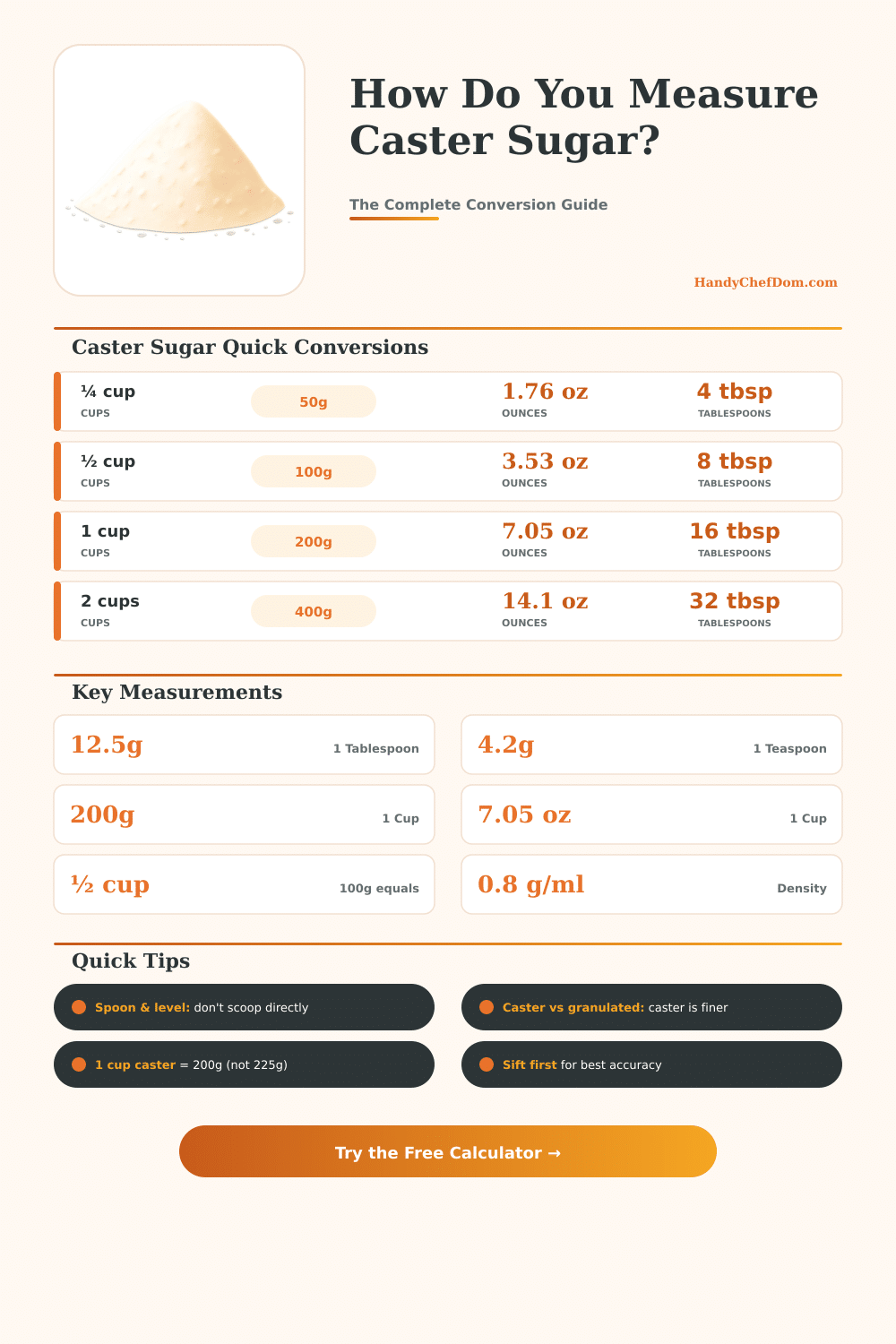
| Cups (US) | Grams (g) | Ounces (oz) | Tablespoons | Teaspoons | Milliliters |
|---|---|---|---|---|---|
| ⅛ cup | 25g | 0.88 oz | 2 tbsp | 6 tsp | 31 ml |
| ¼ cup | 50g | 1.76 oz | 4 tbsp | 12 tsp | 63 ml |
| ⅓ cup | 67g | 2.36 oz | 5.3 tbsp | 16 tsp | 83 ml |
| ½ cup | 100g | 3.53 oz | 8 tbsp | 24 tsp | 125 ml |
| ⅔ cup | 133g | 4.70 oz | 10.7 tbsp | 32 tsp | 167 ml |
| ¾ cup | 150g | 5.29 oz | 12 tbsp | 36 tsp | 188 ml |
| 1 cup | 200g | 7.05 oz | 16 tbsp | 48 tsp | 250 ml |
| 1½ cups | 300g | 10.58 oz | 24 tbsp | 72 tsp | 375 ml |
| 2 cups | 400g | 14.11 oz | 32 tbsp | 96 tsp | 500 ml |
| 3 cups | 600g | 21.16 oz | 48 tbsp | 144 tsp | 750 ml |
| 4 cups | 800g | 28.22 oz | 64 tbsp | 192 tsp | 1000 ml |
| Sugar Type | Density (g/ml) | 1 Cup Weight | Grain Size | Best Substitute |
|---|---|---|---|---|
| Caster / Superfine | 0.80 g/ml | 200g | Fine | Grind granulated |
| Granulated White | 0.85 g/ml | 200–220g | Medium | Caster sugar |
| Icing / Powdered | 0.56 g/ml | 120g | Very fine | Not interchangeable |
| Brown Sugar (packed) | 0.93 g/ml | 220g | Medium | Use same weight |
| Raw / Demerara | 0.88 g/ml | 210g | Coarse | Not recommended |
| Coconut Sugar | 0.72 g/ml | 180g | Fine–medium | 1:1 by weight |
| Measure | Volume (ml) | Grams (g) | Ounces (oz) |
|---|---|---|---|
| ¼ teaspoon | 1.25 ml | 1.0g | 0.04 oz |
| ½ teaspoon | 2.5 ml | 2.1g | 0.07 oz |
| 1 teaspoon | 5 ml | 4.2g | 0.15 oz |
| 2 teaspoons | 10 ml | 8.3g | 0.29 oz |
| 1 tablespoon | 15 ml | 12.5g | 0.44 oz |
| 2 tablespoons | 30 ml | 25g | 0.88 oz |
| 4 tablespoons | 60 ml | 50g | 1.76 oz |
| 8 tablespoons | 120 ml | 100g | 3.53 oz |
Caster sugar. Also called castor sugar or superfine sugar, has a much finer grain than regular white granulated sugar. It is made of granulated white sugar that is ground to a small crystal size.
You get something finer than table sugar but not as powdery as confectioners sugar. Other names you might find are baker’s sugar and superfine sugar. Actually, it is that funny space between granulated and powdered sugar, not quite either one.
What is caster sugar and how to use it
Because of the small crystals, caster sugar dissolves and mixes much more quickly than the regular stuff. Hence it is perfect for making nice, light desserts, like meringues or soufflés. It also sweetens drinks like tea, where the fast dissolve really matters.
The nice texture gives a silky feel in the mouth, and it mixes easily in batters, mixes and meringues without any grittiness. Those fast properties are usefull for cakes, tarts, puddings, meringues and jellies.
In Australia and United Kingdom, caster sugar always appears in baking recipes. Most American bakers know it only from watching “The Great British Bake Off”, it is not a usual ingredient in American stores.
The taste is almost identical to that of regular white granulated sugar, but the main difference is how those tiny crystals spread during preparation. At a meringue or glass of lemonade, you do not want that gritty feel, and caster sugar succeeds here. In British recipes there are two kinds: white and golden.
Golden caster sugar has a loose, sandy texture with a warm golden color, and it works great for creamed sponge cakes due to a bit richer taste.
If a recipe needs heat (for example for custard or sugar syrup); honestly it does not matter which sugar you take. Everything dissolves when you add heat. But for something like French meringue that stays raw, superfine sugar really shines, because the grains are not felt.
Exchange regular granulated sugar for caster sugar usually works well. The best way is to weigh both in grams on a kitchen scale, because they have the same density. If you measure with cups or spoons, you might need to add a bit more granulated sugar to match the recipe.
Here is the reason: crystals of caster sugar are about three times smaller, so more of them fit in the same space.
To make caster sugar at home, nothing is easier. Pass granulated sugar through a food processor, blender or spice grinder for one or two minutes until it is finely ground, but not entirely powdery like confectioners sugar. Short pulses are the best, you want to avoid over grinding and ending up with something too powdery.
Even a coffee grinder can do that quickly. Note that: if you use homemade caster sugar as a topping, it caramelizes more quickly because of a larger surface, so it browns sooner than with big crystals.