🌾 Grams to Tablespoons Flour Converter
Instantly convert any flour weight to tablespoons & teaspoons — all flour types supported
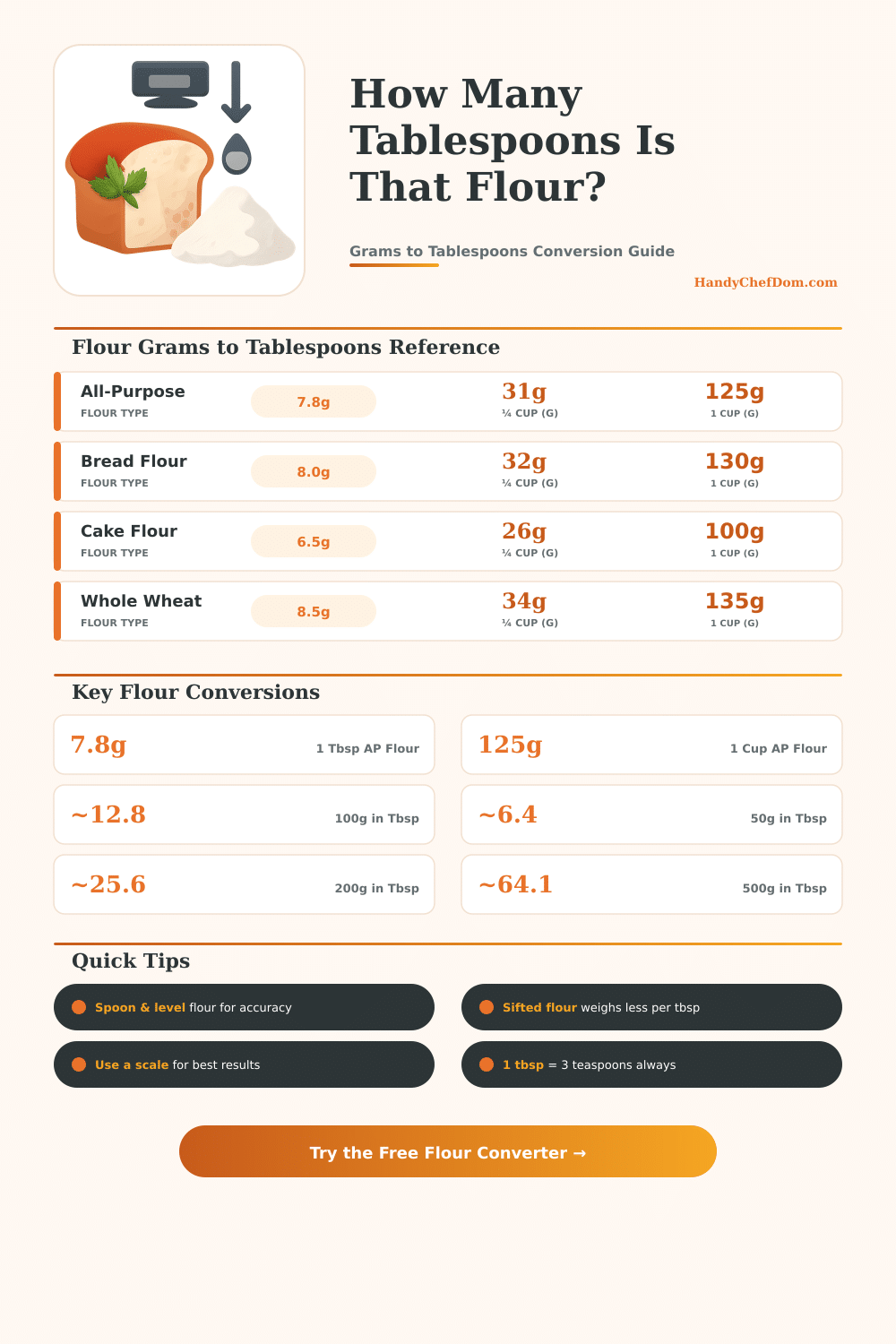
| Flour Type | 1 Tbsp (g) | 1 Tsp (g) | 1/4 Cup (g) | 1 Cup (g) |
|---|---|---|---|---|
| All-Purpose | 7.8g | 2.6g | 31g | 125g |
| Bread Flour | 8.0g | 2.7g | 32g | 130g |
| Cake Flour | 6.5g | 2.2g | 25g | 100g |
| Whole Wheat | 8.5g | 2.8g | 34g | 135g |
| Almond Flour | 7.0g | 2.3g | 28g | 112g |
| Coconut Flour | 7.5g | 2.5g | 30g | 120g |
| Rice Flour | 9.0g | 3.0g | 37g | 148g |
| Self-Rising | 7.8g | 2.6g | 31g | 125g |
| Spelt Flour | 8.0g | 2.7g | 30g | 121g |
| Oat Flour | 6.0g | 2.0g | 24g | 96g |
| Grams | Tablespoons | Teaspoons | Cups (approx) |
|---|---|---|---|
| 10g | 1.28 tbsp | 3.85 tsp | 1/16 cup |
| 25g | 3.21 tbsp | 9.62 tsp | ~1/5 cup |
| 30g | 3.85 tbsp | 11.54 tsp | 1/4 cup |
| 50g | 6.41 tbsp | 19.23 tsp | ~2/5 cup |
| 75g | 9.62 tbsp | 28.85 tsp | ~3/5 cup |
| 100g | 12.82 tbsp | 38.46 tsp | ~4/5 cup |
| 125g | 16.03 tbsp | 48.08 tsp | 1 cup |
| 150g | 19.23 tbsp | 57.69 tsp | 1.2 cups |
| 200g | 25.64 tbsp | 76.92 tsp | 1.6 cups |
| 250g | 32.05 tbsp | 96.15 tsp | 2 cups |
| 300g | 38.46 tbsp | 115.38 tsp | 2.4 cups |
| 500g | 64.10 tbsp | 192.31 tsp | 4 cups |
| Measurement | Tablespoons | Teaspoons | Milliliters |
|---|---|---|---|
| 1 Tablespoon | 1 tbsp | 3 tsp | 14.79 ml |
| 1/2 Tablespoon | 0.5 tbsp | 1.5 tsp | 7.39 ml |
| 1 Teaspoon | 0.33 tbsp | 1 tsp | 4.93 ml |
| 1/4 Cup | 4 tbsp | 12 tsp | 59.15 ml |
| 1/3 Cup | 5.33 tbsp | 16 tsp | 78.86 ml |
| 1/2 Cup | 8 tbsp | 24 tsp | 118.29 ml |
| 1 Cup | 16 tbsp | 48 tsp | 236.59 ml |
Flour is a powder that you use to make many kinds of foods, for instance baked goods. You do it grinding grains, beans, nuts, seeds, roots or vegetables with a mill. Most commonly you use cereal flours, especially from wheat, as the main ingredient for bread that belongs to the everyday meals of many populations
The most common commercial flours are milled in steel roller mills at high speeds. Those devices generate a lot of heat. They handle wheat fast and cheap, but dump the bran and germ.
All About Flour
Parts full of nutrients, oils and aroma. Other mode is stone milling, that crushes whole grains into fresh, deliciouos and nutritious flours.
There are more than eight kinds of flour, and you can make it from non-cereal grains or seeds. Flours from rice, soy, rye, pea and oats help in the making of breads, cakes and cookies, but only wheat kernel has the protein that binds the cakes and give them their structure. Bread flour is white, from hard, high-protein wheat with around 12 to 13 percent of proteins.
Pastry flour has 8 to 9 percent of protein and a bit more thick grind, so it works best for pastries.
Although wheat flour mostly carries carbs, it has also 10 to 15 percent of proteins. When you add water and mix, some proteins combine into gluten, that is sticky and elastic. It helps the mass keep bubbles like little balloons.
This is how bread rises.
If flour labels “semolina“, it is roughly ground. If “durum“, then finely ground. Whole wheat flour stores bran and germ together with the endosperm, while average white flours have only the endosperm.
A bag of 50 pounds oat flour, mixed with whole wheat and white flours, once gave the best textured cake of years.
Measuring flour by volume is inaccurate, because a cup weighs between 4 and 6 ounces according to whether you fluff it or pack it. A test with 67 percent hydration can seem wet or dry according to the brand and kind of flour.
Raw flour is not ready for eat and requires full cooking to avoid bacteria. A staying floury or raw taste in baked goods comes from too much flour, bad blending, old or bad flour, wrong type or wrong proportions in a recipe that makes the bread dry. Flour itself is not inherently bad, everything depends on its processing and amount.
Unbleached, whole grain and stone ground variants widely surpass enriched bleached flours.