⚖️ Quart to kg Converter
Convert US or UK quarts to kilograms for water, milk, oil, honey & more
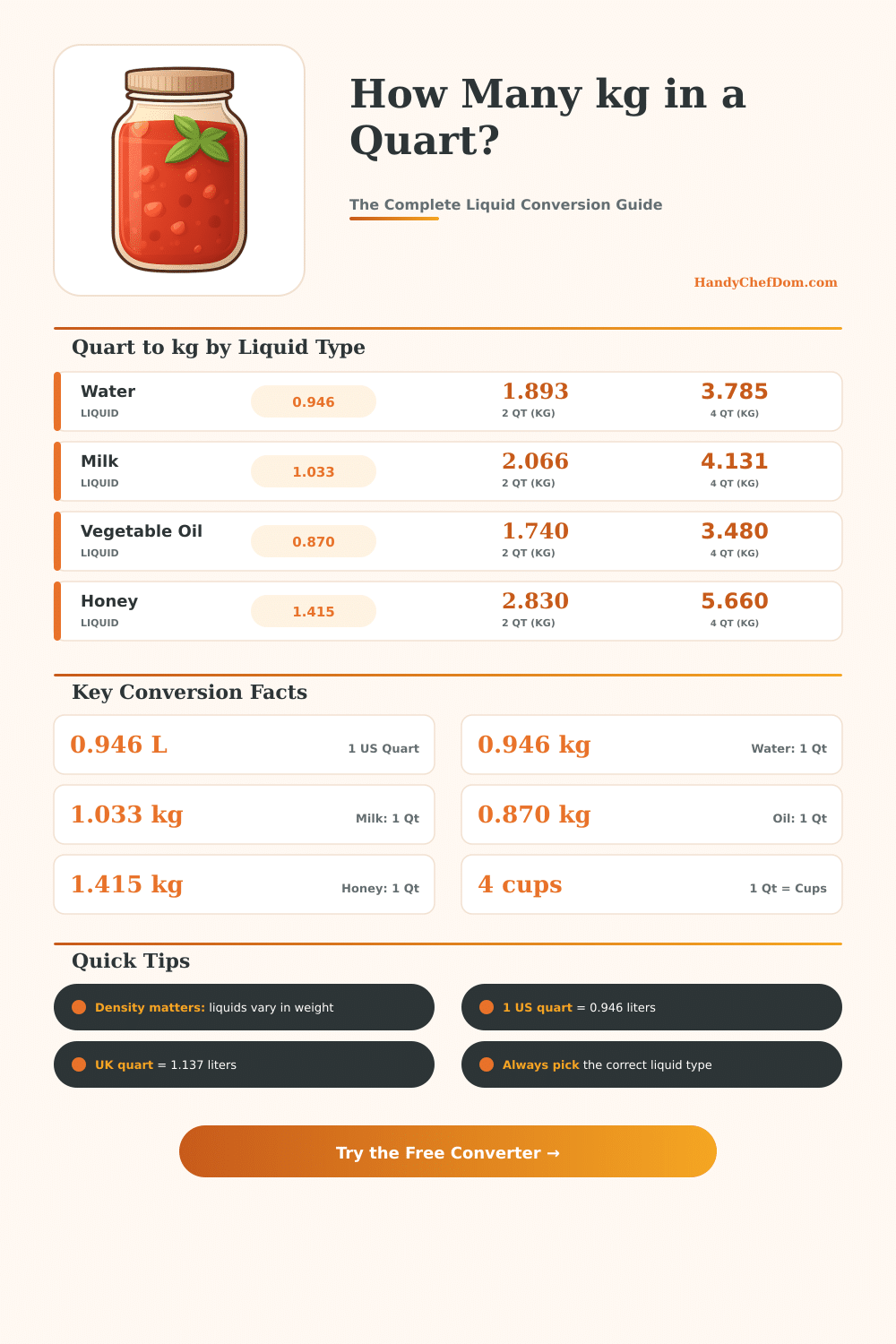
| Liquid | Density (g/ml) | 1 US Qt (kg) | 1 UK Qt (kg) |
|---|---|---|---|
| Water | 1.000 | 0.946 | 1.137 |
| Whole Milk | 1.032 | 0.976 | 1.173 |
| Skim Milk | 1.035 | 0.979 | 1.177 |
| Heavy Cream | 0.994 | 0.940 | 1.130 |
| Vegetable Oil | 0.920 | 0.870 | 1.046 |
| Olive Oil | 0.911 | 0.862 | 1.036 |
| Orange Juice | 1.045 | 0.989 | 1.188 |
| Honey | 1.420 | 1.343 | 1.615 |
| Ethanol/Alcohol | 0.789 | 0.747 | 0.897 |
| Quarts (US) | Liters | Fluid Oz | Cups |
|---|---|---|---|
| 0.25 qt | 0.237 L | 8 fl oz | 1 cup |
| 0.50 qt | 0.473 L | 16 fl oz | 2 cups |
| 1 qt | 0.946 L | 32 fl oz | 4 cups |
| 2 qt | 1.893 L | 64 fl oz | 8 cups |
| 4 qt (1 gal) | 3.785 L | 128 fl oz | 16 cups |
| 8 qt (2 gal) | 7.571 L | 256 fl oz | 32 cups |
| Measurement | US Quart | UK Imperial Quart | Difference |
|---|---|---|---|
| Volume | 946.35 ml | 1136.52 ml | +20.1% |
| Water Weight | 0.946 kg | 1.137 kg | +0.191 kg |
| Fluid Ounces | 32 fl oz | 40 fl oz | +8 fl oz |
| Pints | 2 US pints | 2 UK pints | Different sizes |
A quart is a volume unit that matches a quarter of a gallon. The word comes from the Old French “quarte” which comes from the Latin “quarta” and means “fourth part” One commonly uses the abbreviation “qt.”. Today you use three types of quarts: the liquid and dry quart from the American customary system, and the imperial quart from the British imperial system.
All are almost equal to one liter.
What Is a Quart and How to Use It in the Kitchen
In American measure one quart equals two pints, four cups or 32 fluid ounces. The imperial British quart equals 40 imperial fluid ounces. A quart also equals one-thirty-second of a bushel in dry measure.
A gram measures weight, while a quart measures volume, so you can not convert betwen them without knowing the density of the material.
In the kitchen quart measures really matter. If the serving is one cup, a quart gives four servings. For soup a bowl has around 12 ounces, a cup serving 8 ounces, and a small part for a multi-course meal is about 4 ounces.
A four-quart container holds 128 ounces, so for a stew of 10 ounces per person it feeds around 12 folks. As a side plate, three-quarters to one cup per person, 8 quarts feed 32 to 42 folks. As a main plate at 1.5 to 2 cups per person, 8 quarts provide 16 to 21 servings.
Containers and cookware of quart size are always popular. Ball wide mouth glass mason jars are 32 ounces and work well for canning, pickling, juices, jam and jelly. The Yogourmet starter packet says quart of milk, but it works well for a half gallon too.
Choosing cookware of the right quart size, you commonly must decide in the kitchen. A 6-quart size works ideally for 4 to 6 folks. A 10-quart container serves well for big meal prep, batch cooking and feeding up to 10 people.
For baking bread a 3-quart combo cooker can seem too small for a typical 500-gram flour artisan loaf, while a 4- or 5-quart Dutch oven gives more space. A 5-quart food processor bowl practically does not handle full volume of food. Some cookbooks use American measures, which saves calculations about whether a liter is smaller or bigger than a quart.
Choosing a saucier, you commonly doubt between 2-quart and 3-quart sizes. Cooking stew in a 2-quart saucepan can be very tight, to the point of causing problems with the stirrring.