🍯 Sugar Syrup Viscosity Calculator
Calculate dynamic viscosity, relative viscosity & flow characteristics from Brix or concentration
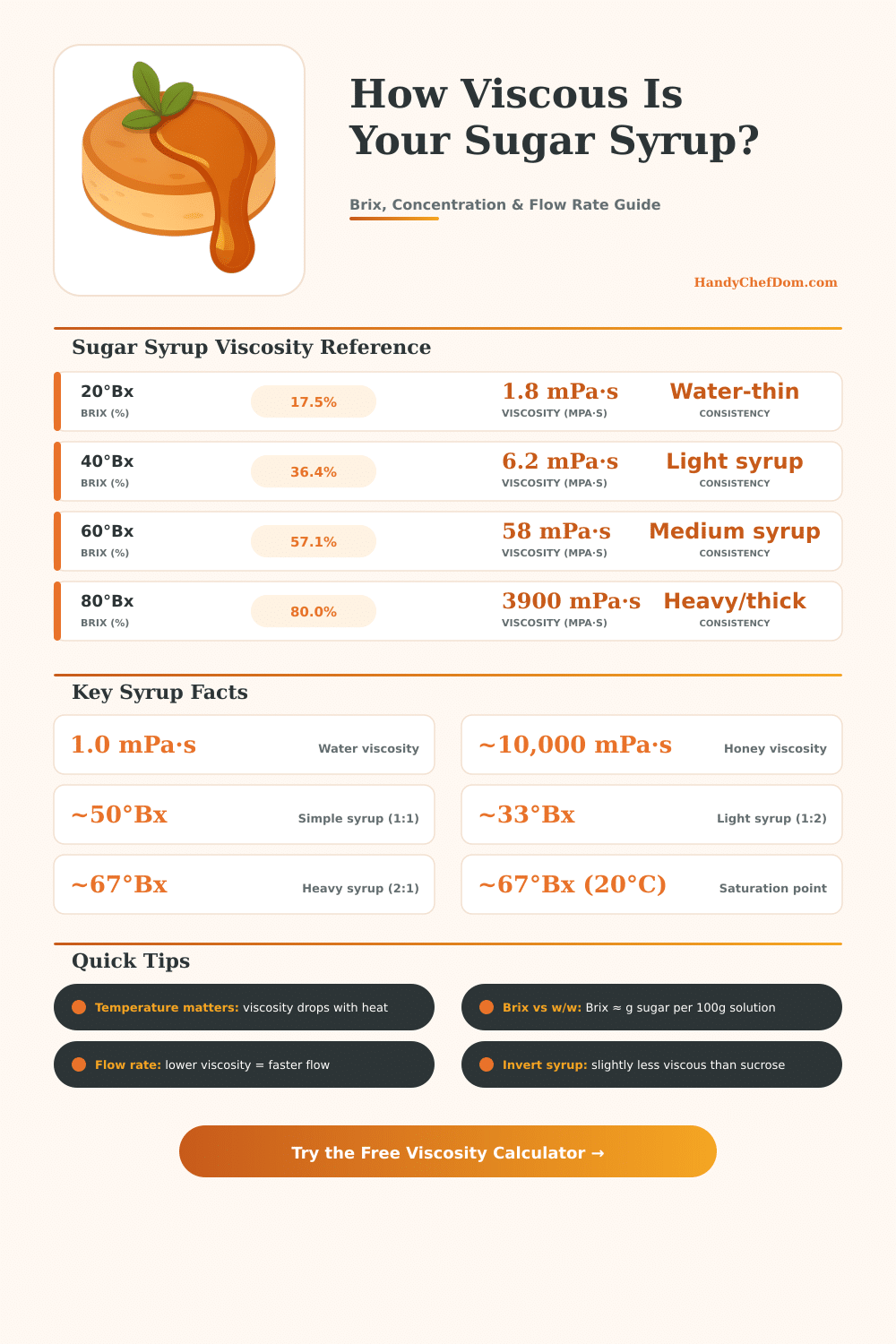
| Brix (°Bx) | % w/w | Density (g/cm³) | Dyn. Viscosity (mPa·s) | Kin. Viscosity (mm²/s) | Consistency |
|---|---|---|---|---|---|
| 0 | 0% | 0.998 | 1.00 | 1.00 | Water |
| 10 | 9.5% | 1.038 | 1.34 | 1.29 | Very thin |
| 20 | 19.1% | 1.081 | 1.80 | 1.67 | Thin |
| 30 | 28.7% | 1.126 | 2.90 | 2.58 | Light |
| 40 | 38.3% | 1.175 | 6.20 | 5.28 | Light-med. |
| 50 | 48.0% | 1.228 | 15.4 | 12.5 | Medium |
| 60 | 57.7% | 1.284 | 58.0 | 45.2 | Med-heavy |
| 65 | 62.5% | 1.314 | 130 | 99.0 | Heavy |
| 70 | 67.0% | 1.345 | 370 | 275 | Very heavy |
| 75 | 71.5% | 1.375 | 1350 | 982 | Ultra heavy |
| 80 | 76.1% | 1.407 | 3900 | 2773 | Syrup/paste |
| 85 | 80.7% | 1.437 | ~18,000 | ~12,524 | Near solid |
| Temp (°C) | Visc. (mPa·s) | Factor vs 20°C |
|---|---|---|
| 10°C | ~130 | 2.24x |
| 20°C | 58.0 | 1.00x |
| 30°C | 28.0 | 0.48x |
| 40°C | 14.5 | 0.25x |
| 50°C | 8.10 | 0.14x |
| 60°C | 4.80 | 0.083x |
| 80°C | 2.00 | 0.034x |
| Syrup Type | Visc. (mPa·s) | vs Sucrose |
|---|---|---|
| Sucrose | 58 | 1.00x |
| Invert sugar | 50 | 0.86x |
| Glucose (DE42) | 95 | 1.64x |
| Glucose (DE60) | 72 | 1.24x |
| HFCS-42 | 48 | 0.83x |
| HFCS-55 | 52 | 0.90x |
| Honey (raw) | ~2,500 | 43x |
| From | To | Multiply by | Example |
|---|---|---|---|
| mPa·s (millipascal-second) | cP (centipoise) | 1.000 | 58 mPa·s = 58 cP |
| Pa·s | mPa·s | 1000 | 0.058 Pa·s = 58 mPa·s |
| cP (centipoise) | poise (P) | 0.01 | 58 cP = 0.58 P |
| mm²/s (cSt) | ft²/s | 1.076 × 10⁻⁵ | 45 cSt = 0.000484 ft²/s |
| °Brix (Bx) | % w/w sucrose | ~0.955 | 50°Bx ≈ 47.8% w/w |
| % w/w | °Brix | ~1.047 | 50% w/w ≈ 52.4°Bx |
| g/mL density | lb/gal (US) | 8.345 | 1.284 g/mL = 10.71 lb/gal |
Sugar syrup is one of the easiest things to make in the kitchen. Just boil sugar together with water. That liquid has the same sweetness as granulated sugar.
For simple syrup you cook equal amounts of sugar and water until the mix thickens a bit. Plain granulated sugar works best and water directly from the tap. The syrup is done when no sugar crystals stay in the pot
How to Make Simple Syrup
The usual proportion for simple syrup is one cup water and one cup sugar. You can however alter it for a thikcer or thinner result. 2:1 rich sugar syrup has more sugar, while 1:1 is the standard.
Simple syrup never really thickens by boiling, to make it thick you simply use a bigger sugar proportion than water.
There is also a no-cook way. Mix equal parts of water and sugar until fully settled, then wait 10 to 15 minutes, mixing often, until the sugar dissolves and the liquid clears. Low heat helps the sugar dissolve more quickly, but you avoid boiling.
After cooling, pour it in a clean bottle and keep it in the refrigerator. If the liquid seems cloudy or forms mold, throw it away.
Simple syrup is a main ingredient for cocktails and other drinks, for instance iced coffee, because it mingles well with other liquids. Unlike granulated sugar, it does not form a gritty deposit in the glass. It is useful also for cold drinks like iced tea, where regular sugar hardly dissolves.
A cocktail recipe commonly requires half to one ounce of simple syrup.
Sugar syrup is not just for drinks. It is a perfect sweet syrup to add moisture and taste to cakes or fruitcakes. In sorbet-making it helps to reduce the formation of ice crystals.
Brown sugar syrup is another good option, simply mix water with brown sugar. Rich syrup from brown sugar and organic cane sugar brings out the cane taste, which goes well with the molasses of brown sugar to create a richer aroma.
Powdered sugar is not right for simple syrup because of its anticaking agents, texture and liquid behavior, which change the syrup. It can make the syrup too thick or gel instead of stay clear. Corn syrup and glucose both are invert sugars, so either of them works for recipes.
Agave is a good replacement for simple syrup in cocktails, because it is stable, lasts long and is usually available.
Strawberry syrup, lavender syrup, brown sugar cinnamon syrup and blackberry syrup are fun varieties to tryathome.