🧂 Pasta Salt Calculator
Calculate exactly how much salt to add to your pasta water for perfect seasoning every time
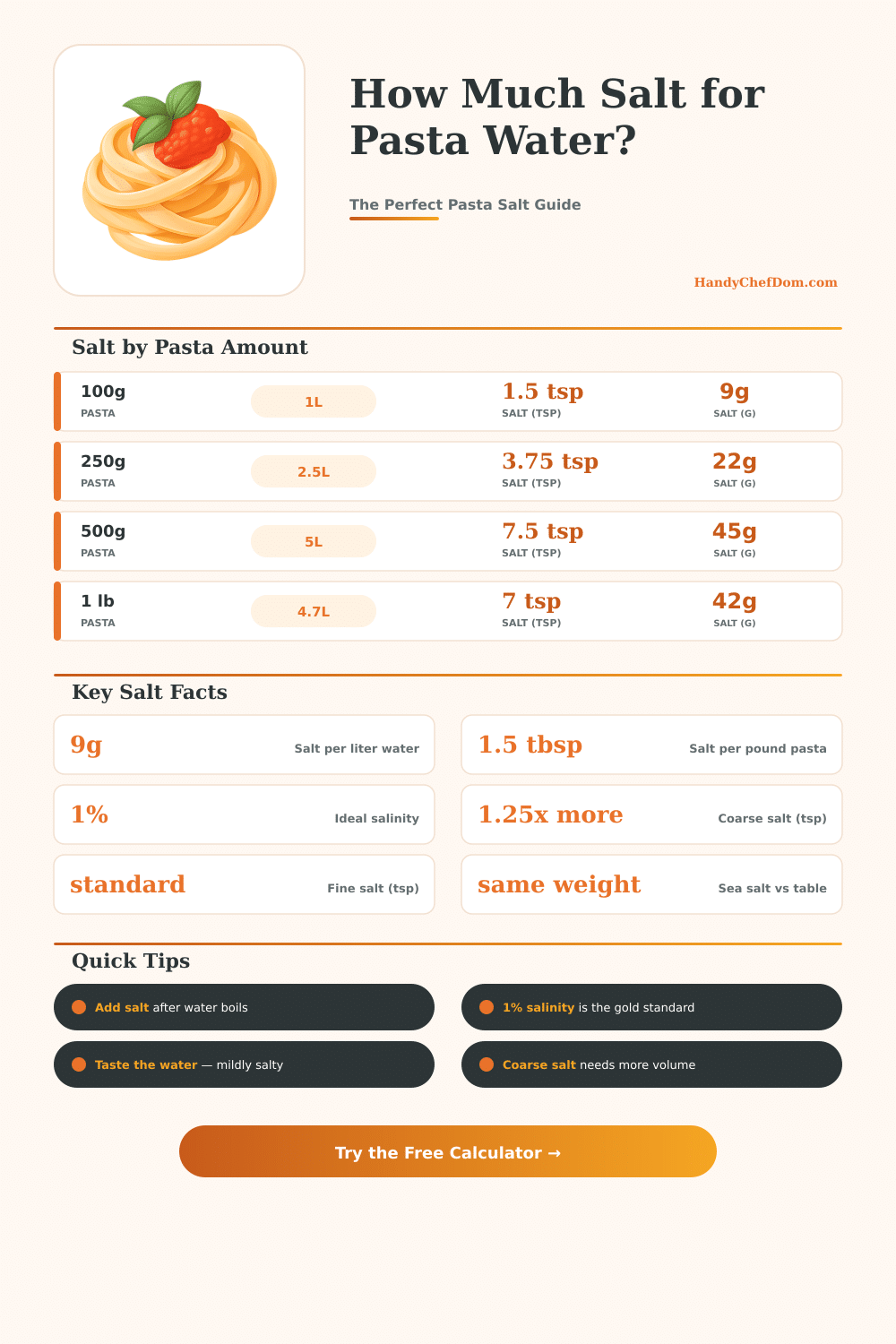
| Pasta (g) | Pasta (oz) | Water Needed | Fine Salt (g) | Fine Salt (tsp) | Coarse Salt (tbsp) |
|---|---|---|---|---|---|
| 100g | 3.5 oz | 1 L / 4.2 cups | 9g | 1.5 tsp | 0.7 tbsp |
| 200g | 7 oz | 2 L / 8.5 cups | 18g | 3 tsp | 1.4 tbsp |
| 250g | 8.8 oz | 2.5 L / 10.6 cups | 22.5g | 3.75 tsp | 1.75 tbsp |
| 300g | 10.6 oz | 3 L / 12.7 cups | 27g | 4.5 tsp | 2.1 tbsp |
| 400g | 14 oz | 4 L / 16.9 cups | 36g | 6 tsp | 2.8 tbsp |
| 500g | 17.6 oz | 5 L / 21.1 cups | 45g | 7.5 tsp | 3.5 tbsp |
| 750g | 26.5 oz | 7.5 L / 31.7 cups | 67.5g | 11.25 tsp | 5.25 tbsp |
| 1000g | 35.3 oz | 10 L / 42.3 cups | 90g | 15 tsp | 7 tbsp |
per 1g
per 1g
per 1g
per 1g
| Salinity % | Style | Salt per Liter Water | Best For |
|---|---|---|---|
| 0.8% | Mild | 8g / 1.3 tsp | Low-sodium diets, delicate sauces |
| 1.0% | Standard | 10g / 1.7 tsp | Most pasta dishes, everyday cooking |
| 1.2% | Bold | 12g / 2 tsp | Unsauced pasta, aglio e olio |
| 1.5% | Italian | 15g / 2.5 tsp | Traditional Italian, heavily sauced dishes |
| Pasta Amount | Min Water | Recommended Water | Servings (approx) |
|---|---|---|---|
| 100g / 3.5 oz | 0.75 L | 1 L / 4.2 cups | 1 serving |
| 200g / 7 oz | 1.5 L | 2 L / 8.5 cups | 2 servings |
| 350g / 12 oz | 2.5 L | 3.5 L / 14.8 cups | 3–4 servings |
| 500g / 17.6 oz | 4 L | 5 L / 21.1 cups | 4–5 servings |
| 1 lb / 454g | 3.5 L | 4.5 L / 19 cups | 4–6 servings |
| 1 kg / 2.2 lb | 8 L | 10 L / 42 cups | 9–11 servings |
Pasta salt is one of those things that seems simple but genuinely has big importance Add salt in the water before adding the noodles is a first step for reaching maximum taste during cooking, even before adding the sauce. Enough salt penetrates the noodles inside while they absorb the liquid and grow. Because of that, the ready dish commonly requires less extra salt.
Traditional pasta doughs usually do not have salt. Hence it matters to add it in the cooking water. The salt brings out the taste of the pasta and the durum wheat.
Salt Pasta Water Before Cooking
Without it, the noodles end up bland and tasteless, no matter how good the sauce is. The ready pasta should taste well on its own, without additional spices. Too salty sauce does not reach the same as well salted watre.
The ideal moment for salting the water is when it starts to boil. Adding the noodles in already salted water gives equally seasoned results. Waiting until full boiling helps the salt dissolve more quickly and saves the pot.
In cold water the salt easily sinks below and can cause too much salt. Adding salt after draining the noodles is a bad idea. It will not divide evenly, so separate parts will stay bland or too salty.
About the amount, one and half tablespoons for every pound of pasta form a good base. According to some, the best ratio is one gallon water against four teaspoons salt. You can adapt upward or down according to your taste.
Some dishes require less, for instance for carbonara or alike: reduce to two teaspoons works better.
One commonly says that pasta water should taste like the sea. But seawater has around 3.5% salt by weight, which is too much. Pasta water should not reach that.
A better comparison is that it should taste like tears.
The kind of salt has little role. In the ready pasta you hardly notice a difference according to the used salt. The main thing is using enough of it.
Scientific viewpoint shows that salt a bit raises the boiling point of water, but one tablespoon in five quarts only adds a tiny bit of a degree Fahrenheit. The impact stays minimal.
If too much salt ends up in the noodles or sauce, it is not possible to remove it. You must only dilute by adding more of everything else. Cooking pasta should be one of the simplest steps in preparing dinner, and right salting makesalld the difference.