🍁 Maple Syrup Brix Calculator
Calculate sugar content, water percentage, density & grade from your refractometer reading
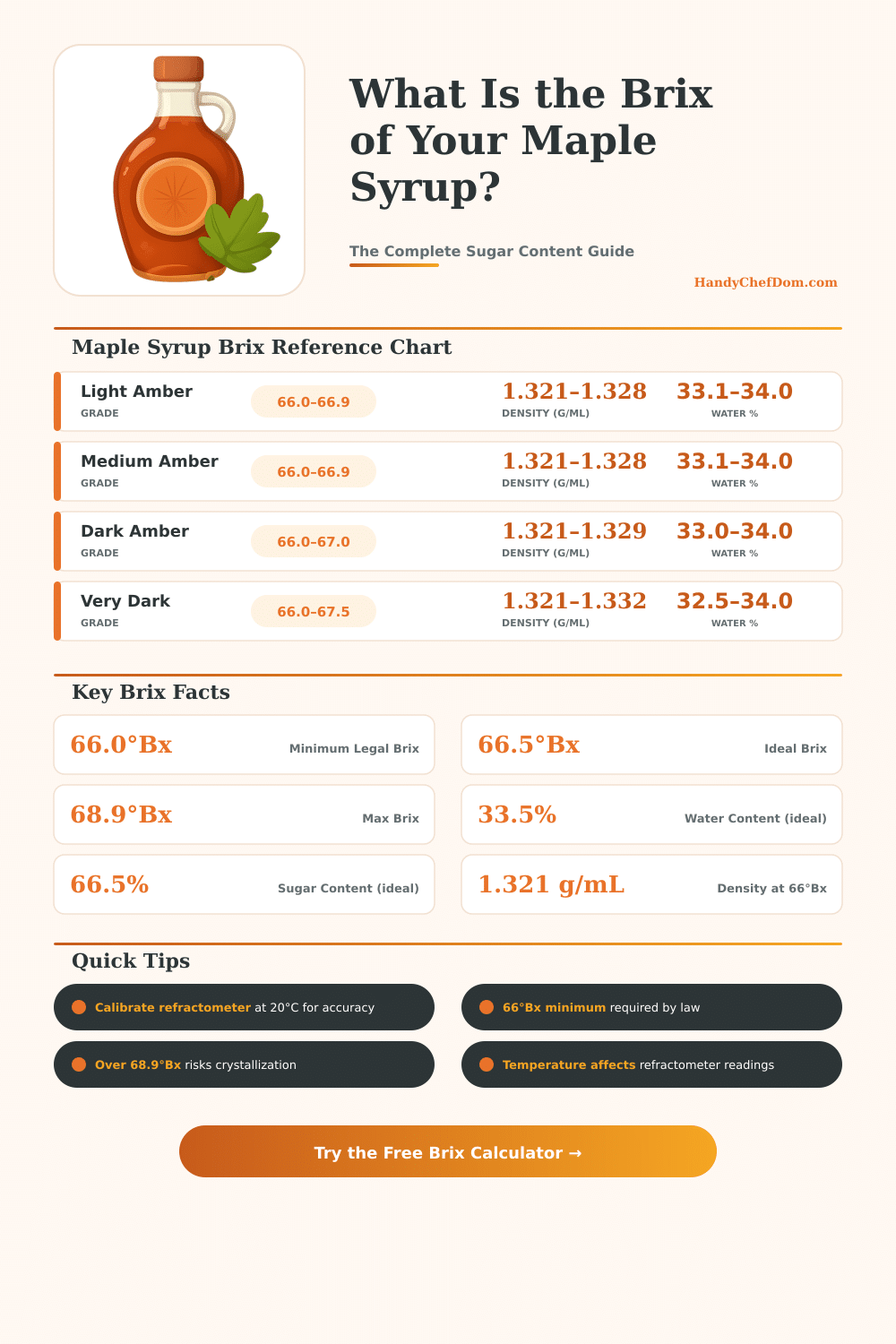
| Brix (°Bx) | Sugar % (w/w) | Water % | Density (g/mL) | Status |
|---|---|---|---|---|
| Below 60 | < 60% | > 40% | < 1.290 | ⚠ Way too thin |
| 60.0 – 62.9 | 60–63% | 37–40% | 1.290–1.300 | ⚠ Too thin |
| 63.0 – 65.9 | 63–66% | 34–37% | 1.300–1.318 | ⚠ Under-boiled |
| 66.0 – 66.9 | 66–67% | 33–34% | 1.321–1.328 | ✅ Legal minimum |
| 66.5 – 67.5 | 66.5–67.5% | 32.5–33.5% | 1.325–1.332 | ✅ Ideal range |
| 67.6 – 68.9 | 67.6–69% | 31–32.4% | 1.333–1.340 | ⚠ Acceptable (thick) |
| 69.0 – 70.9 | 69–71% | 29–31% | 1.341–1.352 | ⚠ Risk of crystallization |
| Above 71 | > 71% | < 29% | > 1.352 | ❌ Will crystallize |
| Sample Temp (°C) | Sample Temp (°F) | Correction (°Bx) | Corrected at 20°C |
|---|---|---|---|
| 10°C | 50°F | –0.58 | Subtract 0.58 |
| 15°C | 59°F | –0.27 | Subtract 0.27 |
| 20°C | 68°F | 0.00 | No correction |
| 25°C | 77°F | +0.33 | Add 0.33 |
| 30°C | 86°F | +0.71 | Add 0.71 |
| 35°C | 95°F | +1.13 | Add 1.13 |
| 40°C | 104°F | +1.58 | Add 1.58 |
| 50°C | 122°F | +2.57 | Add 2.57 |
| Grade (US/Canada) | Color Class | Brix Range | Flavor Profile |
|---|---|---|---|
| Grade A | Golden / Delicate | 66.0 – 68.9°Bx | Delicate, mild |
| Grade A | Amber / Rich | 66.0 – 68.9°Bx | Rich maple taste |
| Grade A | Dark / Robust | 66.0 – 68.9°Bx | Strong maple flavor |
| Grade A | Very Dark / Strong | 66.0 – 68.9°Bx | Very strong, bold |
| Processing Grade | N/A | 66.0°Bx+ | Commercial/industrial use |
| Below Standard | N/A | Below 66.0°Bx | Not legally maple syrup |
| Brix (°Bx) | Density (g/mL) | 1 L weight (g) | 1 gallon weight (lb) |
|---|---|---|---|
| 64.0 | 1.308 | 1308 g | 10.91 lb |
| 65.0 | 1.314 | 1314 g | 10.96 lb |
| 66.0 | 1.321 | 1321 g | 11.02 lb |
| 66.5 | 1.325 | 1325 g | 11.05 lb |
| 67.0 | 1.328 | 1328 g | 11.08 lb |
| 67.5 | 1.332 | 1332 g | 11.11 lb |
| 68.0 | 1.335 | 1335 g | 11.14 lb |
| 69.0 | 1.342 | 1342 g | 11.20 lb |
Maple syrup is sweet liquid from the juice of maple trees. In cold regions all trees store starch in their roots and trunks before the winter. That starch later turns into sugar, that builds in the juice during the end of winter and start of spring One prepares pure syrup by using the a bit sweet juice of sugar maple.
To make it, you need some such trees and a way to turn the juice into syrup.
How Maple Syrup Is Made and Used
Maple syrup can come also from black maple trees. Compared with other natural sweeteners, you consider it better than white sugar because of the high amount of phenols and minerals. It is made up of 50 to 75 percent sucrose, together with glucose, fructose and water.
The syrup is full of manganese and riboflavin, and it has antioxidants. One serving of 60 ml gives 72 percent of the daily need of manganese, 27 percent of riboflavin, 17 percent of copper and 6 percent of calcium.
Only Grade A maple syrup is available for consumers. That guarantees that you got it only by means of boiling maple sap, without clouds, fermentation or deposits, with uniform colour and without unpleasant smell or taste. Authentic syrup is 100 percent juice from sugar maple, unlike pancake versions, that mix it with cane sugar.
Many products in stores are only corn syrup with high fructose and maple flavor.
Maple syrup has rich, very sweet taste, almost as if mix of liquid candy and butterscotch. Thin syrups seem purer and less sticky in the mouth, slip down much more easily than thick. Thanks to its warm smell, it works well as a replacement for sugar in some baked goods.
In whipped cream or meringue it overpowers the simple sweeten.
It perfectly goes with breakfasts as pancakes, waffles and French toast. Jalapeño with maple syrup surprisingly agrees. Also cinnamon matches well.
You can pour it on oats with pecans or use as glaze for roasted sweet potatoes, carrots and squash. As marinade it shines in steaks and eggs for brunch, simply with olive oil, balsamic, salt, pepper and garlic. Substituting sugar in eggnog, it creates more complex taste.
You use it in soups as squash soup or apple soup, or mix in iced coffee, because liquid dissolves more easily than crystals.
Vermont rules the production of maple syrup in the whole land. It stays minimally processed food, prepared according to the same method for centuries.