🥐 Croissant Lamination Calculator
Calculate exact layer counts, butter ratios & fold sequences for perfect laminated dough
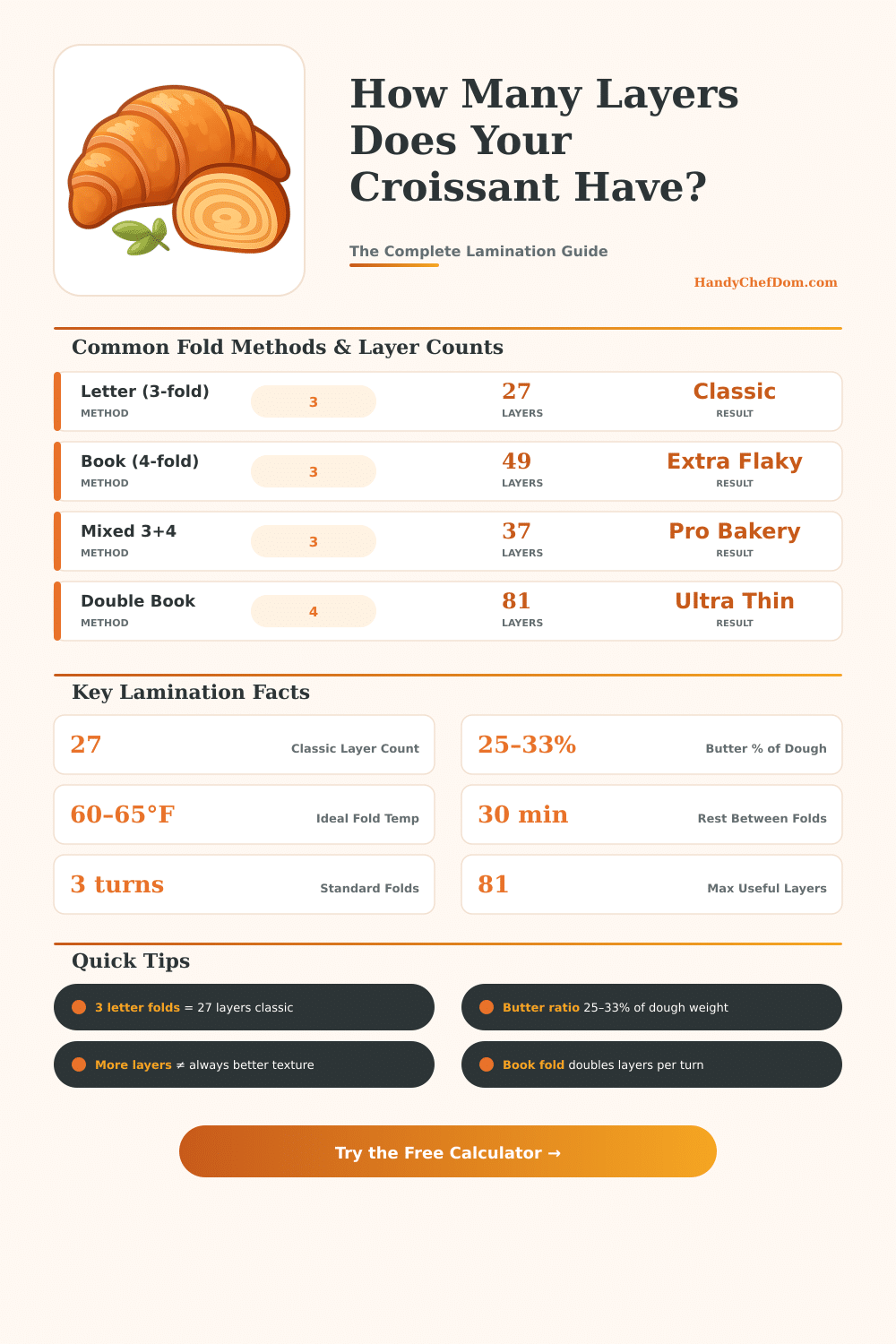
| Fold Method | Multiplier | 3 Turns | 4 Turns | 5 Turns | Use Case |
|---|---|---|---|---|---|
| Letter (3-fold) | x3 per turn | 27 | 81 | 243 | Classic croissant |
| Book (4-fold) | x4 per turn | 64 | 256 | 1024 | Extra flaky layers |
| Mixed (3+4+3) | 3x4x3=36 | 36 | — | — | Pro bakery style |
| Double Letter | x3 x3 per step | 27 | 81 | 243 | Same as letter |
| Puff Pastry | Letter x6 | 729 | 2187 | — | Puff / mille-feuille |
| Pastry Type | Butter % (of total) | Butter per 500g dough (g) | Butter per 500g dough (oz) | Texture |
|---|---|---|---|---|
| Budget croissant | 20% | 100g | 3.5 oz | Soft, less flaky |
| Home baker | 25% | 125g | 4.4 oz | Good lift, easy to work |
| Classic French | 28–30% | 150g | 5.3 oz | Rich, layered, flaky |
| Pro bakery | 33% | 175g | 6.2 oz | Ultra flaky, delicate |
| Danish pastry | 22–25% | 120g | 4.2 oz | Soft, slightly chewy |
| Puff pastry | 50% | 500g | 17.6 oz | Maximum flakiness |
| Layer Count | Total 4mm sheet | Total 3mm sheet | Visible Separation? | Recommended? |
|---|---|---|---|---|
| 16 layers | 0.25 mm | 0.19 mm | Yes, clear | Simple recipes |
| 27 layers | 0.15 mm | 0.11 mm | Yes, ideal | ✅ Classic choice |
| 36 layers | 0.11 mm | 0.08 mm | Good | ✅ Pro standard |
| 64 layers | 0.06 mm | 0.05 mm | Marginal | ⚠ Edge of limit |
| 81 layers | 0.05 mm | 0.04 mm | May merge | ⚠ Not ideal |
| 243+ layers | <0.02 mm | <0.01 mm | Merges | ❌ Too many |
Croissant is pastry in crescent form, made from beaten fermented dough, that sits between bread and puff pastry. It has buttery taste and flaky layers, inspired by the Austrian kipferl form but prepared by a special method. The word croissant in French means crescent and it first appeared in cooking books in the mid 19th century.
Viennese pastries like the kipferl became popular in Paris, where French bakers took the recipes from there.
All About Croissants
Great croissant has the flaky layers, that are crisp and golden-brown outside, but soft and light inside. You roll and fold the dough to form separate layers from dough and butter. While baking the butter layers divide and separate the dough layers, which gives that famous flakiness.
Key is keeping the butter cold. And the dough and the butter must have the right temperture during lamination.
Home making croissants is not simple. It lasts around 15 hours, while a bakery does that in some minutes. The secret lies in an exactly planned process: you fold the dough with layers of cold butter repeatedly back to themselves.
Two three-folds with cooling and one four-fold give the best results. More folds indeed reduce the flakiness. Here most croissants fail, whether professionally or home made.
Also the kind of butter matters. Butter with higher fat percentage from the milk gives richer taste and helps to form smooth layers, that are light. Butter with 84% to 87% milk-fat works well.
The difference between imported and usual butter you feel clearly in blind tests.
Croissants themselves are not really sweet. Sweetness comes from the fillings or toppings. Hence using them for salty foods like hot dogs is not a weird idea.
In France the only traditionally reasonable variation is the croissant aux amandes. Croissant croutons work well in salads, bringing taste and texture, that average croutons do not match.
Average croissant weighs around 60 to 70 grams. A little piece works as one serving for a snack, while for bigger ones you can eat half. Medium plain croissant has around 26.7 grams of carbs, 15 grams of fat, 4.6 grams of protein and 260 calories.
Fresh croissants feel light because of their size, with visual layers and internal honeycomb. Old ones become dense or wet. Their shelf life is 7 days at room temperature, 14 days in refrigerator and 365 daysfrozen.