🍗 Ham Smoking Time Calculator
Set cut style, weight, and smoke profile for fast planning across family meals and party batches.
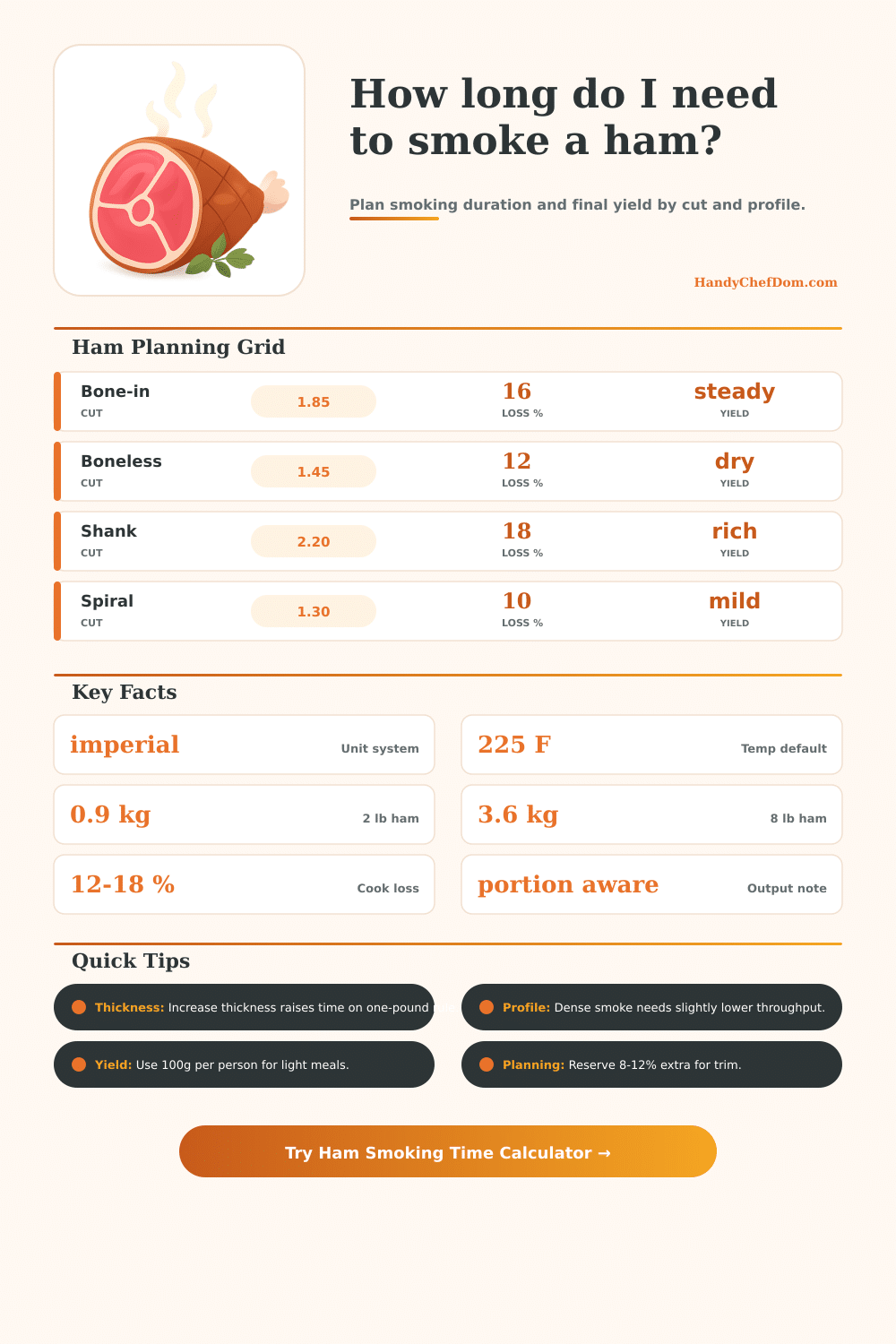
| Cut | Base Time hr/lb | Base Shrink | Typical Slice Weight |
|---|---|---|---|
| Bone-in picnic | 1.85 | 16% | 7 oz |
| Boneless | 1.45 | 12% | 6 oz |
| Shank | 2.20 | 18% | 7.5 oz |
| Loin roast | 1.55 | 14% | 6 oz |
| Profile | Temp Range | Time Multiplier | Yield Effect |
|---|---|---|---|
| Soft | 175-210 F | 1.20 | slower browning |
| Balanced | 210-240 F | 1.00 | steady set |
| Firm | 240-270 F | 0.88 | slightly firm skin |
| High dry run | 270-300 F | 0.82 | higher evaporation |
| Thickness (in) | Factor | Loss Adj. | Use Case |
|---|---|---|---|
| 0.75 - 1.0 | 0.95 | -0.5% | Fast slice prep |
| 1.0 - 1.5 | 1.00 | Base | Standard slices |
| 1.5 - 2.2 | 1.16 | +1.2% | Restaurant portioning |
| 2.2+ | 1.30 | +2.0% | Thick rustic cuts |
| Guests | Raw Ham Rule | Cooked Ham Rule | Trim Buffer |
|---|---|---|---|
| 4-6 | 0.5 to 0.75 lb | 0.45 to 0.64 lb | 5% |
| 7-10 | 0.7 to 0.9 lb | 0.62 to 0.80 lb | 7% |
| 11-16 | 0.85 to 1.1 lb | 0.75 to 0.97 lb | 8% |
| 20+ | 1.0 to 1.2 lb | 0.88 to 1.04 lb | 10% |
Smoking requires planning because there are several variable that will impact how long it will take to cook the ham and how much weight the ham will lose during the smoking process. The cut of ham that you will smoke will impact the cooking time. For instance, bone in ham varieties will take longer to smoke than boneless ham cuts.
Additionally, shank ham cuts requires longer smoking times than loin ham cuts. This is because the shank cut is more densly than the loin cut. However, loin cuts can easly become dry if smoked for too long.
Planning to Smoke a Ham
Cured ham varieties contains salt which will draw out the water from the ham. Uncured ham varieties require more gentle smoking process to prevent the ham from becoming too tough. Finally, spiral-sliced ham cuts are convenient in that the ham is already sliced.
However, the ham can readily become dry at the edges. Thus, identifying the type of ham that will be smoked will allow for an understanding of the time required for smoking. Additionally, another factor that will impact the smoking process is the smoking temperature.
If the smoker is set to 225 degrees, the ham will cook slow and evenly with the smoke, but the smoke will not scorched the exterior of the ham. However, if you set the smoker to an higher temperature in order to create a firm bark on the ham, the smoking time will be lessened. However, higher smoking temperatures will result in the ham losing more of it’s water weight.
Finally, smoking temperatures that are set to be lower than 210 degrees will take longer for the ham to cook. The thicker the slab of ham, the longer it will take to cook the ham. For instance, a thick slab of ham that is over two inches in thickness will take longer to smoke than a thin cut of ham of the same type because the interior of the ham will act as an insulator to the heat required to cook the ham.
One of the other mistakes that many cook make with smoking hams is not planning for the loss of weight of the ham while smoking. Smoked ham can lose anywhere from 12 to 18 percent of its total weight. This is due to the loss of water weight from the ham as well as the loss of fat from the ham that render during the smoking process.
For instance, an 8-pound raw ham could result in 6.5 to 7 pound of cooked ham. Thus, if planning for a meal that includes ham, the portion of ham should be calculated based off the cooked weight of the ham. For instance, if planning on feeding 8 people, portions of 6 ounce of cooked ham per person would feed the population.
However, for a lighter meal, 100 grams of cooked ham per person may be sufficient. Additionally, 8 to 12 percent of ham can be allowed for scraps that are removed while carving the ham. One of the most common mistakes with smoking hams is not understanding the difference between the various cuts of ham.
For instance, a ham that contain bones will require nearly two hours to cook per pound of ham. A boneless ham only requires one and a half hours of cooking for each pound of ham. Additionally, another very common mistake with smoking is overcrowding the smoker.
When you place too much ham into the smoker, the temperature of the smoker is decreased, which may lead to longer cooking times for the ham. More space should be provided in the smoker for better air flow around the ham. Finally, individuals should remember that meat will lose weight during the smoking process.
Therefore, raw meat purchases should of been planned with this in mind. There are a few things that can be done to retain the moisture of the ham while smoking. For instance, uncured ham can be brined prior to smoking to retain moisture and reduce the amount of weight that the ham loses during smoking.
Spritzing the ham with liquid while smoking will keep the exterior of the ham moist and will preserve the yield of spiral-sliced ham products. Finally, the ham can be wrapped in cooking foil at the “stall” stage in the smoker. However, care should be taken with this method as it can prevent the ham from forming a smoke ring.
Finally, allowing the cooked ham to rest for 30 minute after cooking will allow the juices to redistribute within the ham. This will increase the usable yield of the ham.