Gumballs In A Jar Calculator
Estimate jar counts by shape, fill level, and candy size
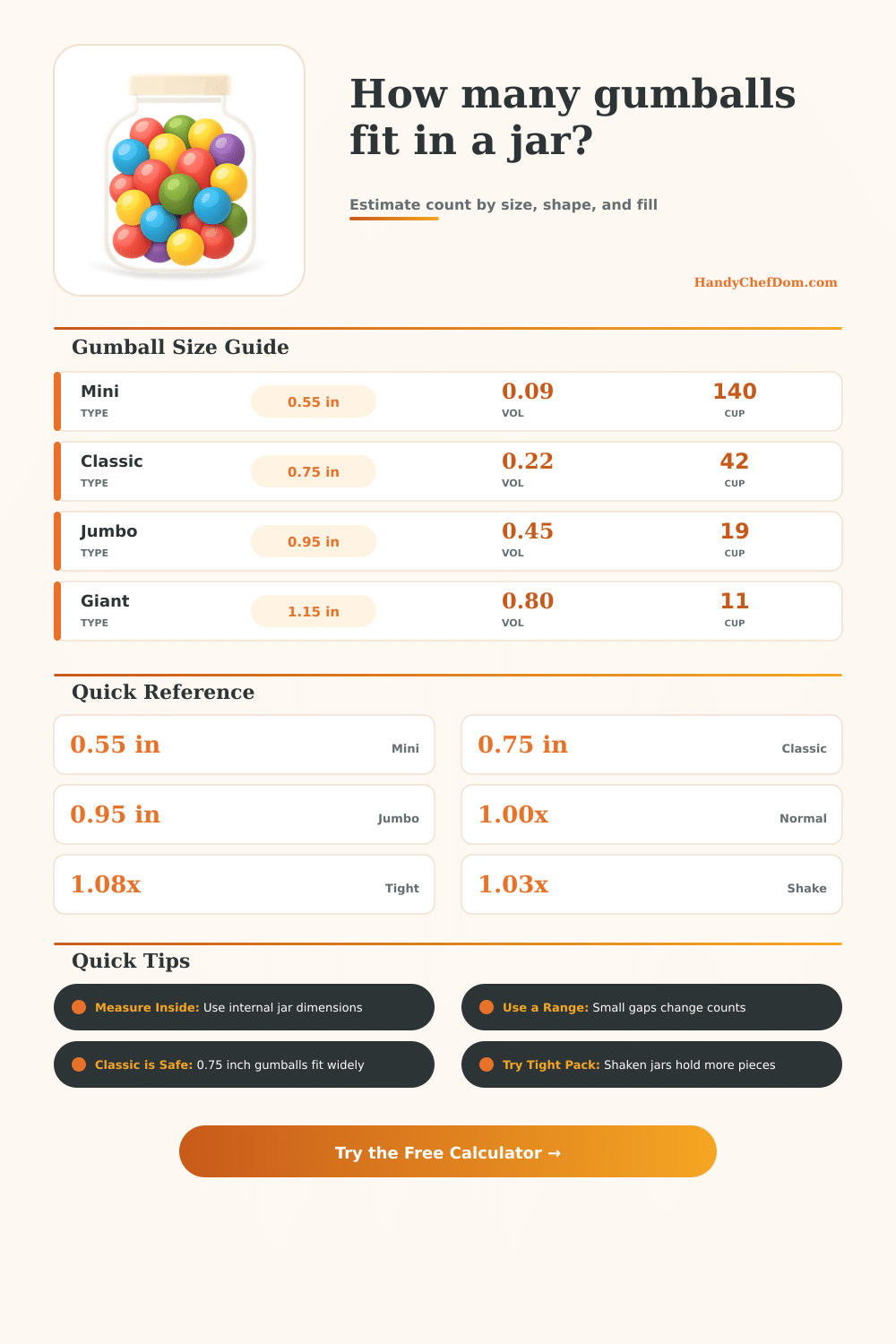
| Type | Diameter | Weight | Pieces per Cup |
|---|---|---|---|
| Mini | 0.55 in | 1.8 g | 130-150 |
| Classic | 0.75 in | 3.6 g | 38-45 |
| Rainbow | 0.78 in | 3.9 g | 34-40 |
| Jumbo | 0.95 in | 6.5 g | 16-22 |
| Shape | Formula | Best Use | Count Effect |
|---|---|---|---|
| Round | Cylinder volume | Classic candy jar | Neutral baseline |
| Square | Side x side x height | Display jars | Slightly efficient |
| Rectangular | Width x depth x height | Bulk counters | Easy to measure |
| Apothecary | Cylinder with taper | Decorative jars | Less usable space |
| Setting | Factor | Typical Use | Count Shift |
|---|---|---|---|
| Loose Pour | 0.92x | Fresh fill | Lower estimate |
| Normal Fill | 1.00x | Everyday guess | Balanced count |
| Tight Pack | 1.08x | Jar settled down | Higher estimate |
| Shaken Down | 1.03x | Top tapped flat | Slightly higher |
| Jar Type | Inside Size | Volume | Classic Count |
|---|---|---|---|
| Small counter jar | 6 x 6 x 8 in | 226 cu in | 175-200 |
| Medium display jar | 8 x 8 x 10 in | 503 cu in | 390-440 |
| Tall apothecary jar | 9 x 9 x 12 in | 763 cu in | 590-660 |
| Bulk prize jar | 12 x 7 x 10 in | 840 cu in | 640-730 |
To find the number of gumballs in a jar, you must understand how the gumballs fills the space within the jar. A gumball are a sphere, and spheres leave air gap between them. For these reason, if you attempted to calculate the number of gumballs by dividing the volume of the jar by the volume of a single gumball, you would find an incorrect number of gumballs in the jar.
Because gumballs leave air gaps between them, the actual number of gumballs in the jar will be less than the theoretical calculation of the number of gumballs that can fill the volume of the jar. The first step in calculating the number of gumballs in the jar is to measure the interior dimension of the jar. You must measure the dimensions of the jar so that the thickness of the glass is accounted for.
How to Estimate the Number of Gumballs in a Jar
If you measured the exterior dimensions of the glass jar, you will find that the measurements are too large. This will lead to an underestimation of the number of gumballs in the jar. For cylindrical jars, you must measure the interior diameter and the interior height of the jar.
For rectangular jars, you will need to find the length, the width, and the height of the interior of the jar. Additionally, you must find the fill level of the jar. It is possible that the gumballs did not fill the jar to the top.
For jars with shoulders at the top, which taper into the remainder of the jar, these area will reduce the number of gumballs that can be in the jar. The size of the gumballs will impact the number of gumballs in the jar. Small gumballs will allow for more gumballs in the jar than large gumballs.
The larger the diameter of the gumballs, the more space they will take up in the jar, creating air gap between them. The size of the gumballs will impact the calculation of the number of gumballs in the jar. You must account for the size of the gumballs prior to calculating the number of gumballs in the jar.
The packing density of the gumballs will also impact the number of gumballs within the jar. Packing density is the amount of the jar that the gumballs fill and the amount of the jar that is filled by air. If you poured the gumballs into the jar, the packing density will be low due to the air gap between the gumballs.
If you shook the jar, the gumballs will pack more tight together, resulting in a higher packing density. The packing density will impact the number of gumballs in the jar. You must account for the packing density of the gumballs prior to calculating the number of gumballs in the jar.
Another method of accounting for the air gaps between the gumballs is to use a packing factor. To find the volume that is occupied by the gumballs, you can multiply the volume of the jar by a packing factor. For randomly stacked sphere, such as gumballs in a jar, the packing factor is between 0.60 and 0.70.
This means that gumballs will occupy 60% to 70% of the jar. The remaining 30% to 40% of the jar will be the air gaps between the gumballs. For jars with a high packing density, you will want to use a higher packing factor.
For jars with low packing density, you will use a lower packing factor. Finally, the shape of the jar can impact the number of gumballs that can be in the jar. For jars in the shape of a circle, or cylinder, the consistent cross-sectional area makes the calculation of the volume of the jar easy.
For apothecary jar or jars with a changing width, such as the top of the jar that tapers into the remainder of the jar, you must account for the loss in the volume of the jar that is caused by the curve of the jar. By measuring the dimensions of the jar, the size of the gumballs, calculating the packing density of the gumballs, and accounting for the shape of the jar, you can successfully estimate the number of gumballs in the jar.