Maple Sap to Syrup Calculator
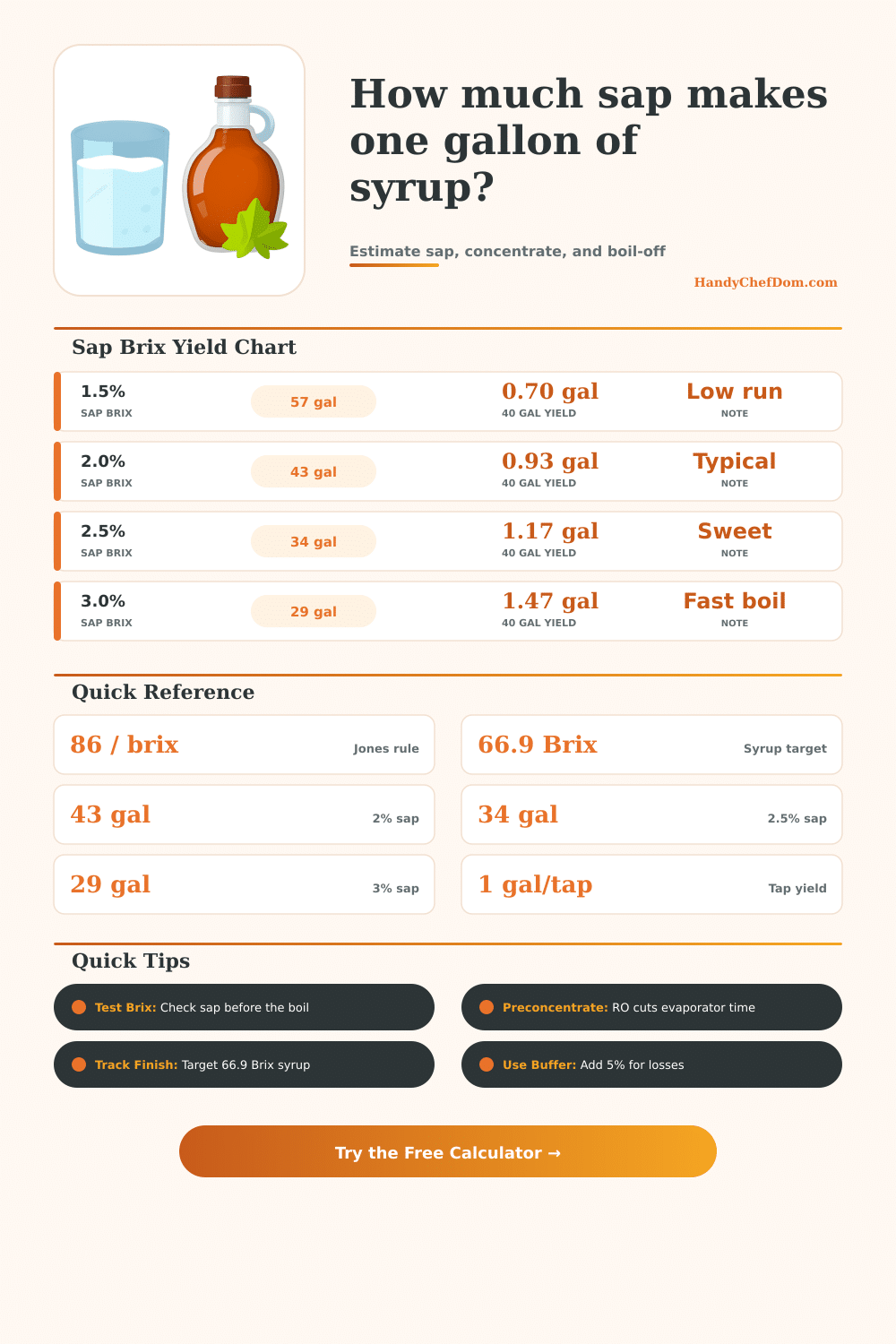
Use sap Brix, finish density, and batch size to estimate raw sap, RO concentrate, boil-off, and tap flow for a syrup run.
| Sap Brix | Sap / 1 gal syrup | 40 gal sap | Note |
|---|---|---|---|
| 1.5% | 57.3 gal | 0.70 gal | Thin run |
| 2.0% | 43.0 gal | 0.93 gal | Standard rule |
| 2.5% | 34.4 gal | 1.17 gal | Sweet sap |
| 3.0% | 28.7 gal | 1.47 gal | Fast batch |
| 4.0% | 21.5 gal | 1.86 gal | Very sweet |
| 5.0% | 17.2 gal | 2.33 gal | RO or rare |
| Batch | 2.0% sap | 2.5% sap | 3.0% sap |
|---|---|---|---|
| 1 gal syrup | 43 gal | 34 gal | 29 gal |
| 2 gal syrup | 86 gal | 69 gal | 57 gal |
| 5 gal syrup | 215 gal | 172 gal | 144 gal |
| 10 gal syrup | 430 gal | 344 gal | 287 gal |
| Species | Typical Brix | Typical yield | Planner note |
|---|---|---|---|
| Sugar maple | 2.0-2.5% | Best baseline | Classic syrup tree |
| Black maple | 2.0-2.5% | Strong output | Sweet, steady flow |
| Red maple | 1.5-2.0% | Lower yield | More sap per gallon |
| Silver maple | 1.5-2.0% | Lower yield | Useful backup sap |
| Boxelder | 1.0-1.8% | Very low | Plan on long boil |
| Mixed stand | 1.8-2.2% | Average | Use measured Brix |
| Evaporator | Size | Rate | Planning use |
|---|---|---|---|
| Small pan | 12x20 | 1 gal/hr | Hobby finishing |
| Medium pan | 19x36 | 3 gal/hr | Backyard batch |
| Compact rig | 2x33 | 5 gal/hr | Small sugarhouse |
| Cabin rig | 2x4 | 15 gal/hr | Weekend run |
| Farm rig | 2x6 | 25 gal/hr | Busy season |
| Large rig | 3x8 | 70 gal/hr | High throughput |
Maple sap contain a small amount of sugar. In order to turn maple sap into maple syrup, the sap has to be boil. Most maple sap are 98% water.
The remaining 2% of sap contain sugar. Because there is so little sugar in maple sap, a lot of waters has to be boiled away in order to produce maple syrup. For example, it take 40 gallon of maple sap to produce one gallon of maple syrup.
How to Make Maple Syrup
The Brix scale are used to determine the concentration of sugar in the sap. Brix measure the percentage of dissolved solids in a liquid. The sugar content in the sap change based on the weather and the time of year.
For example, if the weather is cold, the sugar content in the sap are high. However, if it is warm and the bud on the trees are swelling, the sugar content in the sap is lower. Regular testing of the Brix levels of the maple sap is necessary in order to determine how long to boil the sap to produce maple syrups.
The sugar content in the sap can also vary depending on the species of the maple tree. Sugar maples contains 2-2.5% sugar in there sap. Black maples contains more sugar then sugar maples.
Therefore, black maples are more efficient in producing maple syrup. Red and silver maples contains less sugar at 1.5-2%, meaning that more of the sap from these type of maples must be collected to produce the same amount of maple syrup as the other types of maples. Because they produce thinner sap, more collection tank or tapping of the trees is required for red and silver maples.
The Rule of 86 is used to calculate the amount of sap that is required to make a specific amount of maple syrup. The Rule of 86 allow farmers to balance the density of the maple syrup with the Brix level of the maple sap. The higher the Brix level, the less maple sap that is required to create the maple syrup.
Another option is to use a reverse osmosis unit to increase the sugar concentration in the sap prior to boil. These units can increase the Brix level of the sap to 6 or 8%. Using these units reduce the amount of water that is boiled away to make maple syrup.
The maple sap have to be collected based on the number of tap that are available and the rate at which the evaporator work. If there are many tap, more sap will be collected. However, the collection tanks has to be large enough to contain the amount of sap that is collected.
Additionally, the evaporator must be able to process the amount of maple sap that is collected. If the evaporator is too small, the sap will overflow from the collection tank. However, if the evaporator is too large, the evaporator will remain empty while waiting for more sap to be collected.
The syrup must be monitored until it reach the proper density. When maple syrup reach 66.9 Brix, it is done boiling and is ready to be harvested. Additionally, maple syrup is finished boiling when it reach 219 degrees Fahrenheit.
Prior to measuring the density of the maple syrup with a hydrometer, the syrup must be cooled; the hydrometer will not provide an accurate reading if the syrup is too hot. Lastly, an extra amount of sap must be collected over what is calculate as will be needed; having an extra buffer of the sap account for any that may be lost in the process of collecting and boiling the sap.