How Much Maple Syrup From One Tree
Estimate sap flow, tap count, and finished syrup from a single maple tree
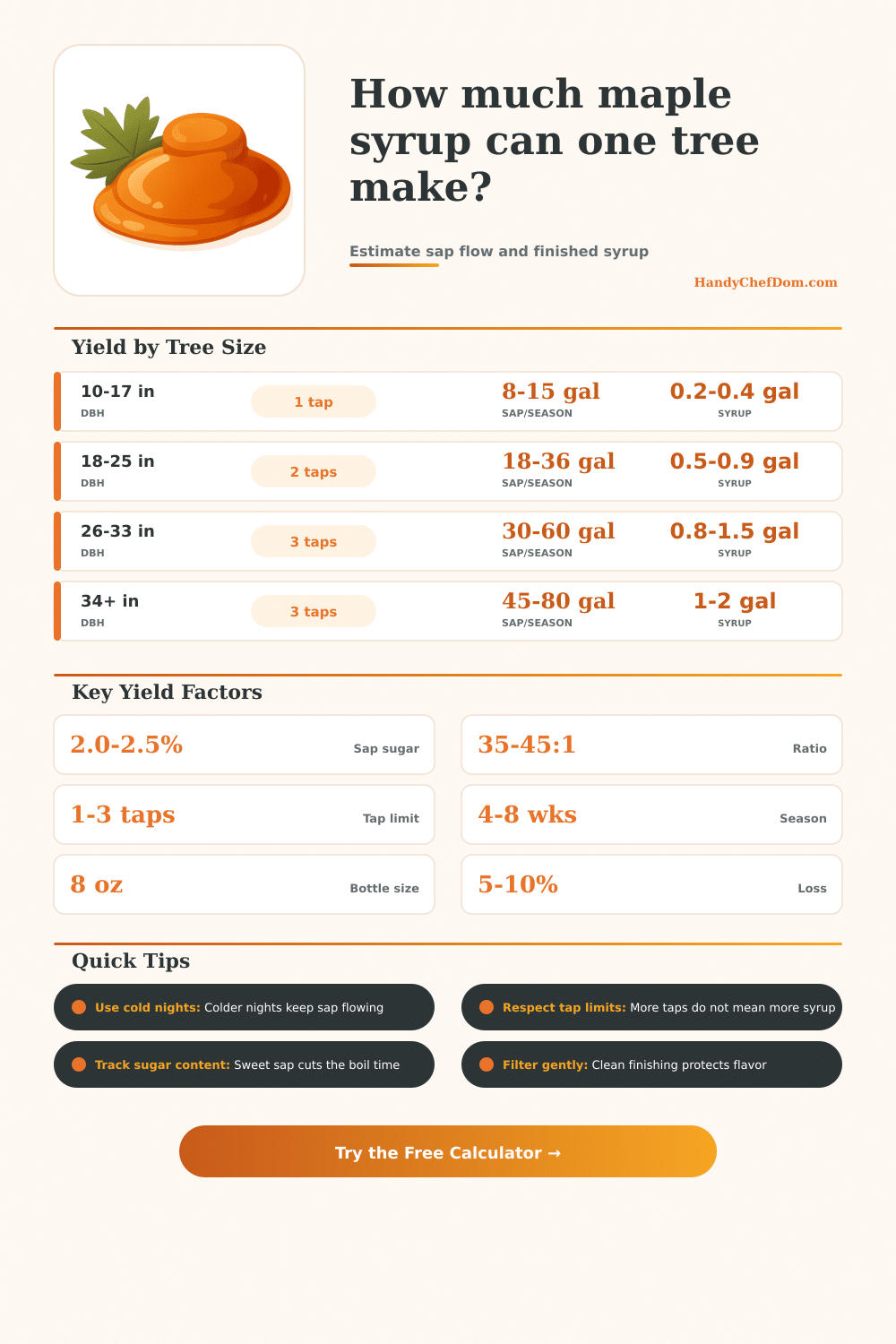
| DBH | Taps | Sap/Season | Syrup |
|---|---|---|---|
| 10-17 in | 1 tap | 8-15 gal | 0.2-0.4 gal |
| 18-25 in | 2 taps | 18-36 gal | 0.5-0.9 gal |
| 26-33 in | 3 taps | 30-60 gal | 0.8-1.5 gal |
| 34+ in | 3 taps | 45-80 gal | 1-2 gal |
| Species | Sugar | Flow | Note |
|---|---|---|---|
| Sugar Maple | 2.0-2.5% | 1.00 | Best baseline |
| Black Maple | 2.3-2.8% | 1.05 | Sweet sap |
| Red Maple | 1.5-2.0% | 0.86 | Moderate flow |
| Silver Maple | 1.5-1.9% | 0.90 | Fast flow |
| Sugar | Sap for 1 gal | Approx Ratio | Yield |
|---|---|---|---|
| 1.5% | 58 gal | 58:1 | Low |
| 2.0% | 43 gal | 43:1 | Standard |
| 2.5% | 35 gal | 35:1 | Sweet |
| 3.0% | 29 gal | 29:1 | Very sweet |
| Measure | US | Metric | Bottles |
|---|---|---|---|
| 1 gal syrup | 4 qt | 3.79 L | 16 x 8 oz |
| 1 qt syrup | 32 oz | 0.95 L | 4 x 8 oz |
| 1 cup syrup | 8 oz | 237 mL | 1 x 8 oz |
| 1 L syrup | 33.8 oz | 1.06 qt | 2 x 500 mL |
Maple syrup production begin with the collection of sap from maple tree. The sap that is collected contains a small amount of sugar. In order to create maple syrup from the sap, the sap must be boil to remove the water from the sap.
The amount of maple syrup that an individual can produce is influence by several different factor. These factors include the species of the maple tree that is being tapped for its sap, the size of that maple tree, and the weather conditions during the time of sap production. The species of the maple tree have the most significant impact on the amount of sap that can be produced.
How Maple Syrup Is Made and What Affects It
Different type of maple trees contain different amounts of sugar in there sap. Sugar maple trees are the most common type of maple tree that is use to produce maple syrup. This is due to the fact that sugar maple trees has high sugar contents in their sap.
Other maple tree species, such as red maple and silver maples, do contain the sap necessary to produce maple syrup; however, their sap has less sugar than sugar maple sap. Therefore, more sap must be collected from red and silver maple trees to achieve the same amount of maple syrup as is produce from sugar maple trees. The size of the maple tree also impact the amount of sap that can be produced.
The diameter of the maple tree at breast height can be measured for various size of maple trees. Trees that are larger in size can produce more sap than smaller maple trees. If too many tap are made into a maple tree, though, the tree will be stress.
The stress that is placed on the cambium layer of the tree will reduce the amount of syrup that the maple tree can produce in the future. Weather condition impact the amount of sap that is produced. The sap will only flow from the maple trees if the temperature drop to below freezing during the night and rise to above freezing during the day.
During these condition, pressure builds in the root of the maple tree, forcing the sap to rise from the ground through the tap. If the weather is too cold or too warm during this period, the sap will not flow as efficient. However, if the temperature swing rapidly between hot day and cold nights, more sap will be produced.
The sugar content of the sap has a direct impact on the amount of sap that will be boil to produce maple syrup. The sugar content of maple sap range from 1% to 3%. If the sugar content in the sap is 2%, 40 gallon of sap must be boiled to make 1 gallon of maple syrup.
However, if the sugar content of the sap is 3%, less gallons of sap must be boiled to produce 1 gallon of maple syrup. This is due to the fact that boiling remove water from the sap, increasing the sugar concentration. In addition to the factor mentioned previously, there are some losses that must be accounted for during the production of maple syrup.
Some of the loss include the amount of sap that is lost while collecting the sap from the maple trees, the amount of sap that is lost during boiling, and the amount of syrup lost during bottling. The losses of these different stage must be accounted for in producing maple syrup. In order to produce high yield from maple trees, specific procedure should be followed in tapping the trees for sap.
The tap holes must be drill slightly downward to allow the sap to drip into the collection container. The tapping tool should be clean to prevent the introduction of bacteria into the sap. The bacteria can ruin the quality of the sap, so the sap should be collect often and store in a clean environment.
Additionally, an individual can measure the sugar content of the sap with a refractometer; using the refractometer to measure the sugar content will allow an individual to understand the efficiency of the sap collection.