Yeast Per Cup of Flour Calculator
Match yeast, flour weight, dough style, and ferment time for predictable bread, pizza, and enriched dough
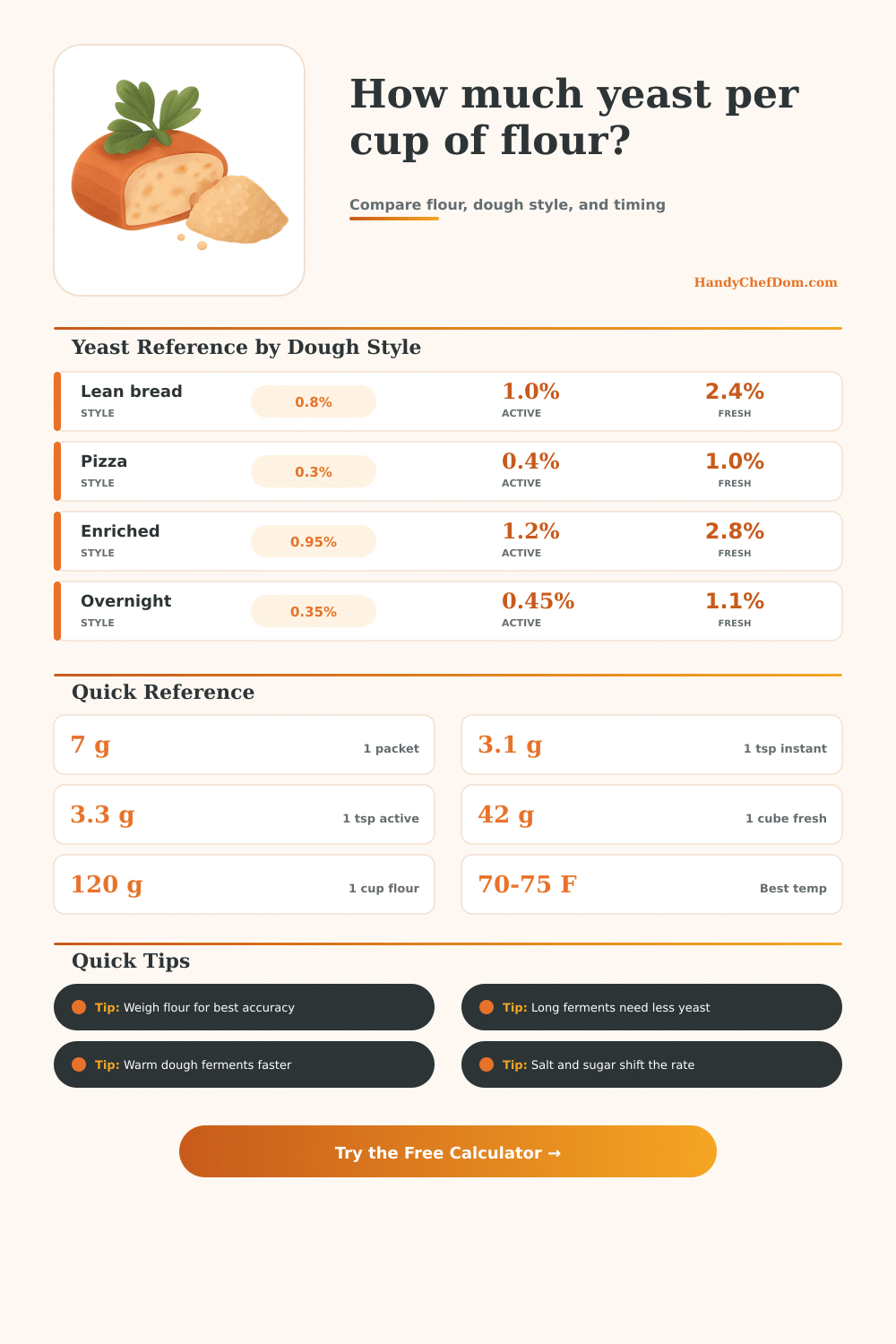
| Type | 1 tsp | 1 Packet | Fresh Cube |
|---|---|---|---|
| Instant | 3.1 g | 7 g | 42 g |
| Active Dry | 3.3 g | 7 g | 42 g |
| Fresh | 3.0 g | 17 g | 42 g |
| Rapid-Rise | 3.1 g | 7 g | 42 g |
| Flour | Grams / Cup | Absorption | Notes |
|---|---|---|---|
| All-Purpose | 120 g | Balanced | Very versatile |
| Bread | 125 g | High | Strong gluten |
| Whole Wheat | 113 g | High | Bran needs water |
| 00 Flour | 95 g | Medium | Soft, extensible |
| Style | Instant | Active | Fresh |
|---|---|---|---|
| Lean Bread | 0.8% | 1.0% | 2.4% |
| Pizza | 0.3% | 0.4% | 1.0% |
| Enriched | 0.95% | 1.2% | 2.8% |
| Overnight | 0.35% | 0.45% | 1.1% |
| Temp | Factor | Time | Use Case |
|---|---|---|---|
| 55-60 F | 1.20 | Longer | Cool kitchen |
| 65-70 F | 1.05 | Normal | Moderate room |
| 71-75 F | 0.93 | Slightly less | Warm dough |
| 76-85 F | 0.82 | Less yeast | Fast ferment |
Yeast is an living organism that will consume the sugars present in the flour. As the yeast consumes the sugars in the flour, the yeast will produce carbon dioxide gas as a byproduct of that metabolic process. The yeast produces the carbon dioxide gas that is what cause the dough to rise.
If too little yeast is used in the dough, the dough will not be able to rise enough to produce a light texture in the finished baked good. Too much yeast, however, will cause the dough to rise too quickly, possibly leading to dough that collapse within the baking tray, and may contain a strong alcoholic taste due to the fermentation process. Each of these variable must be accounted for in determining the amount of yeast that will be used in the recipe: the amount of flour to be used, the type of dough to be produced, and the temperature of the kitchen in which the dough will be allowed to rise.
How Much Yeast to Use
The amount of yeast that will be required for a recipe can be calculated according to the weight of the flour that will be used. One cup of all-purpose flour, for instance, weigh approximately 120 grams. However, the weight of one cup of flour may differ depending on how the flour is scoop into the cup.
Doughs that contain high amounts of sugar and fat will require more yeast or more time to allow the dough to rise due to the effect that those ingredient have upon the fermentation process. The rate at which the yeast perform within the dough can also change according to the temperature of the kitchen. At a temperature of 72 degrees Fahrenheit, the yeast will perform at its standard rate.
However, if the temperature of the kitchen is 80 degrees F, the yeast will perform at a faster rate, leading to the dough rising more quick. The type of flour that is used can also impact the amount of yeast that is required to allow the dough to rise. Bread flour contain proteins that create gluten.
Gluten is the substance that will help to create the structure of the dough. Whole wheat flour contains bran which can slow the fermentation process of the dough. Consequently, when the recipe uses whole wheat flour, adjustments in the amount of water that is added to the flour may be required.
Pizza dough contains less flour and water than other types of dough. As a result, the percentage of yeast that is required for pizza dough is lower; it is typically 0.3 percent of the total weight of the flour. Other enriched dough recipes require more yeast than lean dough recipes.
Brioche dough, for instance, contains both sugar and fat. The higher the percentage of sugar and fat in a dough recipe, the more yeast that is required to provide enough lift to the baked good. The amount of time that the dough ferments will also impact the amount of yeast that is required to cook the dough.
If you are to bake the bread on the same day, more yeast will be required to allow for the dough to rise in time for baking in two hours. For bread recipes that are to ferment overnight in the fridge, less yeast will be required to prevent the dough from collapsing. The rate of fermentation also relates to the amount of sugar in the dough.
High amounts of sugar will feed the yeast, but too much sugar can also dehydrate the yeast. Salt has an effect upon the yeast that is opposite than that of sugar; salt will slow the yeast fermentation process. Precision in the measuring of the yeast is necessary for the yeast to perform correctly.
Weighing the flour with a digital scale will ensure evenness in the recipe; measuring flour with a cup measure may result in up to 20% of a variation in the weight of the flour. Once you have determined the weight of the flour in grams, the type of yeast that is to be used in the recipe can be selected. For instance, instant yeast can be mixed with the flour; active dry yeast must be dissolved in warm water prior to adding the yeast to the flour.
Fresh yeast is a moist, cake-like substance that should be used in amounts three times the weight of dry yeast. One packet of dry yeast will weigh 7 grams; 7 grams of dry yeast is approximately equal to two teaspoons of dry yeast. The type of dough that is to be produced will impact the percentage of yeast that is used in the dough.
For instance, lean doughs, such as baguettes require between 0.8% and 1% of instant yeast according to the weight of the flour. Doughs that contain less flour and water, such as pizza dough and focaccia dough will use a lower percentage of yeast to allow the dough to remain extensible and chewy. Enriched dough, such as brioche will require more yeast due to the effect that the sugars and fats has upon the rising of the dough.
Overnight bread recipes may use a rate of 0.35% of the weight of the flour to allow for flavor development overnight in the fridge. Doughs that contain higher amounts of water will ferment at a faster rate; 70% hydration, for instance, will require slightly less yeast than doughs with a lower hydration rate. The environment in which the bread is prepared can also impact the yeast.
For instance, if the water that is used to dissolve the active dry yeast contains chlorine, the water may stress out the yeast. Using filtered water will reduce the amount of chlorine in the water. The altitude of the kitchen may also impact the yeast; at high altitudes, the air pressure is lower which causes the carbon dioxide gas to rise more quickly.
In altitudes above 3,000 feet above sea level, the amount of yeast should be reduced 20% of the total amount to account for the rising of the dough. Additionally, the activity of the yeast can be tested by adding yeast to a mixture of sugar and water. If bubbles form within 10 minutes, the yeast is alive and can be used in the recipe.
Common mistakes that can be made when baking bread using yeast include using too much yeast; excessive yeast will ruin the flavor of the baked good, and result in dough that is too fluffy. Another mistake is using too little yeast which will result in dough that is dense and difficult to chew. Another mistake is to ignoring the temperature of the kitchen in which the bread is prepared.
Using a proofing box to hold the dough, or placing the dough in an oven that is off but whose light is on will help to maintain the proper temperature of the dough. Finally, the placement of salt in the dough should be avoided too early in the recipe; adding salt too early in the recipe can hamper the activity of the yeast during the autolyse process.