🍕 Pizza Dough Yeast Calculator
Dial yeast for same-day or cold-fermented pizza dough with accurate flour, hydration, and style scaling.
Choose your flour unit, dough style, and fermentation window. The calculator adjusts yeast for room temperature, hydration, and style.
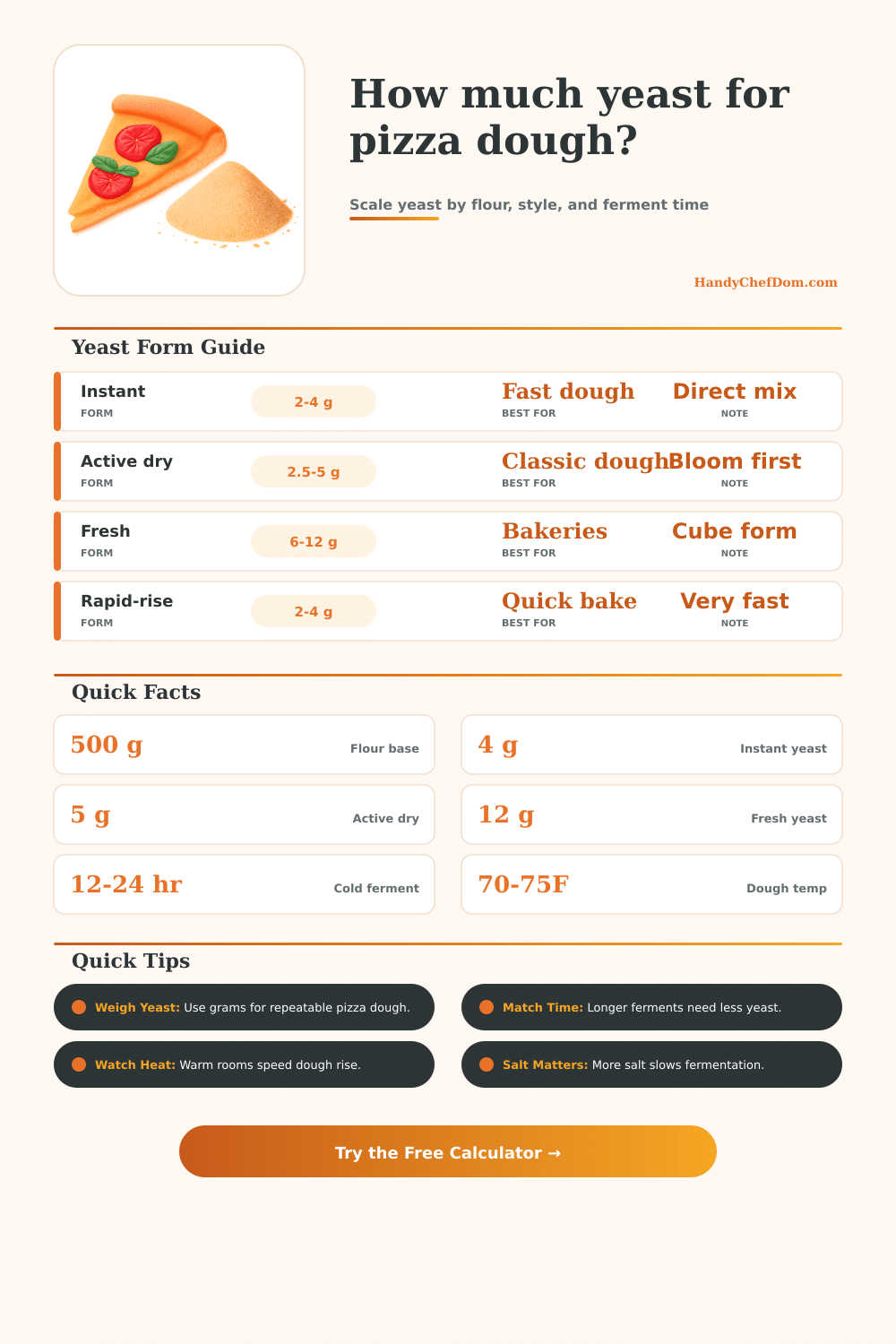
| Yeast form | Relative | Packet | Use |
|---|---|---|---|
| Instant | 1.00x | 7 g | Direct mix |
| Active dry | 1.25x | 7 g | Bloom first |
| Fresh | 3.00x | 42 g | Cube form |
| Rapid-rise | 0.90x | 7 g | Fast bake |
| Pizza yeast | 0.95x | 7 g | Oven ready |
| Osmotolerant | 0.85x | 7 g | Sweet dough |
| Style | Base yeast% | Hydration | Ferment |
|---|---|---|---|
| Neapolitan | 0.08% | 62% | 8-24 hr |
| New York | 0.20% | 60% | 6-24 hr |
| Cold ferment | 0.05% | 65% | 24-72 hr |
| Detroit pan | 0.35% | 68% | 4-18 hr |
| Sicilian | 0.25% | 70% | 4-20 hr |
| Thin crust | 0.12% | 58% | 4-12 hr |
| Hydration | Salt | Oil | Texture |
|---|---|---|---|
| 55-58% | 2.0-2.3% | 0-1% | Firm |
| 60-63% | 2.2-2.6% | 0-2% | Classic |
| 64-68% | 2.4-2.8% | 1-3% | Stretchy |
| 69-72% | 2.5-3.0% | 2-5% | Open crumb |
| 73-76% | 2.5-3.2% | 2-6% | Very airy |
| 77-80% | 2.8-3.5% | 0-4% | Shaggy |
| Pizzas | Flour | Ball | Note |
|---|---|---|---|
| 2 | 500 g | 250 g | Family night |
| 4 | 1000 g | 250 g | Party batch |
| 6 | 1500 g | 250 g | Big tray run |
| 8 | 2000 g | 250 g | Event table |
| 10 | 2500 g | 250 g | Big oven day |
| 12 | 3000 g | 250 g | Catering size |
Yeast is a single-celled fungus that people use to make pizza dough rise. Yeasts consumes the sugars that is present in the flour. When the yeast consumes the sugars in the flour, carbon dioxide and alcohol is created.
The carbon dioxide creates bubbles in the dough that provide the chew to the pizza crust. If you use too much yeast, the dough will rise too quick and then collapse. If you use too little yeast, the dough wont rise at all.
How Yeast Makes Pizza Dough Rise
Temperature and time is two factors that will control the speed of the yeast. Warm environments will increase the rate at which the yeast work and cause the dough to rise faster. Cool environments will decrease the rate at which the yeast work and cause the dough to rise slow.
Salt can also affect the rate of the yeast; it can slow the fermentation process of the dough, allowing flavor to develop without overproofing the dough. The temperature of the environment will affect the rate at which the yeast work. A room at 75 degrees will have a different effect on the yeast than a basement.
Depending on the style of pizza that you are making, the amount of yeast that you will need will change. For instance, to make Neapolitan style pizza, which has a very tangy flavor, you will want to use a small amount of yeast to allow the dough to rise slowly. For New York style pizza, which is strong and has a long proof process, you will need to use more yeast.
Pan style pizza, like Detroit style pizza, contain oil and sugar. Because oil and sugar requires some of the water in the dough, you must use more yeast to make up for this. You must ensure that the amount of yeast that you use correlates to the texture of the crust that you would like to produce; otherwise, the crust isnt the proper texture.
The amount of time that the dough ferments will also change the amount of yeast that you need. If you would like your pizza to be cooked in less than two hours, you will need a large amount of yeast. If you would like to ferment your pizza dough overnight in the refrigerator, you will need a very small amount of yeast.
Using less yeast allows the lactic acid to build up in the dough; lactic acid creates complex flavors for the pizza dough. There are different forms of yeast that you can use in making pizza dough. You can add instant yeast directly to dry flour mixes; it does not require being placed in a water bath to activate the yeast.
Active dry yeast must be placed in a water bath to activate the yeast. You will need to use more active dry yeast then instant yeast because active dry yeast is less active per gram of yeast. Finally, fresh yeast comes in a block that is much heavier than dry yeast.
Thus, you will need more fresh yeast than dry yeast. Using a scale to measure the yeast will provide more accurate measurements of the yeast than using spoon. The hydration of the pizza dough will also affect the action of the yeast.
Higher hydration yields a dough that is more extensible but may dilute the activity of the yeast. The rate of salt that you should use is 2 to 3%. This salt will help control the rise of the yeast and contribute to the structure of the pizza dough.
Oil and sugar are two ingredients that enrich the dough and provide food for the yeast; however, they will cause the yeast to work harder in dough that contain these ingredients. Depending on your schedule for baking your pizza, you can adjust the amount of yeast that you use. For instance, if you would like your pizza done in 90 minutes, you will need to use more yeast and you will need to place the dough in a warm spot to allow the yeast to rise to the state that you require in 90 minutes.
If you have more time, you will use less yeast but will place the dough in the refrigerator for a cold fermentation process. Scale your flour to the number of pizza that you will make. Use a scale to measure the amount of ingredients to ensure the consistency of your ingredients.
Measuring all ingredients precisely will allow you to produce the same result each time.