🍞 How Much Sugar to Activate Yeast?
Estimate the right sugar dose for blooming yeast by type, packet count, water warmth, and dough style.
The calculator uses a standard bloom rule: warm water, a small sugar feed, and a dough-style adjustment so the yeast gets enough fuel without being stressed.
| Type | g/pkt | Sugar | Note |
|---|---|---|---|
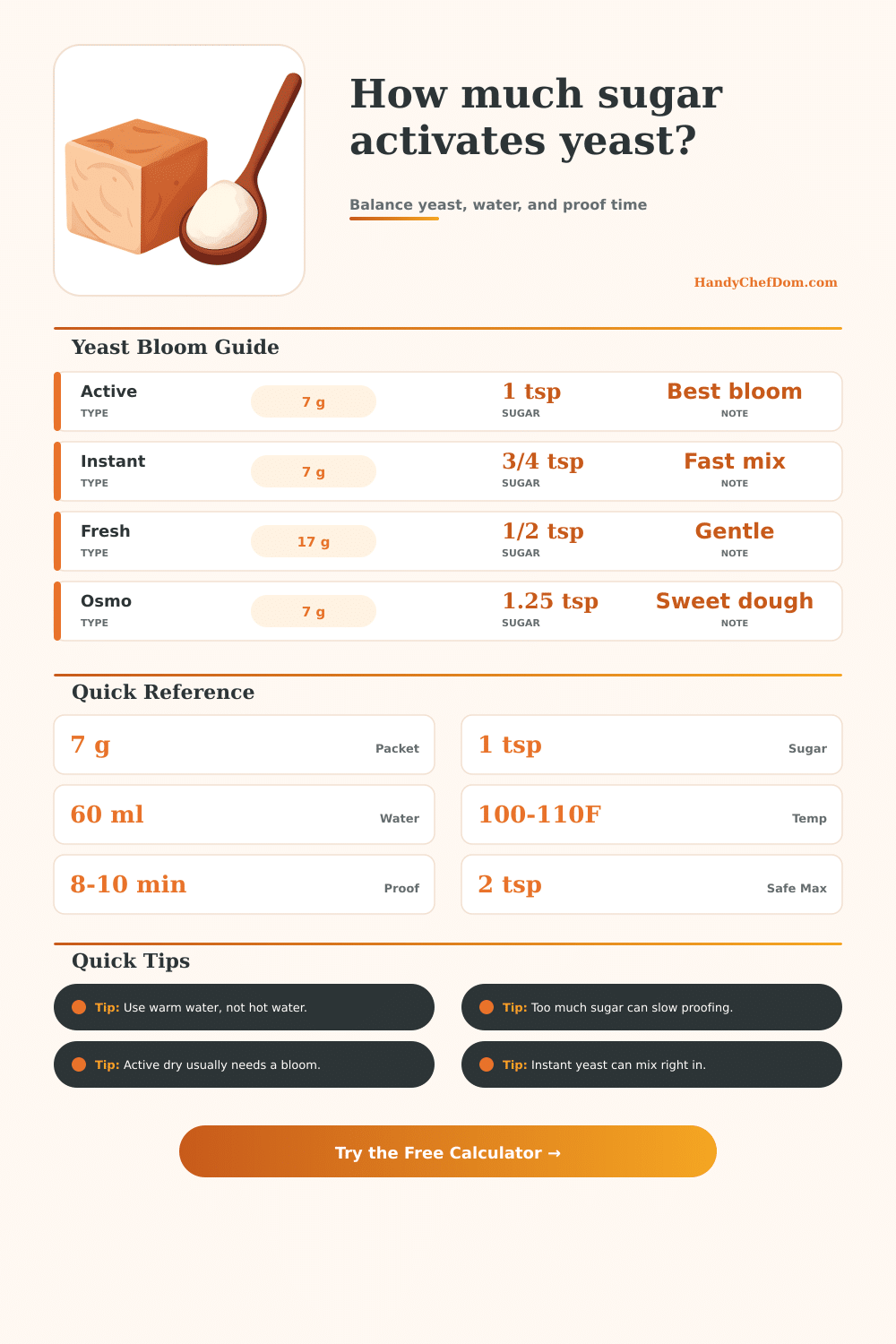
| Active | 7 g | 1 tsp | Best bloom |
| Instant | 7 g | 3/4 tsp | Fast mix |
| Fresh | 17 g | 1/2 tsp | Gentle |
| Osmo | 7 g | 1.25 tsp | Sweet dough |
| Water | Result | Risk | Note |
|---|---|---|---|
| 95-105 | Ideal | Low | Best bloom |
| 106-110 | Warm | Low | Normal |
| 111-115 | Hot | Med | Watch speed |
| 116+ | Too hot | High | Risk kill |
| Style | Tsp/pkt | g/pkt | Note |
|---|---|---|---|
| Lean | 0.5-0.8 | 2-3 g | Low sugar |
| Pizza | 0.75-1 | 3-4 g | Simple |
| Enriched | 1-1.5 | 4-6 g | Soft crumb |
| Sweet | 1.5-2 | 6-8 g | Rich dough |
| Room | Factor | Score | Note |
|---|---|---|---|
| 60-67 | 1.08 | Cool | Add warmth |
| 68-75 | 1.00 | Best | Ideal room |
| 76-80 | 0.95 | Warm | Move quick |
| 80+ | 0.90 | Hot | Short proof |
Yeast require sugar to activate, and the amount of sugar that should be added to the yeast are crucial for ensuring that the yeast performs corectly. If there is too little sugar added to the yeast, there will be not enough foods for the yeast to create the gas that will allow the dough to rise. However, if you add too much sugar to the yeast, the yeast will encounter too higher of a sugar concentration, which will hinder the performance of the yeast.
Since yeast requires sugar to create the energy that will allow it to rise the dough, the amount of sugar that is added should be such that it ensures that the dough contains enough energy to rise and sets properly. Another critical element that will impact the reaction of the yeast to the sugar is the temperature of the water. The ideal temperature of the water should be in the range of 100 to 110 degree Fahrenheit.
How Much Sugar to Use for Yeast
If the water is too hot, it will kill the yeast, rendering it useless in preparing the dough. If the water is too cold, it will slow the yeast down, taking longer for the yeast to becomes activated. Since the temperature of the water can impact yeast activity, it is crucial to adjust the amount of sugars that is added to the yeast in the event that the water temperature are not ideal.
Furthermore, the type of yeast that you use will impact the amount of sugar that is required for the yeast to bloom and become active. For active dry yeast, one full teaspoon of sugar is required per packet of active dry yeast. For instant yeast, only three-quarters of a teaspoon of sugar are needed per packet of instant yeast.
For fresh yeast, only half a teaspoon of sugar is needed per packet of fresh yeast. Lastly, osmotolerant yeast, which is used to prepare sweet doughs, requires one and a quarter teaspoon of sugar per packet of osmotolerant yeast. The type of dough that will be prepared will also impact the amount of sugar that is to be added to the yeast.
For lean doughs, such as artisan bread, only half to three-quarters of a teaspoon of sugar is required per packet of yeast. For enriched doughs, such as brioche and cinnamon rolls, one and a half teaspoon of sugar or more is required. For pizza dough, which falls somewhere in the middle in terms of the amount of sugar that it contains, only a moderate amount of sugar should be added to the yeast.
The amount of sugar that is added will depend on the type of dough being prepared since the yeast will encounter sugar in the dough that is to be prepared. The volume of the water that you will use in activating the yeast will also play a crucial role in the rising of the dough. Sixty milliliters of water are the ideal measure per packet of yeast.
If too little water is used, the sugar concentration will be too highly for the yeast. If too much water is used, there will be too low concentration of sugar for the yeast to activate. Furthermore, the type of sugar will also impact the recipe since brown sugar is denser than granulated sugar.
To ensure that the yeast that is being used in the recipe is alive and active, it is important to perform the bloom test on the yeast. The yeast and sugar will be mixed in warm water and left to stand in that mixture for eight to ten minutes. If the yeast is active, it will produce a creamy foam on the surface of the water.
If there is no foam, it indicate that the yeast is inactive and should not be used in the preparation of dough. Additionally, dont microwave the water, as this can heat the water to a temperature that will kill the yeast. Finally, it should be remembered that sugar will feed the yeast; however, not more than two teaspoons of sugar should be used in a batch of dough prepare by the yeast, as too much sugar will hinder the yeasts rising of the dough.