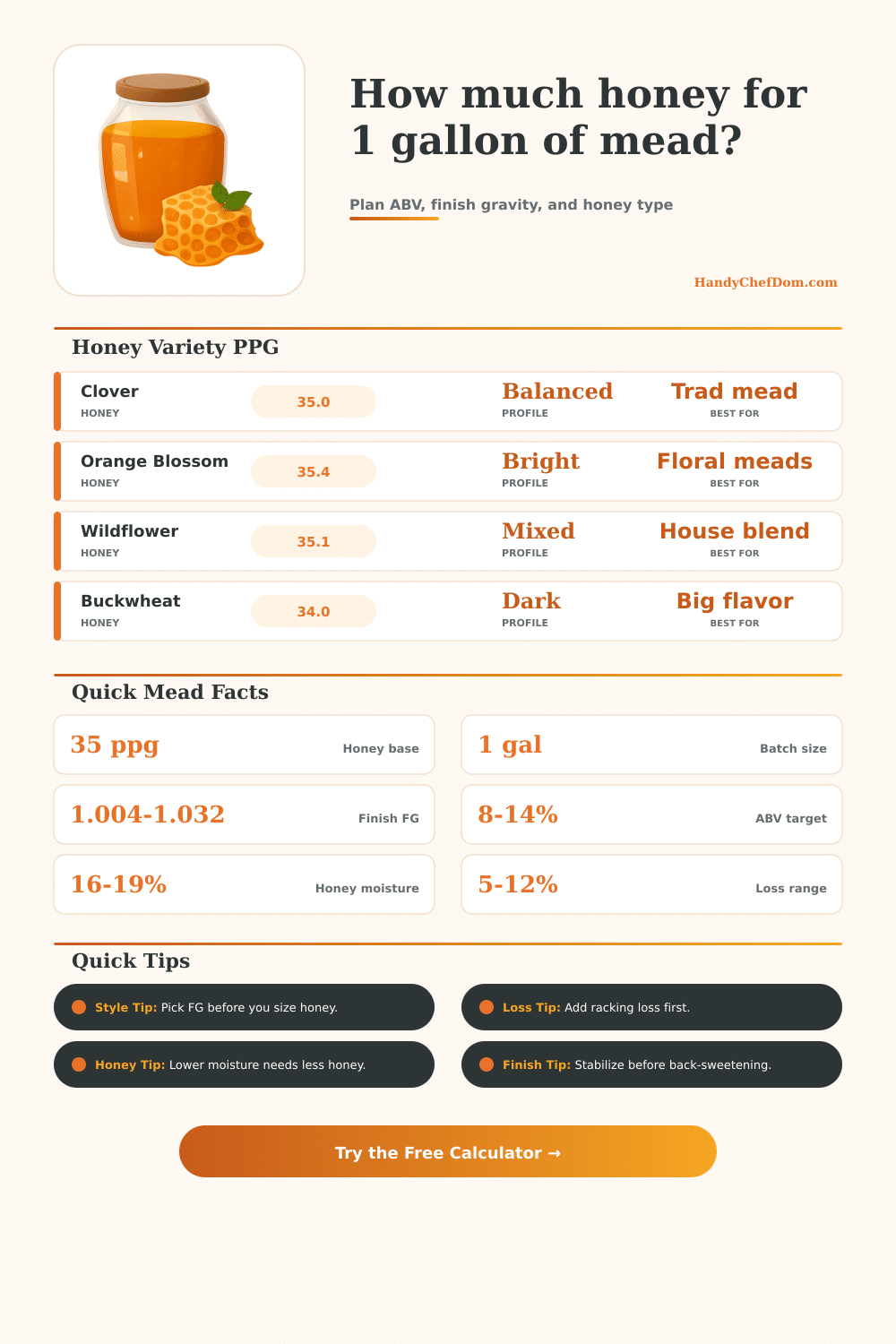
🍯 Honey for 1 Gallon of Mead
Size honey, finish gravity, and ABV for a clean mead must with realistic yeast and loss assumptions.
The calculator sizes honey from target ABV, finish gravity, and a small gravity margin for the selected style.
| Honey | PPG | Flavor | Best Use |
|---|---|---|---|
| Clover | 35.0 | Clean | Classic mead |
| Orange Bl. | 35.4 | Bright | Floral batch |
| Acacia | 36.0 | Light | Dry mead |
| Buckwheat | 34.0 | Bold | Richer must |
| Style | FG | Bonus | Feel |
|---|---|---|---|
| Dry | 1.004 | 4 pts | Crisp |
| Semi-dry | 1.010 | 10 pts | Light |
| Semi-sweet | 1.016 | 16 pts | Round |
| Dessert | 1.032 | 32 pts | Lush |
| OG | FG | ABV | Use |
|---|---|---|---|
| 1.060 | 1.010 | 6.6% | Light |
| 1.080 | 1.014 | 8.7% | Mid |
| 1.100 | 1.020 | 10.5% | Strong |
| 1.120 | 1.028 | 12.1% | Big |
| Batch | Gallons | Liters | Honey at 35 ppg |
|---|---|---|---|
| Small | 1.0 | 3.8 | 1.5-2.5 lb |
| Weekend | 2.0 | 7.6 | 3.0-5.0 lb |
| Club | 5.0 | 18.9 | 7.5-12 lb |
| Event | 10.0 | 37.9 | 15-24 lb |
To make mead, calculate the correct amounts of honey to use based off the amount of water that you are using to make the mead. If you use too little honey when you make your mead, the mead will be weak. However, if you use too much honey, the yeast may struggle to ferment all of the honeys; in that case, the fermentation process may stop altogether.
You must use math to determine the amount of honey that you will need for your batch of mead, as the amount of honey will determine the strength and taste of the mead that is made. The strength of the mead will impact the taste of the mead. If the mead is dry, its final gravity will be low; for instance, its gravity may be 1.004.
How Much Honey to Use for Mead
Dry mead isnt sweet tasting. If the mead is semi-sweet, its gravity will be higher; for instance, it may have a final gravity of 1.016. Semi-sweet mead contains some residual sugar after fermenting.
The gravity that you decide upon prior to beginning fermentation will determine the starting gravity of your mead. The starting gravity is a measurement of the sugar contents of the mead at the beginning of the fermentation process. Additionally, the yeast ferments an amount of sugar referred to as the yeast attenuation.
Yeast attenuation is typically between 70 and 85 percent when making mead. During the fermentation process, you will have to remove some of the honey from the fermentation vessel in order to remove the dead yeast and sediment that form during fermentation; this sediment is referred to as trub. Some buffer must be accounted for in the initial batch of honey and water to ensure that you do not end up with less than one gallon of mead after removing the sediment.
Another factor to consider is the moisture content of the honey. Some honeys contain 18 percent water. If you use honey with 18 percent water, that water will dilute the sugar content of the mead.
Other honey varieties contains less than 16 percent water. The type of honey that you use will impact the sugar content of the mead. For instance, clover honey is a neutral-tasting honey that has 35 points of sugar per pound per gallon.
Orange blossom honey contains 35.4 points of sugar per pound per gallon and features a citrus flavor. Buckwheat honey has 34 points of sugar per pound per gallon and tastes of malty flavors. Each type of honey features different flavor profiles; you must ensure that the type of honey that you use correlates to the type of mead that you wish to make.
If you are adding another ingredient to the mead besides honey, such as fruit puree or apple juice, you must account for the sugar content of that ingredient; you would of had to subtract the amount of sugar points of that ingredient from the total amount of sugar points that the honey will contribute to the mead. The amount of honey that you use will impact the alcohol by volume (ABV) of the mead. For instance, if the starting gravity is 1.060, the ABV will be 6 to 7 percent.
If the starting gravity is 1.100, the ABV will be 10 to 11 percent. Mead yeast strains functions best between ABV levels of 8 and 14 percent. If you attempt to make mead with an ABV of 15 percent or higher, the honey may inhibit the yeast from performing its fermentation task.
In order to determine the amount of honey that is needed to make your batch of mead, you can create a mead calculator. Such a calculator will allow you to determine the original gravity that the mead will create, the number of pounds of honey that will be required, and the ABV of the resulting mead. During fermentation, you should add yeast nutrients to the mead; honey doesnt contain many of the nutrients that yeast require to grow.
Add yeast nutrients to your batch every third day during fermentation. Finally, age the mead for at least six months; this will allow the flavors of the honey to become more stable and clearly.