Powdered to Granulated Sugar Calculator
Convert powdered sugar to granulated sugar by weight or volume, adjust for sift level and humidity, and keep baking ratios accurate with this calculator today.
Pick the input style that matches your recipe, then tune density, sift level, and humidity. The calculator uses powdered sugar mass first, then converts to granulated volume and weight equivalents.
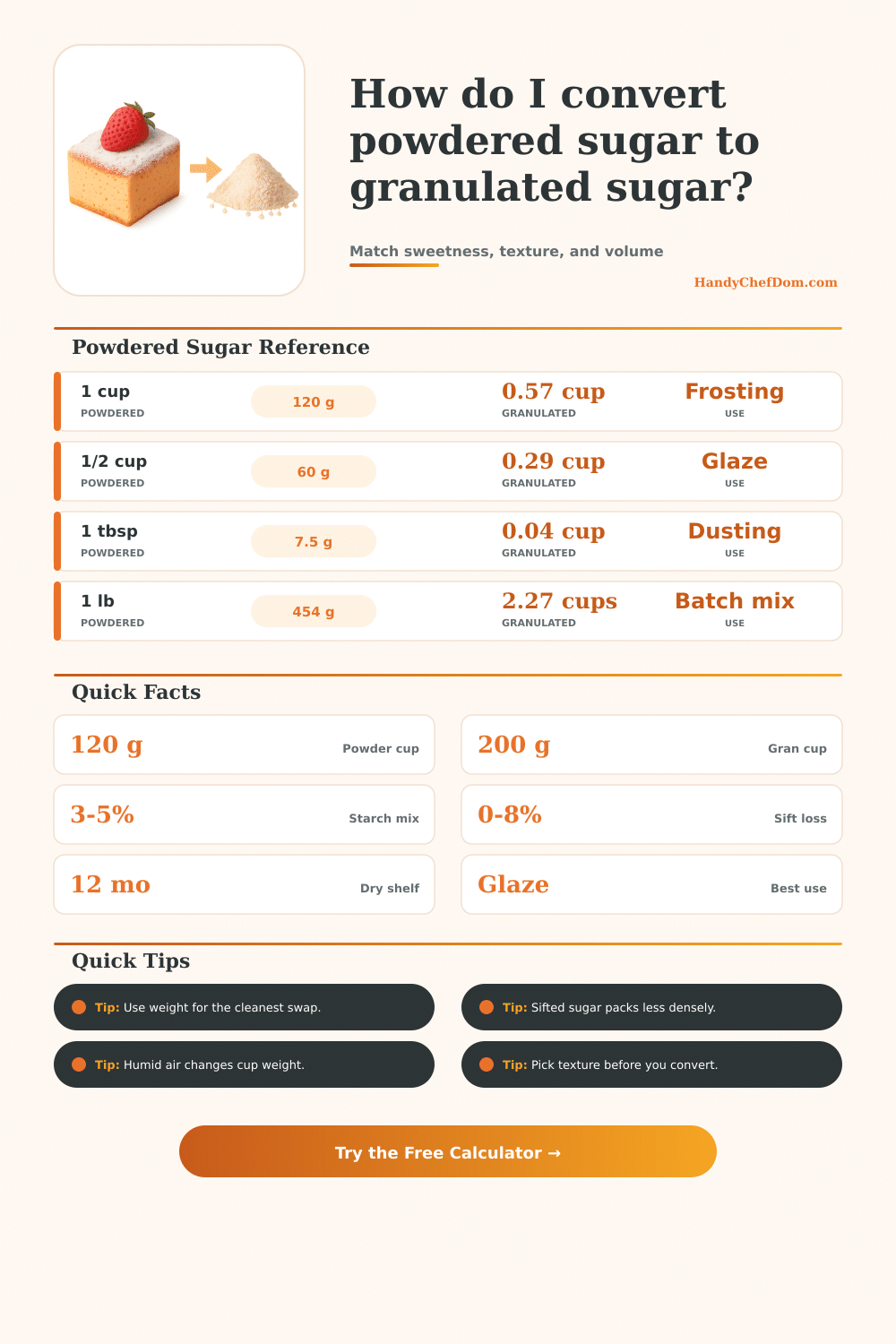
| Powdered | Weight | Granulated | Note |
|---|---|---|---|
| 1 cup | 120 g | 0.57 cup | Frosting |
| 1/2 cup | 60 g | 0.29 cup | Glaze |
| 1 tbsp | 7.5 g | 0.04 cup | Dusting |
| 1 lb | 454 g | 2.27 cups | Batch mix |
| Powdered Style | g/cup | Texture | Best Use |
|---|---|---|---|
| Fluffed | 110 | Light | Dusting |
| Standard | 120 | Balanced | Frosting |
| Sifted | 114 | Airy | Glaze |
| Lightly packed | 128 | Dense | Batch bake |
| Compacted | 135 | Very dense | Heavy mix |
| Granulated Type | g/cup | Grain | Use |
|---|---|---|---|
| Table | 200 | Standard | Everyday bake |
| Caster | 190 | Fine | Quick dissolve |
| Superfine | 195 | Small | Smooth batter |
| Raw | 180 | Coarse | Rustic crust |
| Sanding | 210 | Large | Finish sparkle |
| Context | What to watch | Swap rule | Note |
|---|---|---|---|
| Frosting | Smoothness | By weight | Whip well |
| Glaze | Clarity | By volume | Thin fast |
| Cookies | Spread | By weight | Keep texture |
| Royal icing | Set time | By weight | Use sifted |
| Meringue | Dissolve | By weight | Fine sugar wins |
Powdered sugars and granulated sugar are two differently types of sugar. Powdered sugar and granulated sugar has different densities. A machine pulverize granulated sugar into a fine dust to make powdered sugar.
Powdered sugar also contain 3 to 5 percent cornstarch. The cornstarch absorbs moisture so the powdered sugar dont clump. Because powdered sugar contains cornstarch, it have less sweetness per scoop than granulated sugar.
Powdered Sugar and Granulated Sugar: Differences and How to Substitute
Granulated sugar is more denser than powdered sugar. Granulated sugar weigh about 200 gram per cup. Powdered sugar weighs about 120 grams per cup.
You cant easily substitute powdered sugar for granulated sugar or vice versa due to the difference in the density of these two sugars. Powdered sugar have different densities depending on how it is measure. If you sift powdered sugar, air are added to the sugar that decreases the weight of the powdered sugar by up to 8 percent.
If you pack powdered sugar into a measuring cup, the density increase to 135 grams per cup. If high humidity exposes the powdered sugar, the water in the air will add moisture to the powdered sugar. The moisture allow the sugar crystals to compact.
To avoid these measurement problem, use a scale to measure the sugar in gram. Measuring sugar in grams is more accurate than measuring in cups because grams measure the mass of the sugar and the mass does not change due to changes in the density of the sugar. The texture of the sugar you use in a recipe depend on the recipe and the texture that the recipe require.
Many baking recipes that contains frosting use powdered sugar because powdered sugar dissolve easily in the fats in the frosting. Granulated sugar does not dissolve as easy and can create a grainy texture in frosting. Many cookies and batter recipes require granulated sugar.
Powdered sugar may make the cookie dough too tender or the dough may spread too much during the baking process. The texture that a recipe need will determine the kind of sugar that should be used. You need to consider the texture that a recipe require before you substitute one type of sugar for another.
Common mistake occur if you dont take into account the cornstarch in powdered sugar and the density of powdered sugar. Royal icing that contain unsifted powdered sugar will dry more slow because of the lumps in the unsifted sugar. Meringues that use too much powdered sugar may weep because of the cornstarch in powdered sugar.
Cookie doughs that do not include sifted powdered sugar may result in cookies whose spread is difficult to control. To avoid these mistakes, use the correct type of sugar for you’re baked good based off the texture the recipe require and the humidity level in your kitchen. Powdered sugar can be substituted for granulated sugar or granulated sugar can be substituted for powdered sugar.
If you are substituting powdered sugar for granulated sugar, you must convert the units from weight to weight. This is because the weight of powdered sugar is less than the weight of granulated sugar. To make the conversion, calculate the weight of granulated sugar need and convert the weight to the equivalent weight of powdered sugar.
Add 2 percent to the measurement to account for the loss of powdered sugar during sifting. Measuring by weight will ensure that your recipe come out with the proper texture. When you follow these steps, you can use the sugar you have access to in your kitchen to achieve the outcome that your recipe require.