Recipe Yield Calculator
Estimate final recipe yield, servings, and scaling from batch size, shrink, and buffer.
Set the recipe style first, then enter the starting batch weight and the losses you expect in the pan or pot.
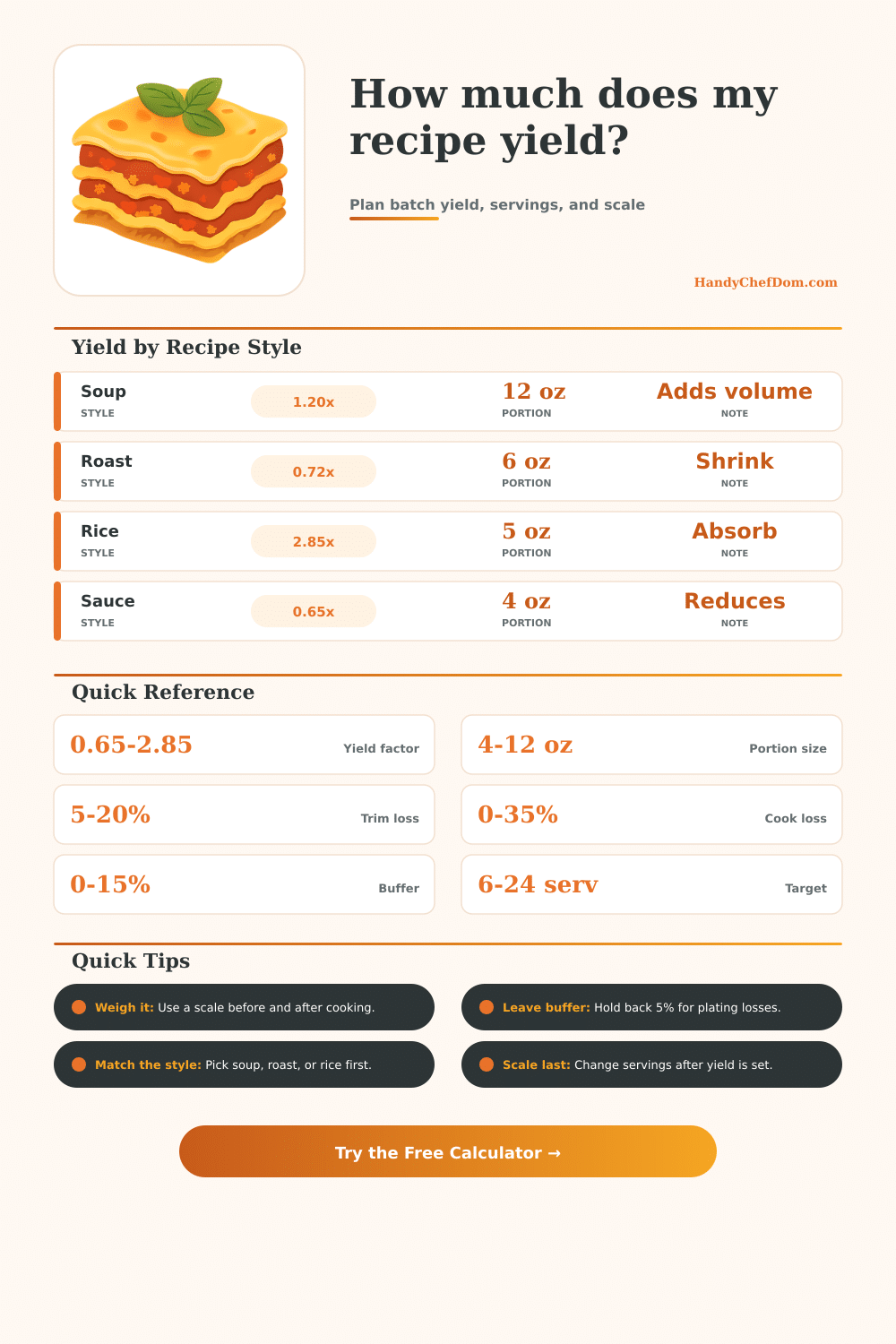
| Style | Factor | Portion | Note |
|---|---|---|---|
| Soup | 1.20x | 12 oz | Adds volume |
| Stew | 0.95x | 10 oz | Thick body |
| Roast | 0.72x | 6 oz | Natural shrink |
| Sauce | 0.65x | 4 oz | Reduces down |
| Rice | 2.85x | 5 oz | Absorbs water |
| Bake | 1.15x | 8 oz | Set batter |
| Food class | Trim | Cook loss | Note |
|---|---|---|---|
| Lean meat | 8% | 18% | Slice after rest |
| Ground meat | 3% | 22% | Drain fat |
| Vegetables | 5% | 10% | Steam softens |
| Rice grains | 0% | 0% | Absorb liquid |
| Sauces | 0% | 25% | Reduce on heat |
| Cold salad | 4% | 2% | Hold dressing |
| Serving size | Light | Standard | Hearty |
|---|---|---|---|
| Soup | 8 oz | 12 oz | 16 oz |
| Roast | 4 oz | 6 oz | 8 oz |
| Rice | 4 oz | 5 oz | 6 oz |
| Salad | 3 oz | 5 oz | 7 oz |
| Sauce | 2 oz | 4 oz | 6 oz |
| Bake | 6 oz | 8 oz | 10 oz |
| Conversion | Metric | Imperial | Use |
|---|---|---|---|
| 1 oz | 28.35 g | 0.06 lb | Fast weighing |
| 1 lb | 453.6 g | 16 oz | Batch base |
| 1 cup | 240 ml | 8 oz | Liquid yield |
| 1 tbsp | 15 ml | 0.5 oz | Small loss |
| 1 kg | 1000 g | 2.2 lb | Metric batch |
| 1 pint | 473 ml | 16 oz | Pan compare |
Recipe yield are a mathematical concept that describes the amount of food that you will have once you have prepared and cooked the recipe. Often, the amount of food that is measured in the recipe isnt the same as the amount of food that can be prepared after cooking due to the loss of food that occur during cooking. Food loss occurs during several different stage of cooking.
Food loss includes trim loss, cook loss, and evaporation. Failure to account for these forms of food loss may result in either not having enough food to feed all of the individual that you intend to feed, or in having too much food. Trim loss is the loss of food that occurs when food is prepared for cooking.
Recipe Yield and Food Loss
Food that is trimmed includes food like meat that has fat remove from it, or food items like vegetables that may have bruised or damaged portion removed. The cook can calculate the loss of weight of food due to trimming in advance. For example, lean meats may lose 8% of there weight when trimmed, but ground meat may only lose 3% of its weight due to its pre processed nature.
Cook loss is the loss of food that occurs during the cooking process. The most common example is the loss of weight of meat when it is roasted; meats can lose between 18% and 22% of their weight due to the evaporation of the meat juices during the roasting process. However, other foods may gain weight during cooking.
For instance, rice and other grain can expand to nearly three times their initial weight when cooked due to the absorption of the cooking liquid by the grains. Thus, foods like sauces may lose volume during cooking due to liquid evaporation, but foods like rice may gain volume during the cooking process. Yield percent is a term used to indicate the survival rate of food after it has been trimmed and cooked.
For instance, if a roast weighs 72% of its original weight after trimming and cooking, then the yield percent of the roast is 72%. This percentage can help to determine the amount of raw meat that should be purchase for a recipe. In order to account for food loss, however, it is recommended that 5% to 10% of food be provided as a buffer for food loss during the cooking process.
Using scales to measure ingredients is more accurate than using volume measurement to measure ingredients. For instance, weight measurements are more accurate than volume measurements because weight is a constant measurement, but volume can vary depending on the product to be measured. The cook should weigh the raw food ingredients at the start of the cooking process, and the cook should weigh the finished food product at the end of the cooking process.
The difference between these two measurements can reveal the amount of food loss that occur during the cooking process. Because food may experience different environments during cooking, yields may vary with changes in altitude in the cooking area, for instance. Foods that cook at high altitude may lose more of their liquid components than foods that cook in an area that has a higher altitude.
Thus, the cook should consider the location where the food will be cooked prior to cooking. In order to make food recipes that include an amount of food that is greater than the amount that will be prepared with the recipe as written, the recipe must be scaled. Scaling involve the use of a scale factor in the recipe that determines how much each ingredient should be multiplied.
For instance, using a scale factor of 1.2 will multiply the amount of each ingredient by a factor of 1.2. In order to accurately use a scale factor to alter the amount of food that will be prepared using a recipe, the cook should calculate the yield percent of the recipe prior to scaling the recipe. Additionally, if it is necessary for the food to provide a certain amount of food to each individual, the cook can calculate the total amount of food necessary to provide for the number of individuals.
If there is a shortfall in the amount of food prepared compared to the number of individuals that will eat, one may prepare an additional side dish for those individuals. In contrast, if there is a surplus in the amount of food prepared, the surplus may be frozen for later use. Through repeated cooking process, the yields of various food items can be tracked.
For instance, vegetables may lose 10% of their weight when cooked due to the evaporation of their moisture, but meats may lose more weight due to the loss of fat during the cooking process. Additionally, foods like salads that are prepared in advance and that are cooked to room temperature may not lose any of their weight during the cooking process. By weighing the food items before and after cooking, and by accounting for food loss and buffers, the chef can ensure that they have the correct amount of food for each meal.