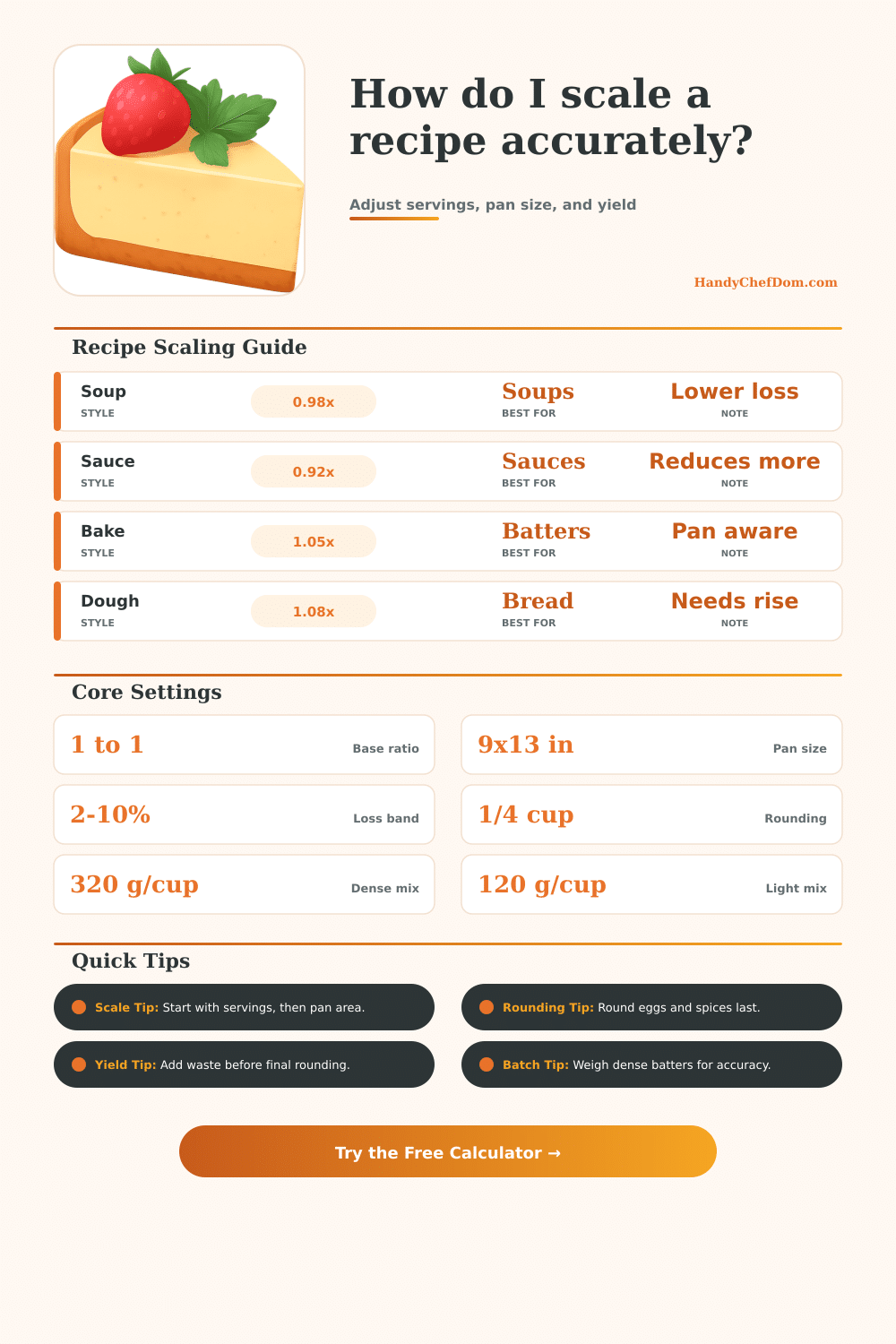
📊 Recipe Scaling Calculator
Scale recipes by servings, pan size, and ingredient style. Tune waste, density, and rounding so your batch lands where you want it.
The calculator first scales by servings, then adjusts for pan area, recipe style, and waste before rounding to your chosen increment.
| Original | Target | Multiplier | Note |
|---|---|---|---|
| 2 servings | 4 servings | 2.00x | Double batch |
| 4 servings | 6 servings | 1.50x | Small upsizing |
| 6 servings | 12 servings | 2.00x | Party size |
| 8 servings | 16 servings | 2.00x | Meal prep |
| 10 servings | 25 servings | 2.50x | Large event |
| 12 servings | 18 servings | 1.50x | Buffet size |
| Pan | Area | Relative | Use |
|---|---|---|---|
| 8x8 | 64 sq in | 0.55x | Thick bars |
| 9x9 | 81 sq in | 0.69x | Small bake |
| 9x13 | 117 sq in | 1.00x | Standard pan |
| 10x15 | 150 sq in | 1.28x | Sheet style |
| Half sheet | 216 sq in | 1.85x | Large tray |
| Full sheet | 432 sq in | 3.69x | Event tray |
| Rounding | Step | Best For | Example |
|---|---|---|---|
| Exact | 0.01 cup | Dry mix | Measured |
| 1/4 cup | 0.25 cup | Soups | Easy pours |
| 1/2 cup | 0.50 cup | Sauces | Fast batches |
| Tablespoon | 1 tbsp | Spices | Fine tuning |
| Teaspoon | 1 tsp | Salt | Precise flavor |
| Whole cup | 1.00 cup | Bulk prep | Quick scale |
| Profile | g/cup | Ounces | Note |
|---|---|---|---|
| Light batter | 120 | 4.2 | Aired mixes |
| Silky sauce | 220 | 7.8 | Pourable |
| Standard mix | 240 | 8.5 | Balanced |
| Rustic mix | 275 | 9.7 | Chunky |
| Dense batter | 320 | 11.3 | Heavy |
| Fluffy batter | 150 | 5.3 | Lighter crumb |
Scaling a recipe involve more than simply multiplying each ingredient by the same number. The ingredients do not always react in the same way to an increased recipe volume. While many peoples believe that doubling a recipe involves simply multiplying the amount of each ingredient by two, scaling a recipe involve more than simply doubling the recipe.
If these factors isnt accounted for, the end product of the recipe can have the wrong texture, the wrong flavor, or the wrong thickness. The first step in scaling a recipe is to determine the number of servings that the recipe should make. This number will become the basis of all calculations for the recipe.
How to Scale a Recipe
However, the number of servings is not the only factor that must be considered when scaling a recipe. The shape of the pans in which the recipe is prepared also change the way in which the food cooks. The surface area of the pan can impact the rate of evaporation of liquids in the food, and the depth of the food in the pan can impact the amount of time it take for the food to fully cook.
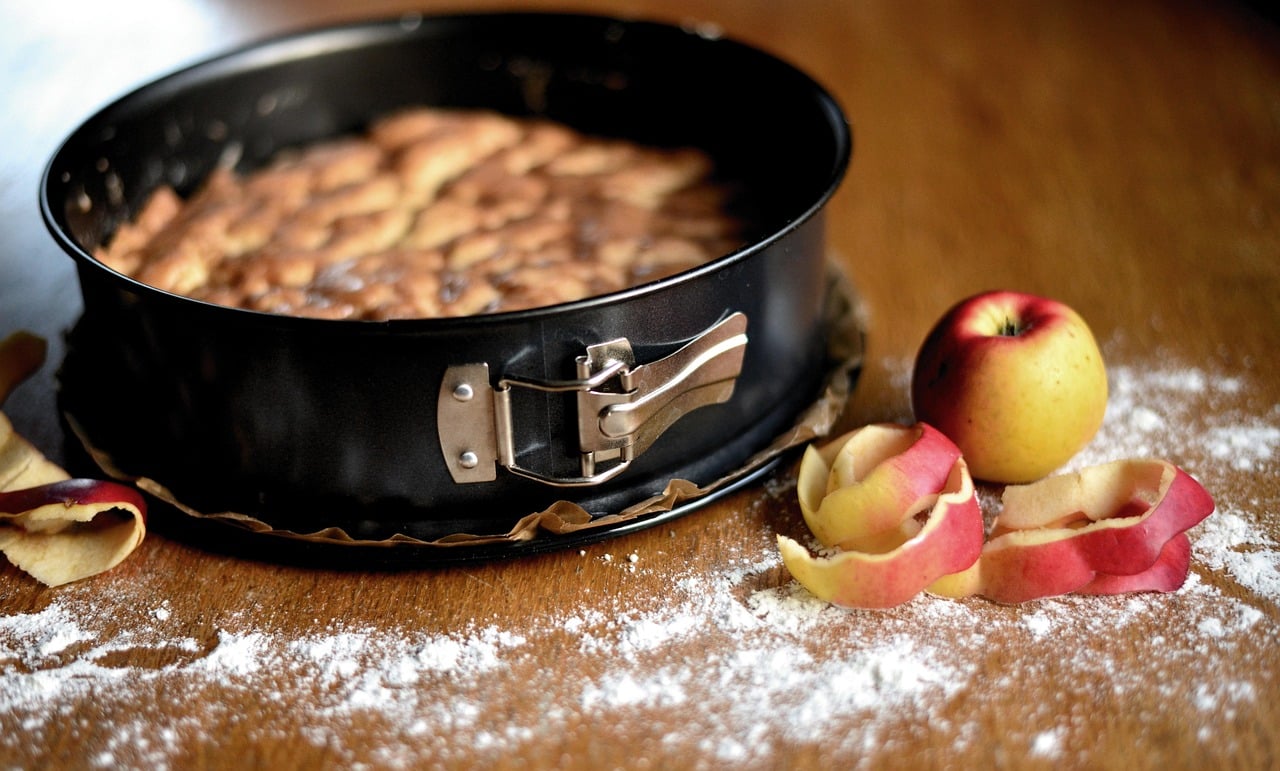
If a recipe is to be cooked in pans of a different shape and size different than those originally prescribed for the recipe, the cook may have to adjust the amount of batter so that the depth of the batter is the same as in the original recipe. Another factor that must be considered when scaling a recipe is the density of the ingredients. The density of an ingredient can change the weight of that ingredient within a certain volume.
For instance, light batters will have a different density then heavy doughs. The amount of food that is cooked also affect scaling. Some foods tend to lose some of their volume during the cooking process.
For instance, stews and sauces can lose five to ten percent of there liquid during the simmerming process in which they are cooked. To account for this loss of volume, the cook can add extra liquid to the stew or sauce before it is cooked. Another consideration when scaling a recipe involves rounding the measurements for the ingredients.
The exact measurements for each ingredient can be calculated through simple mathematics. However, these mathematical calculations often create measurements that are difficult to measure for the cook. For instance, if the calculation for an ingredient is 2.37 cups, this measurement may be rounded to a value such as 2.25 or 2.5 cup.
Additionally, the cook can round the amount of spices to the nearest tablespoon and the amount of liquids to quarter cup. By rounding these measurements, the cooking process will run smooth without having to stop to measure some ingredient. Some of the common pitfalls of scaling recipes can occur if the cook is unaware of the logic behind scaling those recipes.
One common pitfall is with recipes that use marinades. Marinades are used to coat the food, not fill a container with the marinade. Another common pitfall is in recipes that use bread doughs and yeast.
The yeast will make the dough expand when baked. The third common pitfall is with ingredients like salt and acids. These ingredients can become strong when used in large quantities in a recipe.
Therefore, tasting the food during the cooking process will allow the cook to adjust the recipe to avoid strong flavor in the food. These scaling recipe principle can be used to improve the batch cooking of recipes. Batch cooking involve preparing large quantities of food, such as chili or soup.
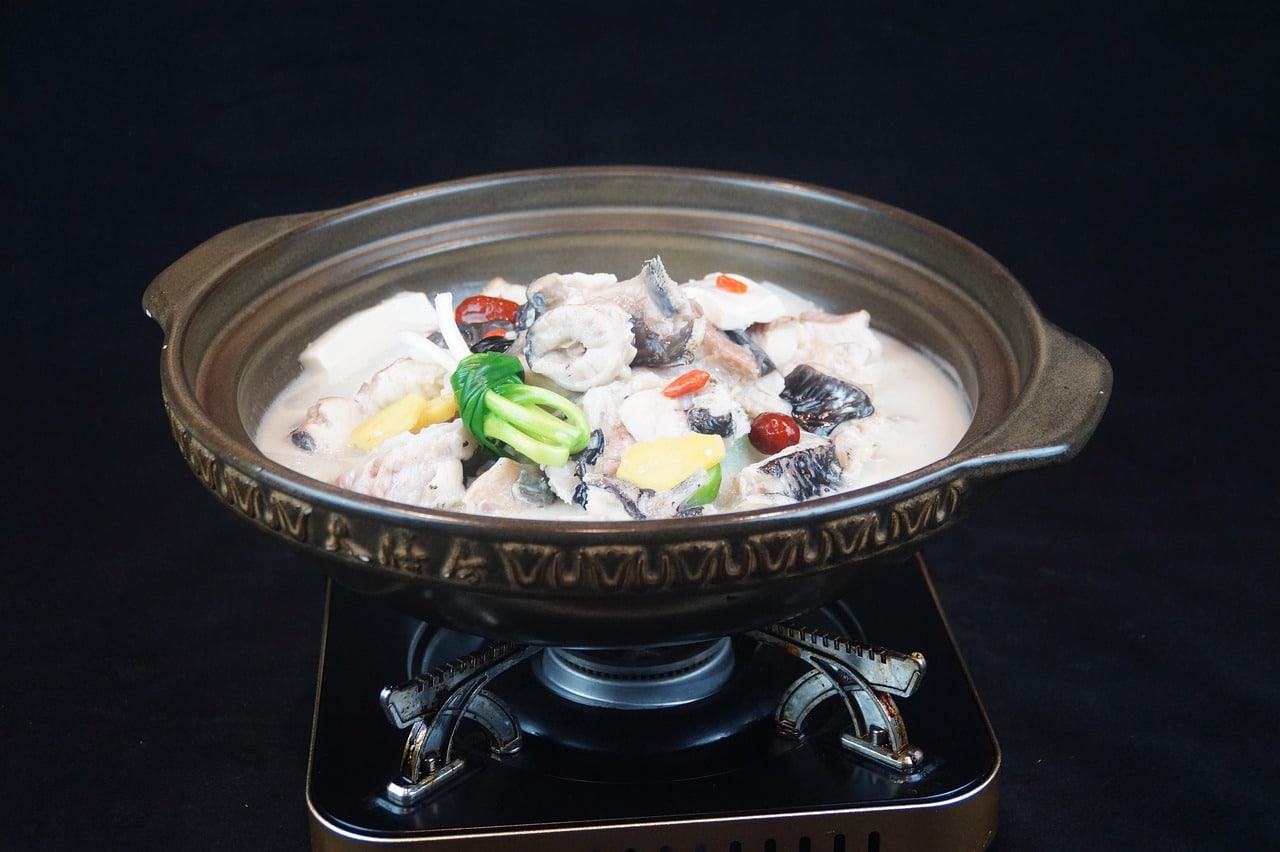
In these types of recipes, the density of the ingredients must be accounted for, as well as the amount of liquid that will evaporate during cooking. If batches of food are prepared according to the logic of scaling recipes, the batches will contain the same flavor and texture every time they are prepared. Thus, scaling recipes transform guesswork into predictability.
By following the steps described in this article, cooks can prepare batches of food that will have the same quality as the original recipe.