Grams to Cups Conversion Calculator
Convert flour, sugar, oats, cocoa, and more by ingredient density, packing style, and cup standard.
The calculator starts with a base grams-per-cup density, then adjusts for cup standard, packing style, grain size, humidity, and buffer loss.
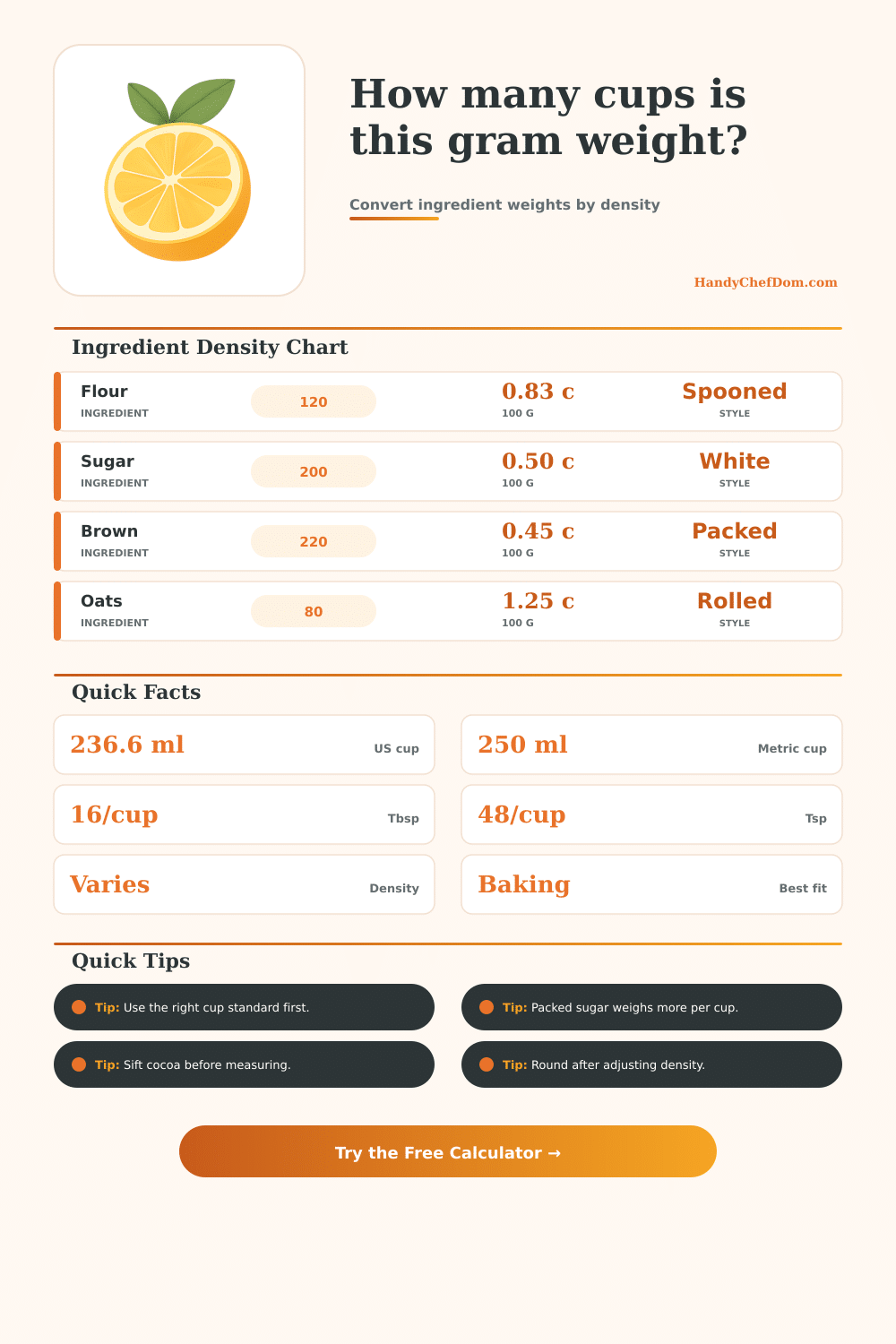
| Ingredient | g/cup | 100 g | Best style |
|---|---|---|---|
| AP flour | 120 | 0.83 c | Spooned |
| Bread flour | 127 | 0.79 c | Leveled |
| Cake flour | 114 | 0.88 c | Sifted |
| Sugar | 200 | 0.50 c | Leveled |
| Brown sugar | 220 | 0.45 c | Packed |
| Powdered sugar | 120 | 0.83 c | Sifted |
| Measure | US cup | Metric cup | Notes |
|---|---|---|---|
| 1 cup | 236.6 ml | 250 ml | Metric is larger |
| 1 tbsp | 14.8 ml | 15.6 ml | 16 tbsp per cup |
| 1 tsp | 4.93 ml | 5.21 ml | 48 tsp per cup |
| 1/2 cup | 118.3 ml | 125 ml | Half measure |
| 1/4 cup | 59.1 ml | 62.5 ml | Quarter measure |
| 1/8 cup | 29.6 ml | 31.3 ml | Two tbsp |
| Style | Factor | Works for | Note |
|---|---|---|---|
| Spooned | 1.00x | Flour | Most precise |
| Sifted | 0.92x | Cocoa | Airy texture |
| Packed | 1.10x | Brown sugar | Compresses density |
| Compacted | 1.14x | Breadcrumbs | Heavier cup |
| Loose scoop | 0.90x | Oats | Fluffier fill |
| Leveled | 1.00x | Dry goods | Standard use |
| Weight | Flour | Sugar | Oats |
|---|---|---|---|
| 50 g | 0.42 c | 0.25 c | 0.63 c |
| 100 g | 0.83 c | 0.50 c | 1.25 c |
| 150 g | 1.25 c | 0.75 c | 1.88 c |
| 200 g | 1.67 c | 1.00 c | 2.50 c |
| 250 g | 2.08 c | 1.25 c | 3.13 c |
| 300 g | 2.50 c | 1.50 c | 3.75 c |
Baking require precision because baking involve a chemical process for which the ratio of ingredients determine the texture of the final baked good. Many recipe use the weight of ingredients in grams for accuracy in the baking process. However, many home cooks use volume measurement in cups because these is the measuring cups that is found in most kitchens.
Using volume measurements for baking can be inaccurate because the density of the ingredient can change depending on how the ingredient are measured. Density is the amount of mass of an ingredient that occupy a certain volume. Dense ingredient will weigh more when poured into a measuring cup than less densly ingredients.
Measuring Ingredients for Baking
Knowing the density of ingredients is essential in the kitchen because the density can change depending on how a cook place an ingredient into the measuring cup. For instance, if you spoon flour into the measuring cup, the density of the flour will be less than if the flour is pack into the measuring cup. If the flour is packed, it will weigh more than if the flour was spooned into the measuring cup.
The difference in the weight of the same ingredient can cause baking error. Using too much of an ingredient, such as flour, can make a baking good toughly. Using too little of an ingredient can result in a baking good that dont have the proper structure to set.
The size of the measuring cup can also have an impact on the measurement of an ingredient. Depending on the region of the world from which a recipe originate, the size of a cup can change. In the United States, a standard cup has a volume of 236.6 milliliters.
However, in most other countries, a cup, also known as a metric cup, have a volume of 250 milliliters. Because a metric cup is larger in volume than a United States cup, using a metric cup will measure more of an ingredient. The size of the cup can change the amount of an ingredient require in a recipe.
Therefore, it is essential to know which kind of cup a recipe require. Additionally, the packing of an ingredient will affect it’s density. For instance, you should spoon flour into the measuring cup and level it off with a knife to ensure that the density of the flour is the same throughout the recipe.
In contrast, brown sugar is moist and you should pack it into the measuring cup so that it weigh the same as other batch of brown sugar. The environmental factor in which an ingredient is measured can affect the weight of that ingredient. For instance, high humidity will add moisture to dry ingredients such as flour or powdered sugar.
The moisture will make the dry ingredients heavier. This additional weight will impact the weight measurement for these ingredients. The size of the grain within an ingredient can also impact the weight of the ingredient.
Fine powder like cocoa powder will fill the gap between the granules within the measuring cup. Therefore, cocoa powder will have a different density than coarse ingredient like nuts. Coarse ingredients will leave gaps within the measuring cup so that the density of these ingredients will be more lower than that of fine powders.
To avoid mistake in the kitchen, there are specific method that cooks should use when measuring different ingredients. For example, you should spoon flour into the measuring cup and level it off with a knife to ensure that the flour is not pack too tightly into the cup. Cocoa powder should be sifted before it is measured to ensure that the ingredients are even throughout the recipe.
Brown sugar should be packed into the measuring cup because the brown sugar are moist. If you scoop flour directly from the bag into the measuring cup, the flour will be packed too tightly. This will ruin the texture of the baked good.
Professional baker will weigh ingredients by using a scale because it is the most accurate way to measure ingredients. However, most cooks will use measuring cup because they are the quickest way to measure ingredients. If cooks choose to use measuring cups instead of weighing ingredients on a scale, they can use a reference chart to see the weight of an ingredient that fill a measuring cup.

For instance, using a reference chart, cooks can determine that 100 grams of flour will take up more space in a measuring cup than 100 grams of sugar. This is because sugar is more densly than flour. Knowing the difference in density of ingredients allow cooks to bake goods with precision and accuracy.