Scoville Calculator for Pepper Heat
Estimate Scoville heat, capsaicin load, dilution, and serving impact with this scoville calculator. Compare peppers and scale recipes with confidence.
This tool estimates a recipe heat score from pepper heat, amount used, dilution, and serving size. Use the sample batch presets for quick planning.
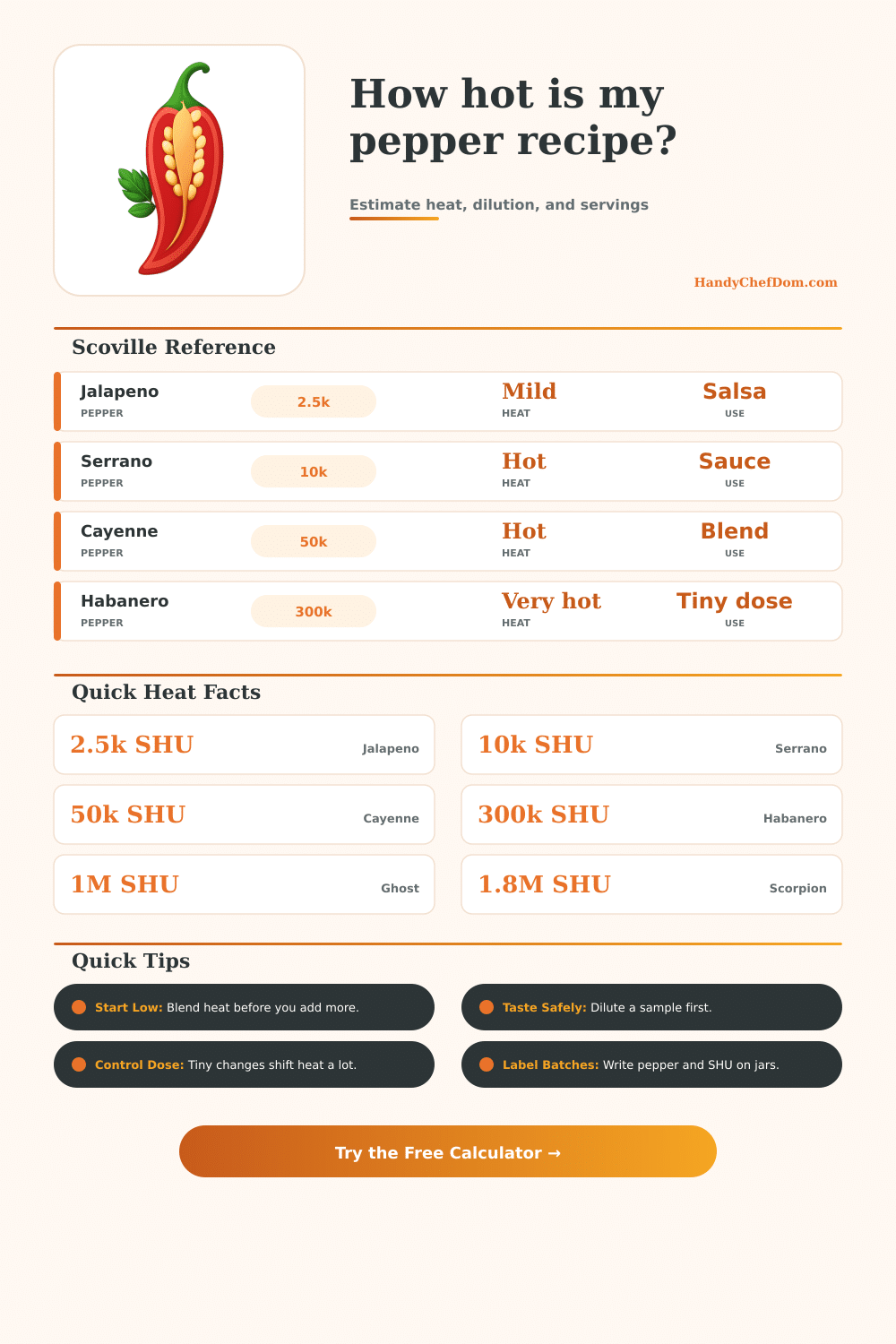
| Pepper | SHU | Heat | Use |
|---|---|---|---|
| Jalape?o | 2.5k | Mild | Salsa |
| Serrano | 10k | Hot | Sauce |
| Cayenne | 50k | Hot | Dry rub |
| Habanero | 300k | Very hot | Micro dose |
| Ghost | 1M | Extreme | Test batch |
| Scorpion | 1.8M | Extreme | Trace use |
| Style | Base | Limit | Note |
|---|---|---|---|
| Salsa | 2.5k | 10k | Fresh bite |
| Hot sauce | 10k | 50k | Thin, sharp |
| Dry rub | 50k | 150k | Short burn |
| Wing sauce | 10k | 80k | Butter softens |
| Brine | 2k | 8k | Spread heat |
| Paste | 100k | 300k | Dense dose |
| Dilution | Factor | Result | Use |
|---|---|---|---|
| None | 1.0x | Full heat | Need max |
| Slight | 0.9x | Small cut | Balanced |
| Medium | 0.8x | Soft burn | Family |
| Heavy | 0.7x | Wide spread | Big batch |
| Oil rich | 0.85x | Long finish | Sauce |
| Acid boost | 0.95x | Brighter | Salsa |
| Serving | Heat | Detail | Note |
|---|---|---|---|
| 1 tbsp | High | 1-2 dabs | Small hit |
| 2 tbsp | Med | Spoonable | Everyday |
| 1/4 cup | Med | Dip level | Party use |
| 1/2 cup | Low | Spread out | Shared |
| 1 cup | Low | Diluted | Family |
| 2 cups | Very low | Wide pan | Buffet |
Scoville Heat Units, or SHU, are a measurement of the amount of capsaicin in a pepper. Capsaicin is the chemical compound in peppers that create the sensation of heat in the body. The Scoville Heat Unit scale allows a person to understand how much heat a pepper will add to a recipe.
Wilbur Scoville created the Scoville Heat Unit scale in 1912. The Scoville scale measure the amount of capsaicin in a pepper by diluting the peppers extract in sugar water until no heat is detected. The higher the number of times the extract must be diluted until no heat is detectable, the more higher the capsaicin content in the pepper.
Scoville Heat Units: What They Mean and How to Control Heat in Cooking
A jalapeño pepper will have a lower Scoville Heat Unit rating than a scorpion pepper because the scorpion pepper contain more capsaicin. The Scoville scale is measured today via high-performance liquid chromatography machines to determine the amount of capsaicin in a pepper. Understanding Scoville Heat Units can help a chef determine how much heat a pepper will add to a final recipe, but the raw Scoville Heat Unit rating of a pepper dont indicate the heat in the final recipe.
Consider how chopping a single habanero pepper and adding it to eight cups of tomato and vinegar can dilute heat. The heat from the habanero pepper will be diluted in this sauce. Chefs must take into account other ingredients besides peppers when estimate heat in a recipe.
Liquids will distribute the capsaicin throughout the batch, but fats like oil will coat the tongue and create the sensation of less heat. This occurs because capsaicin molecules binds to fat rather than remaining on the tongue. Acids like lime juice will alter how heat is perceived in the recipe, but they will not add capsaicin to the dish.
A person can make mistakes in adding peppers to a recipe if estimating the amount of pepper by eye. Capsaicin load should be calculated per bite of the recipe because each recipe has a different level of heat. For example, adding butter to a sauce will create less heat than if the sauce were dry and contained no liquids.
The heat from cayenne pepper will be tempered if it is cooked in butter because the fat molecules will bind to the capsaicin. However, heat from cayenne pepper in a dry rub will be stronger because there are no fat molecules to bind to the capsaicin. Pastes will contain more capsaicin per batch than brined peppers because the capsaicin molecules will not diffuse throughout the batch of food in oil.
A person can set presets for recipes to manage the amount of capsaicin in the food. A person can create presets to add typical amounts of peppers to a recipe, such as setting a stir fry recipe to use pods of Thai chilies, or a salsa recipe to use specific cups of fresh peppers. A person can also adjust the base liquid to use in the recipe or the batch dilution levels for the heat of the recipe.
Dilution is the ratio of the mass of the pepper to the total mass of the batch of the recipe. If the recipe is for a large group of people, the dilution level should be increased to allow for the heat to be lower. For recipes that are meant to be very spicy, the dilution level should be decreased to increase the heat levels of the food.
The outputs of the calculation provide information for the chef to understand the heat levels of the food. If the heat level per serving is 2,500 Scoville Heat Units, the heat level of the food will be mild. If heat level per serving are 10,000 Scoville Heat Units, the food will be hot.
If the heat level per serving is more than 50,000 Scoville Heat Units, the food is considered to be very hot and might be used as a rub or a paste. The information can be used to scale the recipe up or down. For instance, ghost peppers contain a very high dose of capsaicin with a load of one million Scoville Heat Units.
However, only a very small amount of ghost pepper is used in a large batch of food. There are several ways to avoid common pitfalls when cooking with peppers. Because the heat level of the pepper can vary, even with the same species of pepper, it is critical to understand that fresh peppers will have more capsaicin than others.
Additionally, peppers will be more intense when they are dried. Therefore, tasting a sample of the food and adding capsaicin to a dish will allow a person to taste the heat level of the food before adding all the ingredient. If a person finds that the sensation of heat from the peppers is becoming too strong, milk or bread can be added to the food.
However, water should not be used to counteract the heat from the capsaicin in the peppers because the water will spread the capsaicin throughout the mouth. Some people will feel less heat from capsaicin in their foods than others. The genetics of a person can affect how they will feel the heat from the peppers.
Sweetness from ingredients like onions or fruit can balance the heat from the peppers in a dish. Therefore, it is best to build up the heat levels in a recipe gradual. Finally, any peppers that are prepared should be labeled with the type of pepper that is used and the estimated Scoville Heat Unit value.
The memory of how hot a pepper was can fade over time. Labeling peppers will allow cooks to prepare food that contains the heat value that is desired. If a chef can control the dose of capsaicin that is added to food, the peppers can be used as a precision ingredient rather than one that is guess at during the cooking process.