🍖 Meat Roasting Time Calculator
Plan roast time, pull temp, and rest windows for beef, pork, lamb, chicken, turkey, and brisket with confidence.
Use the cut type first, then tune weight, thickness, roast temp, and starting temp. Safe cuts clamp to USDA floors while whole roasts still pull early for carryover.
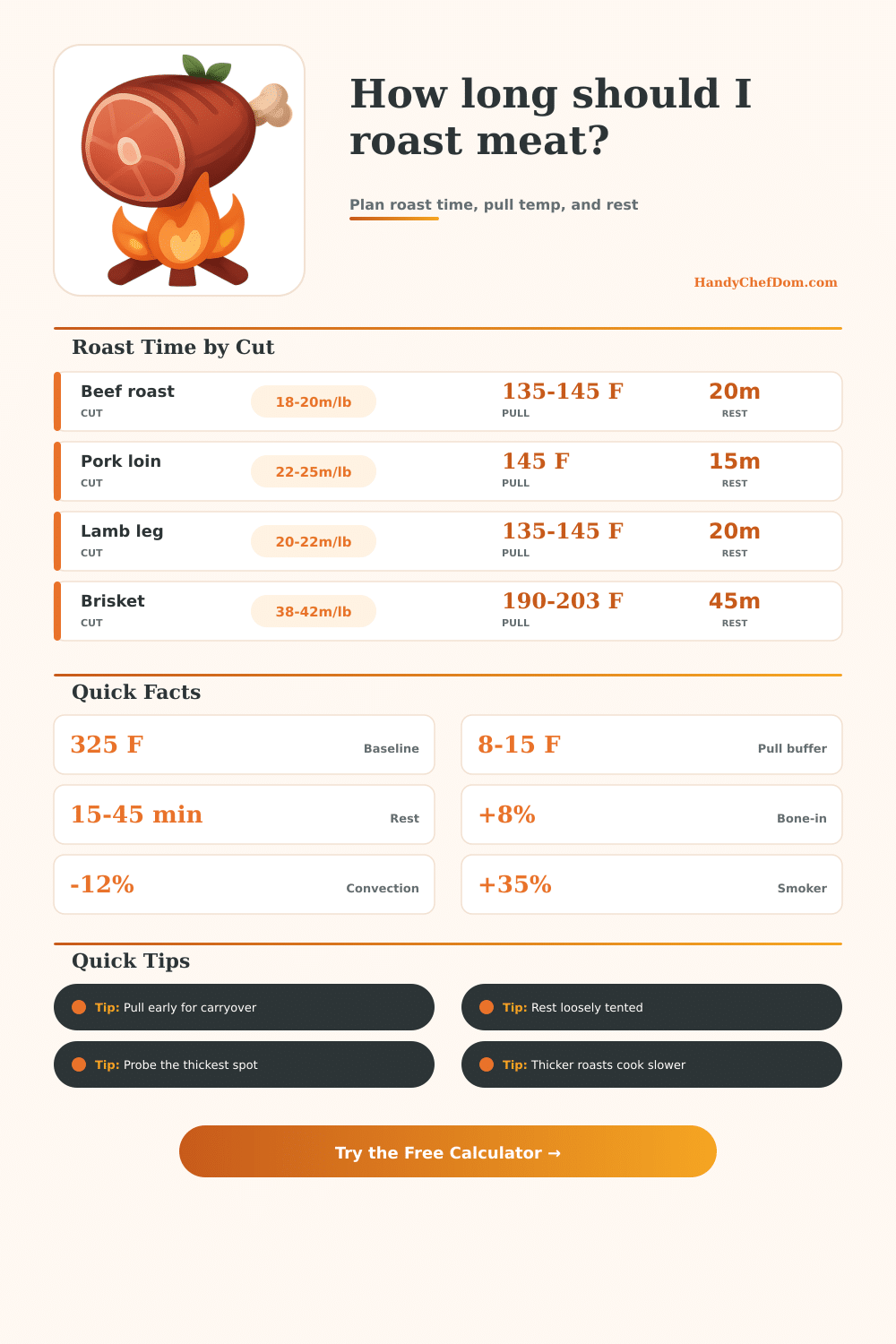
| Cut | 325 F | Pull | Rest |
|---|---|---|---|
| Beef roast | 18-20m/lb | 135-145 F | 20m |
| Pork loin | 22-25m/lb | 145 F | 15m |
| Lamb leg | 20-22m/lb | 135-145 F | 20m |
| Turkey breast | 16-18m/lb | 165 F | 20m |
| Brisket | 38-42m/lb | 190-203 F | 45m |
| Meatloaf | 28-32m/lb | 160 F | 15m |
| Meat | Target | Pull | Note |
|---|---|---|---|
| Beef steak | 130-145 F | 125-138 F | Medium rare |
| Pork roast | 145 F | 137-140 F | Juicy finish |
| Poultry | 165 F | 158-160 F | Safe floor |
| Lamb | 135-145 F | 128-138 F | Slice after rest |
| Ground beef | 160 F | 156 F | Safe minimum |
| Brisket | 203 F | 190-198 F | Probe tender |
| Method | Factor | Heat | Note |
|---|---|---|---|
| Oven | 1.00 | Even | Baseline roast |
| Convection | 0.88 | Circulated | Faster cook |
| Smoker | 1.35 | Low | Slow bark |
| Slow roast | 1.15 | Gentle | Longer finish |
| Open pan | 0.96 | Dry heat | Good browning |
| Foil tent | 0.92 | Covered | Moist finish |
| Serving | Raw | Cooked | Note |
|---|---|---|---|
| Beef roast | 0.75 lb | 0.60 lb | Hearty plate |
| Pork loin | 0.50 lb | 0.39 lb | Lean slices |
| Chicken | 0.40 lb | 0.29 lb | Family meal |
| Turkey | 0.45 lb | 0.34 lb | Holiday plate |
| Brisket | 0.33 lb | 0.20 lb | Slow roast |
| Meatloaf | 0.33 lb | 0.24 lb | Classic slice |
Roasting meat require an understanding of several specific variable. The variables impact the end texture and temperature of the roast. Carryover cooking is the process in which the roast’s internal temperature continue to rise after removing the roast from the oven.
This is due to the heat from the outer layers of the roast cooking the interior of the roast. Because the interior of the roast continues to cook after the roast is removed from the oven, the roast should be removed from the oven before it reach the target internal temperature. The cook should remove the roast from the oven when the internal temperature of the roast is eight to fifteen degrees below the target temperature.
What Affects How Meat Cooks
The thickness of the roast and whether or not it include any bone will impact how the roast cooks. A thick roast will require more cooking time than a thin roast. Additionally, the presence of bones will reduce the rate at which heat can travel to the center of the roast.
Bone in cuts of meat will require approximately eight percent more cooking time than cuts without bones. A probe thermometer should be used to gauge the internal temperature of the roast. The probe should not touch any bone when measuring the roast’s internal temperature.
Different type of meat will require different cooking time and temperature. Beef roasts will require different cooking time then roasts like brisket. Additionally, the target internal temperature of a pork loin will differ from roasts like beef.
For instance, a beef roast cooked at 325 degrees F will require a specific amount of time per pound of beef. Brisket will cook for a different amount of time per pound of beef due to the higher amount of connective tissue in brisket. Pork loin contain less fat and is a leaner cut of meat than beef roasts.
Therefore, the cook should roast the pork loin until the internal temperature reaches 145 degrees F. Turkey will require approximately sixteen to eighteen minutes of cooking per pound of turkey to reach the internal temperature needed to ensure food safety. The internal temperature should reach 165 degrees F. The same can be said for ground meats like meatloaf. Because ground meats have a higher surface area of protein, it need to be cooked to 160 degrees F to kill any harmful pathogen.
The method in which the roast is cooked will impact the amount of time the roast spend in the oven. A convection oven use a fan that circulates the hot air around the roast. Using a convection oven can reduce the cooking time of the roast by approximately twelve percent.
A smoker use low heat and cooks the roast over a long period of time. Using a smoker will increase the cooking time of the roast by thirty-five percent or more. Placing a tent of foil on the roast will trap the steam that cooks the roast slight faster while retaining the moisture of the roast.
The starting temperature of the roast can also impact the cooking time of the roast. If the roast starts at forty degrees F, like when taken out of the refrigerator, it will require more time to cook than if the cook took the roast out of the refrigerator and allow to sit at room temperature for the roast to reach an equilibrium in temperature. Once the roast is removed from the oven, it must rest for the juice to redistribute throughout the roast.
The roast should rest for fifteen to forty-five minutes. During the cooking process, the juices are forced to the flats of the roast, so when the cook removes the roast from the oven and slice, the juices will exit the roast, making the roast dry. A loose tent of foil can be placed on the roast while it rest.
The foil tent will allow the steam to escape from the roast so that the roast does not become too wet. Another variable to plan for is the fact that the roast will lose weight during the cooking process. During roasting, the moisture in the roast will evaporate.
Additionally, the fat in the roast will render during cooking. For instance, a six pound beef roast will come to the table as only four pound of cooked meat. This weight should of been considered when planning portions of the roast.
If the recipe is planned for the raw weight of the roast, there may not be enough meat for each person who will eat the roast. Youll also need to consider teh size of the furnitures in the room if your hosting a large group. It isnt always easy to plan for alot of guest.