Dough Hydration Calculator
Balance flour, water, salt, oil, and starter for bread, pizza, focaccia, and enriched doughs with clear baker's percentages.
Baker's percentages are based on flour weight. Starter is treated as a 100% hydration levain so the water and flour in the starter both count toward the final dough.
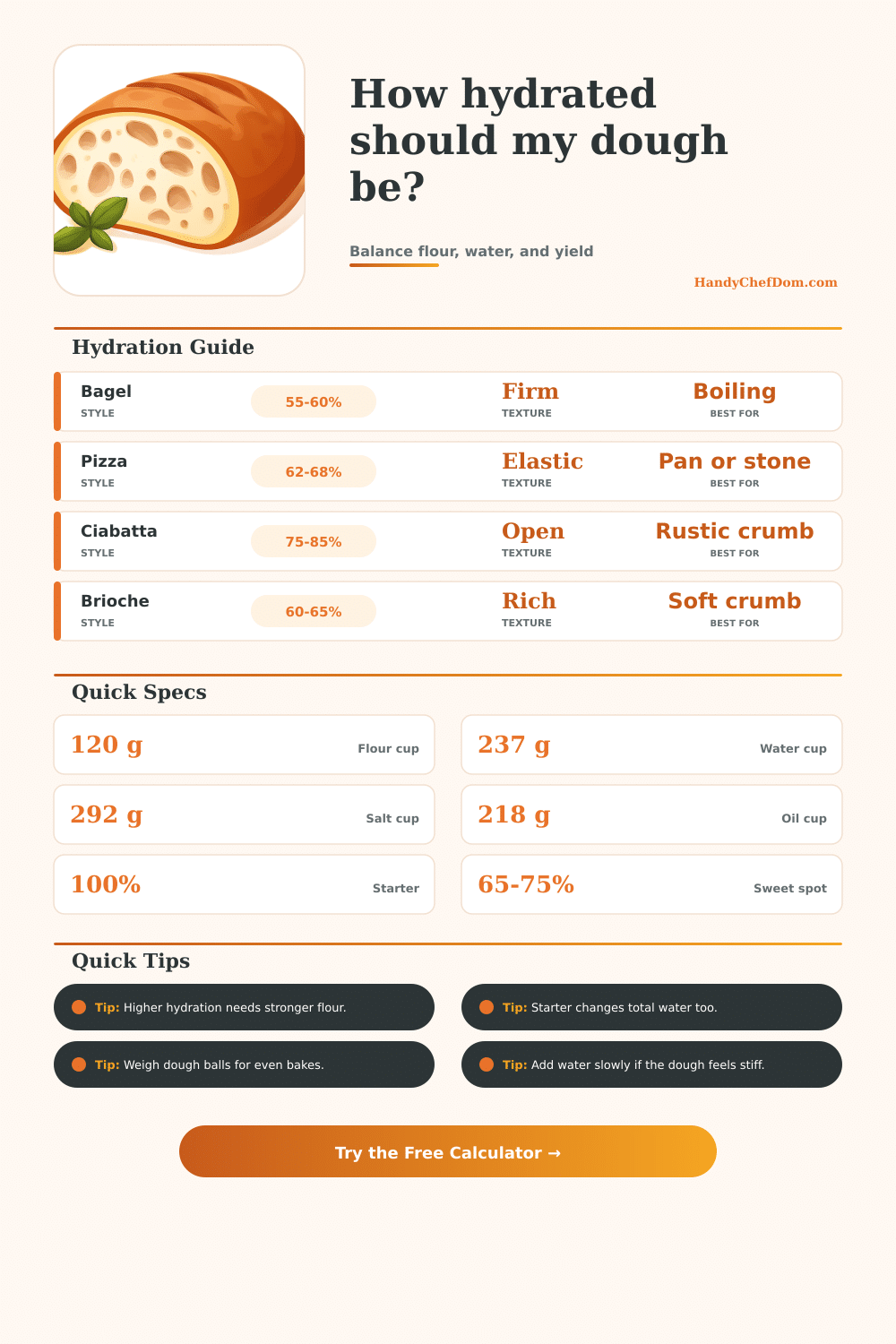
| Style | Hydration | Feel | Use |
|---|---|---|---|
| Bagel | 55-60% | Firm | Shaping |
| Pizza | 62-68% | Elastic | Stretching |
| Sandwich | 60-65% | Tight | Loaf pan |
| Ciabatta | 75-85% | Slack | Open crumb |
| Focaccia | 70-80% | Soft | Sheet pan |
| Brioche | 58-65% | Rich | Enriched |
| Flour | Absorb | Best Range | Note |
|---|---|---|---|
| Bread | High | 65-80% | Strong gluten |
| AP | Mid | 60-72% | Easy balance |
| 00 | Mid | 58-70% | Fine crumb |
| Whole wheat | High | 70-85% | More bran |
| Rye | Very high | 75-95% | Sticky dough |
| Semolina | Mid | 60-75% | Firm bite |
| Ingredient | 1 Cup | 1 Tbsp | Note |
|---|---|---|---|
| Water | 237 g | 15 g | Baseline |
| Bread flour | 120 g | 7.5 g | Light scoop |
| AP flour | 120 g | 7.5 g | Similar weight |
| Salt | 292 g | 18 g | Fine table salt |
| Oil | 218 g | 13.5 g | Olive or neutral |
| Starter | 240 g | 15 g | 100% hydration |
| Flour | Hydration | Dough | Pieces |
|---|---|---|---|
| 500 g | 65% | ~845 g | 3 x 280 g |
| 500 g | 75% | ~895 g | 3 x 295 g |
| 1000 g | 65% | ~1690 g | 6 x 280 g |
| 1000 g | 75% | ~1790 g | 6 x 300 g |
| 2000 g | 70% | ~3380 g | 12 x 280 g |
| 2000 g | 80% | ~3580 g | 12 x 300 g |
Hydration refer to the ratio of water to flour in a dough recipe. The amount of water used in the dough will affect dough’s texture and structure. Using too little water will result in a dough that is tight and firmly to the touch.
Using too much water will result in a dough that is slack and sticky. Knowing the amount of hydration necessary for a particular recipe is essential to understanding how the dough will behave during kneading and while ferment. Hydration is calculated as a percentage of the weight of the flour that is used in the recipe.
What is dough hydration and why it matters
For instance, 70% hydration mean that 70 grams of water are added to every 100 gram of flour. The percentage allow for dough recipes to be easily scaled to whatever amount of flour is to be used. You must weigh the flour and water for a recipe on a scale to ensure accuracy of ingredients.
Using volume measurements for flour can lead to inaccuracies in the amount of flour that is added to the recipe. The weight of flour will always be the same, but the weight of flour that is scooped from a sack can differ. The type of flour that is used in a recipe will impact the hydration level that is used.
Flours that contain a higher protein content, such as bread flour, can absorbs more water than flours that contain less protein, like all-purpose flour. Flours that contain bran, such as whole wheat or rye flour, can absorb even more water than white flour. If the type of flour has a high hydration level but a low protein content, the dough can collapse.
The baker will need to adjust the hydration level to the type of flour that is being used in the recipe. The amount of hydration that is added to the sourdough starter will impact the total hydration level of the dough. A sourdough starter typically contain equal parts of flour and water, making its hydration level 100%.
Adding this to a dough will add both flour and water to the recipe. You will need to account for the amount of flour and water in the sourdough starter when determining the total hydration level of the dough. The type of bread that is to be baked will impact the hydration level of the dough that is used.
For instance, Neapolitan pizza dough contains 65% hydration levels because this hydration level results in an elastic dough that is easy to shape. Focaccia dough contains 80% hydration because a higher hydration level creates a soft texture. Sandwich loaves will contain a lower hydration level to provide the dough with more structure.
The type of bread that is to be baked will inform the hydration level that is used when preparing the dough. The humidity in the kitchen will impact the hydration level of the dough. In a kitchen with high humidity levels, the flour will absorb more water from the air.
In this case, less water will need to be added to the dough. In a dry kitchen, more water will need to be added to allow the flour to properly hydrate. An autolyse is a process that allow the flour to absorb the water before the salt is added to the dough.
This allows for high hydration levels to be easier to mix and knead. Depending on the hydration levels of the dough, different mixing techniques will be used. Low hydration dough will require more kneading to allow the gluten in the flour to properly develop.
High hydration levels for dough will require the use of the slap and fold technique to allow the gluten to develop without adding more flour to the recipe. High hydration dough can also be rested in a refrigerator to perform a cold retard. This allows the dough to stabilize and develop deeper flavor during the fermentation phase.
Using a scale to measure the flour and water will always be used in baking sourdough. Using volume measurements will result in inconsistencies in the hydration levels of the dough. If the hydration level of the dough is not consistent, the texture of the baked bread will also not be consistent.
By weighing out the flour and water separately, you can maintain control over the hydration levels of the dough. By maintaining control over the hydration levels, consistency in the texture of the baked bread can be achieved.