🔪 Knife Sharpening Angle Calculator
Set the edge angle, lift height, and finish grit for Western, Japanese, and outdoor blades.
Use the unit toggle first, then enter the blade and stone dimensions. The calculator converts the values internally before solving the angle geometry.
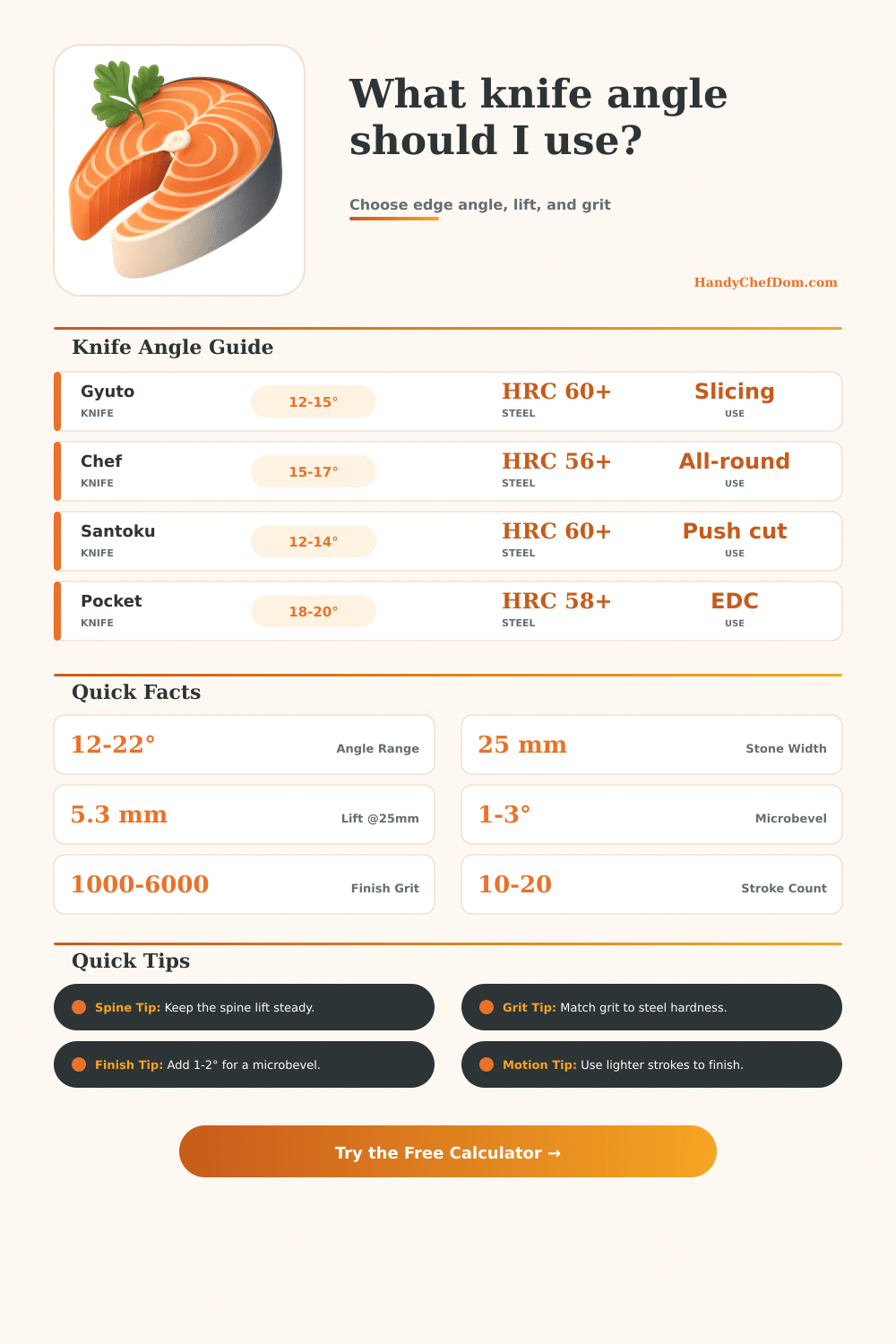
| Knife | Angle | HRC | Best Use |
|---|---|---|---|
| Gyuto | 12-15° | 60+ | Slicing |
| Santoku | 12-14° | 60+ | Push cuts |
| Western Chef | 15-17° | 56+ | All-purpose |
| Fillet | 16-18° | 56+ | Flexible cuts |
| Pocket Knife | 18-20° | 58+ | EDC |
| Cleaver | 20-22° | 52+ | Chopping |
| Stone Width | 10° | 15° | 20° |
|---|---|---|---|
| 20 mm | 3.5 mm | 5.4 mm | 7.3 mm |
| 25 mm | 4.4 mm | 6.7 mm | 9.1 mm |
| 40 mm | 7.1 mm | 10.7 mm | 14.6 mm |
| 50 mm | 8.8 mm | 13.4 mm | 18.2 mm |
| HRC | Angle | Edge Feel | Note |
|---|---|---|---|
| 52-55 | 18-22° | Durable | Field tools |
| 56-58 | 15-18° | Balanced | Kitchen work |
| 59-61 | 12-15° | Fine | Hard steel |
| 62-64 | 10-12° | Very keen | Light touch |
| Finish | Grit | Strokes | Result |
|---|---|---|---|
| Mirror | 3000-8000 | Light | Polished |
| Balanced | 1000-3000 | Medium | Clean bite |
| Toothy | 600-1500 | Short | Aggressive |
| Workhorse | 400-1000 | Short | Durable |
The angle of the knife edge can determine how a knife will perform during the cooking tasks. Depending on the knife, the angle can be too acute or too obtusly. A knife with the incorrect angle for the food to be chopped will not cut the foods well, such as a knife skin tearing a tomato.
A person must have an understanding of the angle of a knife edge in order to successfully sharpen a knife. The person must balance the angle of a knife edge appropriately between the sharpness of the knife and the durability of the knife. A very narrow angle, like a Japanese gyuto knife, will produces a very sharp knife that will chip on encountering hard objects.
Knife Angle and How to Sharpen a Knife
A wider knife blade, like a hunting knife, will be durable but will dull quick when cutting on objects like paper. The ideal knife edge angle depends on the type of task the knife will perform and the type of steel from which the knife is made. The hardness of the steel that the knife is made of will impact the appropriate angle for the knife edge.
The Rockwell C Hardness scale, or HRC, is used to rate the hardness of the steel. Knives with softer steels, at around 55 HRC, will be more durable but will require a wider knife edge. Hard steels at 60 HRC or above can take a much narrower knife edge, such as 12 degrees.
Using a narrow angle with soft steel will cause the knife to fail, and using a wide knife angle with hard steel will result in a knife edge that is not as sharp as it could of been. The height of the spine of the knife and the thickness of the blade will impact how much the knife must be lifted to achieve the desired knife angle. The taller and thicker the blade, the more that the knife must be lifted to achieve the desired knife angle.
Using mathematics, a person can calculate what the elevation of the spine should be for the knife to maintain it’s edge. Maintaining a consistent knife angle for the blade will ensure that the knife edge is sharpened even from the heel of the blade to its tip. A microbevel can be ground into the knife edge to increase its durability.
A person can do a microbevel by grinding one or two degree into the knife edge where the blade meets the steel of the knife. The microbevel acts as insurance for the knife edge because it prevents the knife edge from rolling on the cutting surface during food preparation. A person can alter the grit of the sharpening stone according to the type of edge that is desired from the knife.
For knives used for outdoor tasks, the cook will use a coarser grit to create a toothed knife edge. For knives that will be used for food preparation, a fine grit will create a polished knife edge. Sharpening stones are used to sharpen the knife edges.
A person can sharpen knives on sharpening stones of various widths. Using wider sharpening stones allow for the knife to be more stable, especially if it has a tall and thick spine. Using mathematics, a person can determine how much of a lift is required to the knife so that the knife edge maintains its angle.
A person should use sharpening stones of varying grits. A person should begin with a coarse grit sharpening stone and work to finer grit sharpening stones. A person should alternate the sharpening of each side of the knife because sharpening only one side will cause the knife to become dull on that side.
There are many mistakes that people can make when attempting to sharpen a knife. One of the most common knife sharpening mistakes is attempting to sharpen the factory edge of the knife. Another of the most common sharpening mistakes is failing to control the knife spine when sharpening the knife freehand.
If a person sharpens a knife freehand, the knife spine must be controlled to maintain the knife angle. If using a guided knife sharpening system, the guided system will assist in maintaining the knife edge angle, but it may limit the finesse that a person can use when sharpening the knife. The edge retention of a knife is related to the angle of the knife edge.
A knife with a narrow knife angle will cut deeply into the food but will fatigue more quickly when using knives to cut foods with more abrasive characteristics. Using a knife with a wide knife angle will push the food aside when cutting but will last longer during repeated knife uses. Chefs who perform precision tasks with their knives may use a knife angle of 13 degrees.
Home cooks may use a knife angle of 17 degrees as it require less maintenance. A person can determine when to change the grit of the sharpening stones by visually inspecting the knife edge for the formation of a burr. A burr forms on the knife edge when sharpening and indicates that the knife has been successfully sharpened.
A person should not use a timer to determine when to change the grit of the sharpening stones but should visually inspect the knife edge. Finally, a person should test the sharpness of the knife before using it on food by testing it on newsprint or a thumb pad. There is alot of ways to do this, but the visually inspect method is best.
You’ll want to make sure you’re looking at the edge closely.