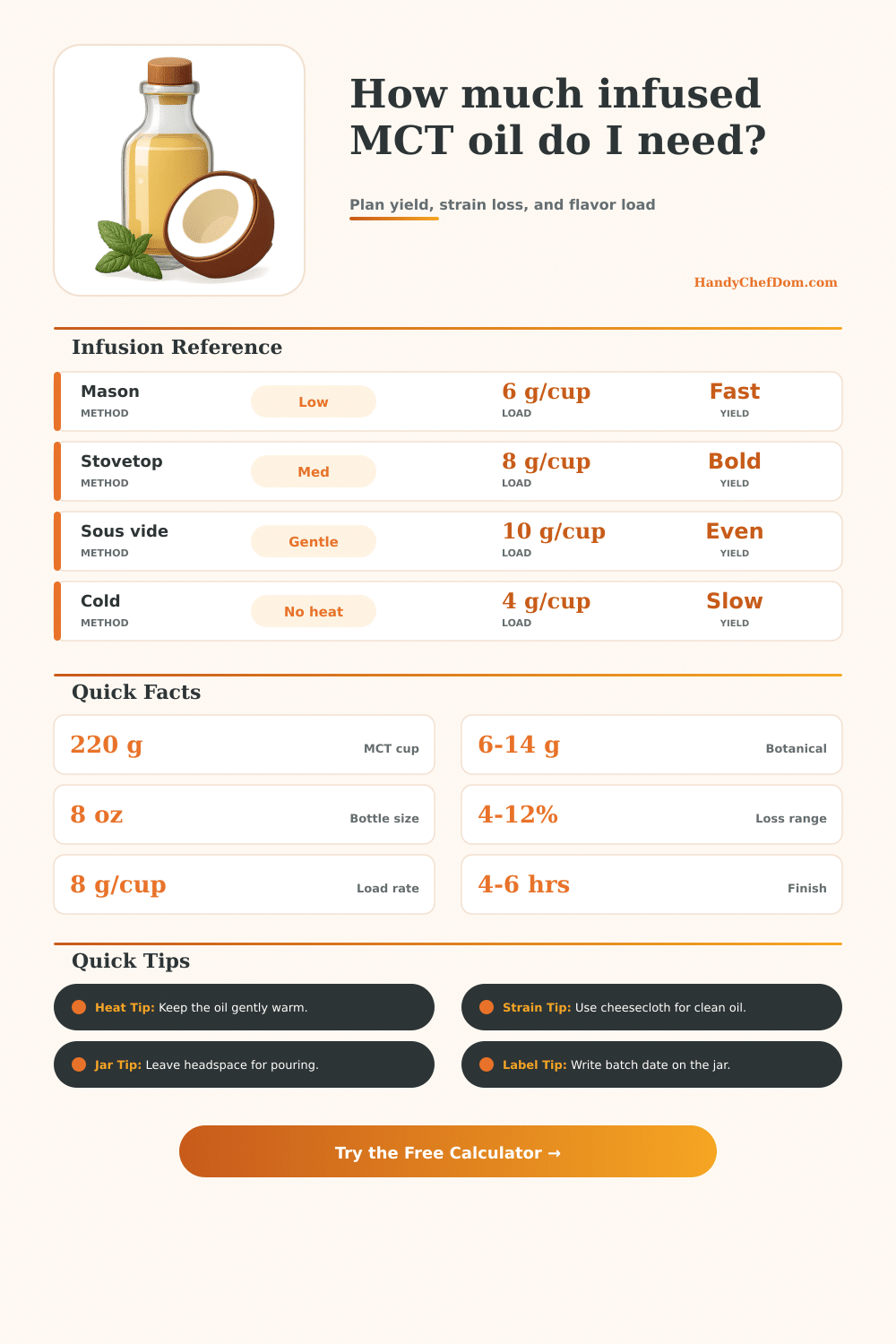
Infused MCT Oil Calculator
Batch culinary MCT oil, tune botanicals, and estimate strain loss for savory or aromatic infusions.
Pick a finished yield and the calculator sizes the MCT oil, botanical load, and strain loss before you bottle.
| MCT Type | g/cup | Flavor | Use |
|---|---|---|---|
| Fractionated | 220 | Neutral | Everyday |
| Organic | 221 | Clean | Pantry |
| Blend | 219 | Soft | Balanced |
| Warm | 218 | Loose | Infuse |
| Chilled | 225 | Firm | Store |
| Melted | 214 | Fluid | Fast mix |
| Material | g/cup | Mild | Bold |
|---|---|---|---|
| Basil | 6 | 6 g | 10 g |
| Rosemary | 8 | 5 g | 12 g |
| Chili | 12 | 8 g | 16 g |
| Garlic | 14 | 10 g | 18 g |
| Lavender | 4 | 3 g | 6 g |
| Ginger | 7 | 5 g | 9 g |
| Method | Temp | Time | Result |
|---|---|---|---|
| Stovetop | 180F | 4 hrs | Fast |
| Slow cooker | 170F | 6 hrs | Even |
| Sous vide | 165F | 8 hrs | Stable |
| Mason jar | 120F | 24 hrs | Gentle |
| Cold | 70F | 48 hrs | Light |
| Warm | 140F | 12 hrs | Balanced |
| Yield | Oil | Botanical | Note |
|---|---|---|---|
| 1 cup | 1 cup | 6-8 g | Small jar |
| 2 cups | 2 cups | 12-16 g | Mid batch |
| 4 cups | 4 cups | 24-32 g | Bulk oil |
| 8 oz | 0.75 cup | 4-6 g | Mini batch |
| 12 oz | 1.5 cup | 9-12 g | One bottle |
| 16 oz | 2 cup | 12-14 g | Pantry size |
Medium-chain triglyceride (MCT) oil is a type of oil that can be use as a base for botanical infusions. MCT oil infusions can be used to flavor a variety of food product, including vegetables, grilled fish, and salad dressing. The MCT oil base allows the botanical ingredients to readily infuse into the oil.
However, you must give careful consideration to the ratio of botanical ingredient to MCT oil; some of the flavor component will be lost during the infusion process. The botanical load is the amount of botanical ingredients relative to the amount of MCT oil that is used. While the botanical load will determine the strength of the flavor that the infused MCT oil expresses, the temperature and length of time that the MCT oil is in contact with the botanical ingredients will also impact the flavor that is extracted from the botanical ingredients.
How to Make MCT Oil Infusions
For instance, rosemary can be simmermed in MCT oil that is heated on the stovetop for a few hour to extract the flavor from the herbs. In contrast, lavender is a more delicate herb whose flavor you can better preserve by steeping it in MCT oil for several days. Basil is another herb that should be used in limited quantity in MCT oil; using too much of the herb will impart a grassy flavor to the oil.
Using approximately six grams of the herb per cup of MCT oil will allow for a more subtle flavor to be extracted from the herb.
strain loss may occur when filtering the botanical ingredients from the MCT oil using a cheesecloth. When filtering the MCT oil, strain loss may range between four and twelve percent of the total volume of the MCT oil. However, if the botanical ingredients contain fibrous element, such as ginger root, more than twelve percent of the oil may be lost during filtration.
Prior to beginning the infusion process with the botanical ingredients, account for strain loss to ensure that there is enough MCT oil to fill the number of bottles that is desired. The size of the bottles into which the MCT oil will be dispensed should also be considered. For instance, eight ounce bottles contain approximately one cup of MCT oil.
There are a variety of types of MCT oil that can be used to make infusions. Fractionated MCT oil remains in liquid form at room temperature. Therefore, fractionated MCT oil is best used in applications in which the infused oil is to be poured quick.
Another option is to utilize organic MCT oil. Organic MCT oil contains a clean flavor and is an ideal oil for adding to pantry staples. MCT oil has a density of 220 grams per cup of oil.
This density allow for the conversion of gram measurements of botanical ingredients to cup measurements. When choosing an MCT oil, ensure that the chosen MCT oil has the correct density; otherwise, the strength of the infusion will be inaccurately measure. The strength of the infusion is another factor in the creation of MCT oil infusions.
The strength is determined by the botanical load, the infusion method, the infusion temperature, and the length of time that the botanical ingredients were in contact with the MCT oil. The method that is used to infuse the MCT oil will have a major impact upon the flavor of the finished MCT oil infusions. The sous vide method of heating the MCT oil to 165 degrees Fahrenheit is an ideal method of extracting the flavor from ingredients like garlic.
The sous vide method also prevents the MCT oil from losing any of its flavor during an eight-hour infusion period. Another method is to utilize a mason jar to soak the botanical ingredients in MCT oil at relatively low temperature. This method is an ideal one for infusing vanilla beans into the MCT oil so that the beans do not burn during the infusion process.
Another method of infusions is to use cold infusion methods to allow citrus peels to be infused into MCT oil at room temperature over a period of two day. However, because citrus ingredients are strong botanical flavors, a lighter botanical load should be used in this infusion process to avoid imparting a bitter flavor to the infused oil. In making MCT oil infusions, there are some mistake that need to be avoided.
For instance, it is important to leave enough headspace in the MCT oil bottles in which the infused oil will be stored; if you fill the bottles to the top with MCT oil prior to filtering the oil through a cheesecloth, the oil will spill from the bottle when the liquid is poured into bottles of a smaller size. Additionally, you should take care in the heat of the stovetop that is used to infuse the oil with botanical flavors. Using too high of a temperature can flatten the flavors of the botanical ingredients.
For instance, chili peppers contain compounds that bloom best at around 180 degrees Fahrenheit. There are some preset ideas regarding MCT oil infusions that can be followed to start the infusion process. For instance, you can prepare chili citrus heat oil by using one and a half cup of MCT oil and heavy amounts of chili and citrus peels; the oil can be heated on the stovetop for a short time.
Rosemary oil can be prepared by heating the oil slowly in a slow cooker for six hour. Cocoa nib oil can be prepared by slowly heating the oil over long periods of time so that the cocoa nibs do not become bitter. The amount of botanical ingredients to be used in the infusion process can be scaled according to the strength of flavor that the MCT oil infusion is to be create.
For instance, one cup of MCT oil can contain between six and eight grams of botanical ingredients. To prepare four cups of MCT oil, use between 24 and 32 grams of botanical ingredients. For strong flavors, such as garlic, use 14 grams of botanical ingredients per cup of MCT oil.
For mild flavors, such as lavender, use only four grams of botanical ingredients per cup of MCT oil. Finally, the infused MCT oil should be stored correctly. Store the infused oil in a location that is cool and dark so that the oil does not degrade in quality and rancidify over time.
Because strain loss can occur during the infusion process of the botanical ingredients, it is important to strain the oil twice. Straining the oil through coarse material followed by fine material will ensure that the infused MCT oil is smooth and ready to use in various application. Following the steps described in this article will allow the reader to successfully create there own MCT oil infusions.